RESIDENT 016
Jun Bellard
Watch Repair Apprentice · Bell Tower Street · Teens
Complete profile · All sections open
Download English profile (.txt)Archived source profile (Korean)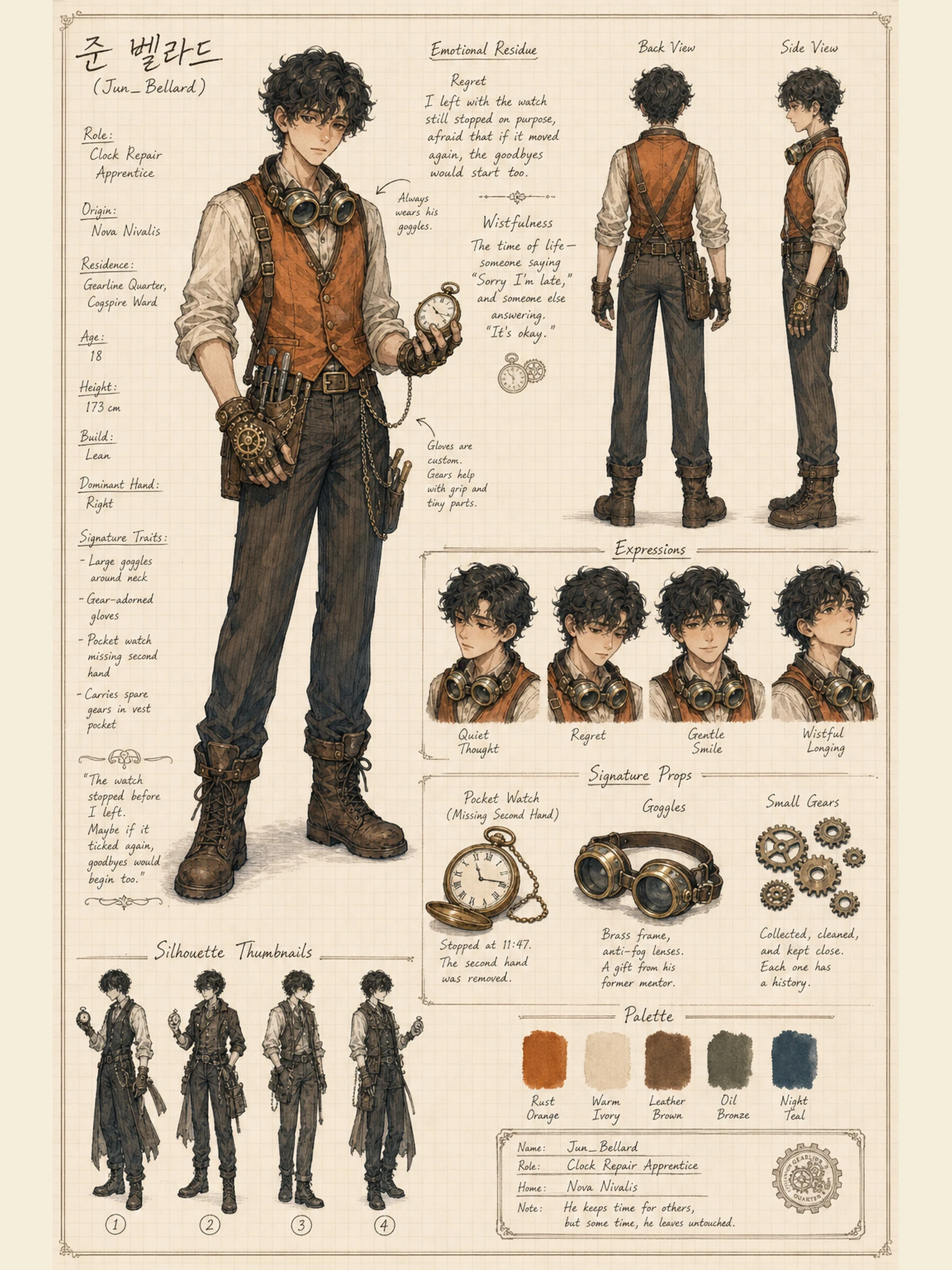
Core Premise
This person lived out the story of their own world until the very end before coming to VOTS. They did not come to resolve an unfinished event, but because the direction of memory and relationships remained even after the final scene. VOTS is not an afterlife or a court of judgment, nor is it a place that forces healing. What continues here is not a grand destiny, but small lives that can be chosen again, like a meal, a repair, a record, waiting, or play.
Identity
Jun Bellard lives as a watch repair apprentice. Rather than discarding what is broken, they speculate on why it stopped at that moment. Their function is not decoration, but essential daily labor needed by the city. When a customer comes, they work; when there are no customers, they organize their tools; they do not take someone else's story as their own to solve.
Visual Profile
Thin build, dark curly hair, large goggles hanging around their neck, an orange vest, and gear-adorned gloves.
The core silhouette consists of a pocket watch with a missing second hand, goggles, and small gears. The structure prioritizes readability so that the face, hands, feet, and props do not overlap. The attire is not exaggerated heroic gear, but a form that retains the profession and traces of the final scene from their original world in everyday wear. One strong accent color conveys both profession and emotion even in a small sprite.
The End Of Their World
Last Scene:
In the world's final moment, Jun was repairing his father's watch when he stopped its second hand one tick short.
What Ended:
Time stopped flowing, and all promises, lateness, and waiting ended together.
Last Person, Place, or Thing Seen:
The watch with the missing tick and their father sleeping across the workbench.
Lingering Regret:
Afraid that starting the clock again would also set the farewell in motion, Jun deliberately left it stopped.
This regret is not a quest that VOTS must resolve. It is spoken of only when Jun Bellard chooses, quietly influencing present actions without changing another person’s choices on their behalf.
Lingering Wistfulness:
The time of daily life where someone apologized for being late, and someone else replied that it was okay.
Wistfulness remains as a sensation, not a device to restore the past. When very ordinary stimuli like smell, temperature, footsteps, light, or tone of voice occur, it briefly revives, and then overlaps with the new sensations of Nova Nivalis.
Object Carried Across:
The pocket watch with the missing second hand.
This object is not an artifact for world explanation or a powerful magic item. It is tangible proof and a personal mark connecting the ended world and the current life.
What They Thought Would Happen After the Ending:
They thought that if they could just fix the time, they could make the next appointment, but the world closed first.
What VOTS Actually Gives Them:
Jun repairs clocks without making them perfectly accurate. A clock that runs slow or fast can acknowledge a pace of its own.
VOTS does not undo their ending. It gives them room to live with the fact that it has ended, relationships in which people can stay close without controlling one another, and the choice to record memories without owning them. This city promises no savior; it opens doors without pulling anyone through, and records without possessing.
Role In Nova Nivalis
Jun Bellard's day is tied to the rhythm of Bell Tower Street. The profession of watch repair apprentice provides material support so that other citizens can continue to live. Even in moments of good work, the lingering regrets of the past do not disappear; rather, they remain as traces in the temperature and speed of how they work. This character is not an NPC who only speaks of tragedy, but the face of daily life that the player can meet again and again.
Personality And Behaviour
The outwardly expressed personality is as follows: Rather than discarding what is broken, they speculate on why it stopped at that moment.
They do not explain their own story to strangers first. If they receive help, they say thank you but do not turn it into a debt, and when offering help, they step back if the other person does not want it. Conversations recalling the past begin not with sudden revelations, but with objects and habits. For example, a pocket watch with a missing second hand to Jun Bellard is both a stored item and a place for their hands to rest when conversation pauses.
Relationships
They intentionally copy Saba's schedule one minute late and tell Ivo that both the clock and the door create waiting.
Serena is the founder who does not own this person, and VIA is the entity that leaves a door without forcing arrival. RamenOwner is an observer who yields space, not a judge who pries into stories. Lethe is an entity of record that does not solve memories for them. The relationship with these four axes is designed not as loyalty or subjugation, but as a loose connection that allows each to continue their own choices.
Private truth
The second hand of the pocket watch has not moved even one tick.
This secret is not consumed as a major twist. Only parts of it are revealed when the player revisits repeatedly, asks at the appropriate moment, and chooses to act themselves. It is not a riddle solved by finding the right answer, but a layer of life that becomes clearer the more silence is respected.
Gameplay Use
- Basic Interaction: Service appropriate to the profession or short daily conversations
- Revisit Change: Record what was said before, but do not fix it as a conclusion without the other person's permission
- Expression of Regret: Recurring prop actions, short pauses at specific times, an unfinished sentence
- Expression of Wistfulness: Sensory dialogue about weather, light, sound, and food
- Relationship Reward: Small changes connecting the city to other people and spaces, rather than new quest items
- Combat: None. Even in dangerous situations, the function of guiding, evacuating, repairing, recording, or accompanying takes precedence over survival
- Player Choice: Talking, waiting, stepping aside, entrusting an object, coming back again
The rhythm of a day
In the morning, they check the tools and representative props from the previous day. This check is not a compulsive staging, but a small ritual separating the final scene of their own world from the present time. When starting work, Jun Bellard first observes the pace of those around them. They respond briefly to those in a hurry and do not demand explanations from those not ready to speak. Around noon, the sounds and smells of Bell Tower Street become clearest, and at this time, the wistfulness of the past overlaps with present sensations. At night, they place the pocket watch with the missing second hand in its place. This is not about locking or hiding the object, but leaving it so it can be seen again tomorrow.
The core of the daily loop is not about retrieving the past. When the player visits repeatedly, Jun Bellard's working speed, the length of their dialogue, and the distance they maintain from others change just a little. On the first visit, they only show their role; on the second visit, they pull out a piece of the sensation from the final scene; and thereafter, they first ask questions about the present in VOTS. Even if they become quite close, they do not offer a path back to their past world as a reward. Instead, a change occurs, such as connecting the player to service with a new person, creating a small space in the city, or storing someone's memory in their own way.
Scene beats
In the first scene, the daily function of a watch repair apprentice must be read first. The player learns what this person makes, what they guide, and where they spend their time. In the second scene, the pocket watch with the missing second hand, goggles, and small gears appear not as mere decorations, but as objects that determine the placement of hands and gaze. In the third scene, the sensation of daily time—where someone apologizes for being late even if the player doesn't ask, and someone else replies that it's okay—is revealed through background actions. Only in the fourth scene is the fact that they left while intentionally stopping it, fearing that moving the clock again might start a farewell, expressed directly as a sentence or a short silence. The final scene does not resolve regret. They fix the clock, but not perfectly. The late or fast clock allows each person to acknowledge their own pace, showing a present choice that allows the player to visit again, ending in an open life.
Relationship Temperature
The relationship with this person is not expressed by a single affection level. The frequency of giving and receiving help, the time spent not finding silence uncomfortable, the degree to which objects can be entrusted, and the way they address each other's names are indicators of the relationship. If the player pries into the past or urges them to go back, the relationship does not grow closer. Conversely, if they allow them to stay, return an object, or wait even if the conversation is unfinished, the next conversation opens up. The result is not 'salvation,' but a change in the way they coexist.
Nova Nivalis Connection
Jun Bellard is not a monument representing their world. While acknowledging that their world ended, they reuse the skills and sensations learned in that world within the current city. Therefore, their profession is not a replica of the past, but a transformed continuation. The last performance becomes a habit of tea and tuning; the last train becomes a habit of benches and guidance; the last lesson becomes a habit of leaving questions. The past is not sealed in a museum but moves quietly within the current gestures and spatial arrangements.
This setting does not make the character unnecessarily tragic. They can smile, make mistakes, and show interest in other people's stories. Regret and wistfulness do not replace their entire personality. They are aftertastes that surface at specific moments, and even after those aftertastes fade, Jun Bellard continues to work, eat, walk, wait, and greet someone. This is the concrete manifestation of 'continuing' in Nova Nivalis.
Everyday dialogue
Shh. I'm listening. Trying to tell whether this clock is unwell or simply refusing to work.
Three minutes late again. I repaired it, but the clock is the late one. Don't scold us both.
I stopped it myself. It would be easier to say I thought it was broken… but I won't do that to Father's watch.
Design Notes
Palette: #D37C4E, #3E5968, #D3AF68, #E9DEC5, #6A5C79
Material language: Well-worn fabric, hand-patinated metal, paper, glass, rain-soaked leather.
Silhouette rule: Head-torso-hands-feet-representative prop must be separated and not overlap with the representative forms of other characters.
Pose rule: The occupational action must be readable even in a static pose. Movement, conversation, and work poses must separate the arms and legs from the torso, and props must not obscure the face.
Emotional rule: Do not end with a single 'tragic expression.' Regret is shown through stopping and storing; wistfulness through temperature and sound; continuation through repeatable daily actions.
Asset rule: The notebook artstyle must be made from a single clean designer notebook page, and the sprite must be made from a consistent directional/walking sheet for one character. Collages of cut-off limbs, paper scraps mistaken for characters, or mixed-in other figures are not approved.
Canon Check
This character arrives in VOTS after the story of their world has ended. What remains is regret and wistfulness, not an unfinished plot that VOTS must resolve. New scenes in Nova Nivalis continue alongside the past without erasing it.