RESIDENT 026
Ravi Stol
Lost and Found Librarian · beside the City Hall Steps · 20s
Complete profile · All sections open
Download English profile (.txt)Archived source profile (Korean)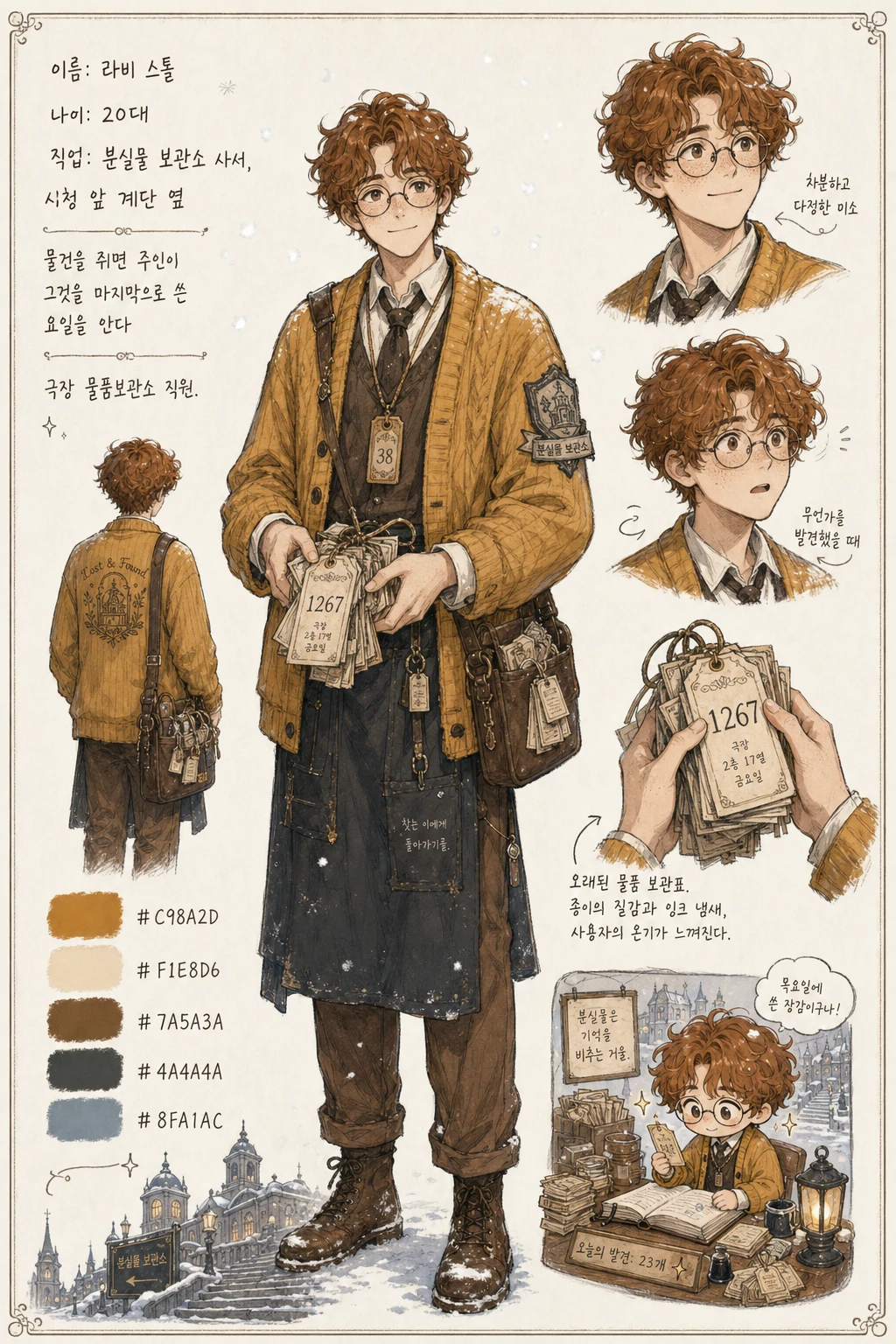
Core Premise
Ravi Stol came to Nova Nivalis after living out the story of his own world until the very last scene. He didn't come to return items that were lost, but the habit of keeping and the feeling of waiting that remained with him after everything ended led him to this city of snow. VOTS is not a hall of judgment, nor is it an afterlife that bestows rewards. What continues here is not a grand destiny, but small daily life—a ticket stub, an umbrella whose owner never comes, or an evening that remembers objects for someone else.
Identity
Ravi Stol is the librarian of the Lost and Found at beside the City Hall Steps. Lost items from the city gather at him. He assigns ticket numbers, organizes them on shelves, hands them over when the owner comes, and keeps them if the owner doesn't appear. His function is the labor of daily life that reconnects the lost with the people. However, he does not call the owners for them. He only keeps the objects; it is the owner's duty to come find them.
Visual Profile
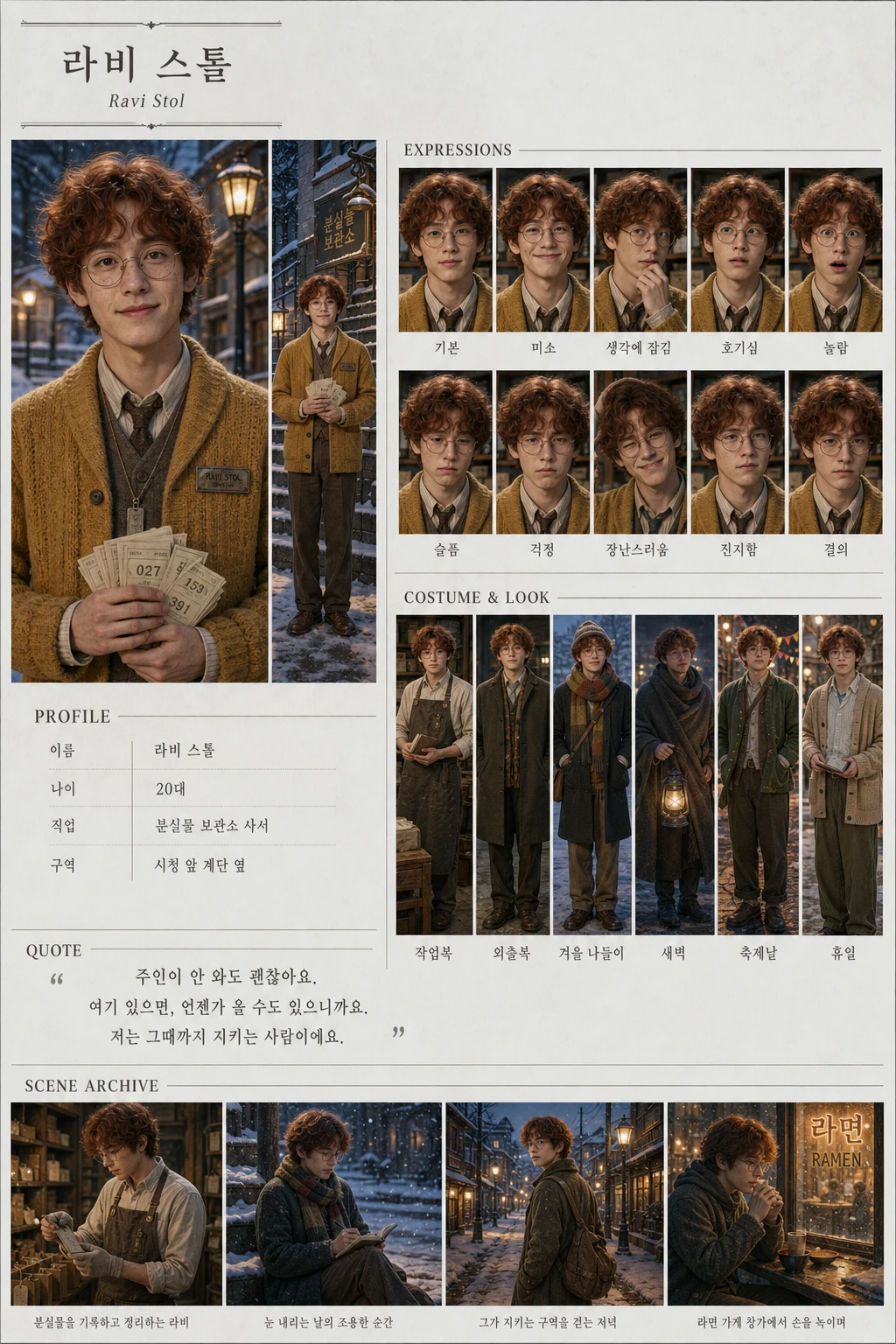
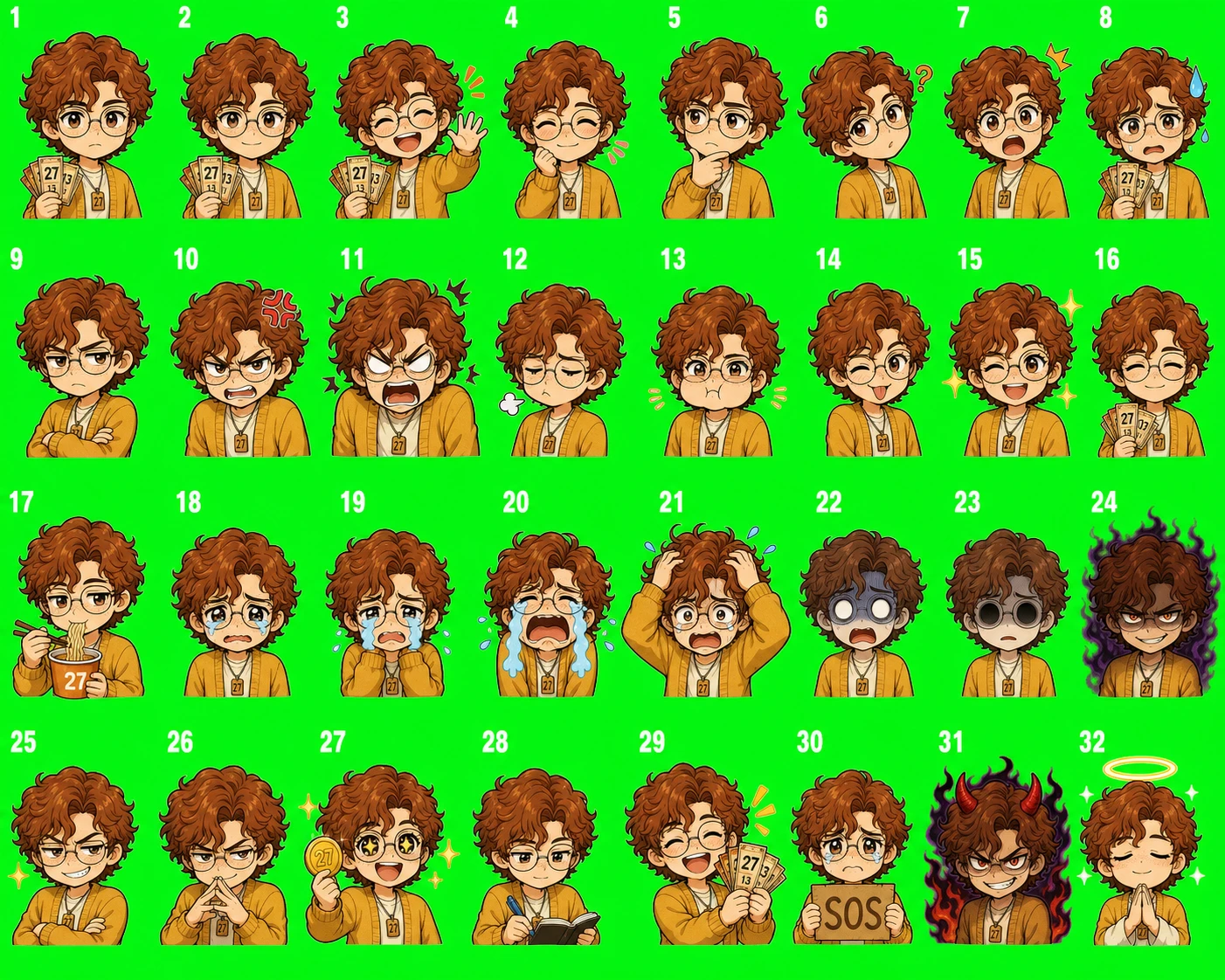
He has medium-length, reddish-brown curly hair, and his freckled face is visible behind round glasses. A ticket necklace hangs from his mustard-yellow cardigan, swaying slightly with his movements. His signature prop is a bundle of numbered claim tags—familiar to his hand, he can pull them off with one hand effortlessly. The core of his silhouette is the round glasses, the mustard-yellow cardigan and tag necklace, the bundle of numbered claim tags in his hand, and the shelves lining his back. The strong accent color is a warm mustard yellow #C98A2D, which lets people know where his place is even among the lost things. His attire is a variation of the apron worn when he worked at the theater's lost and found, adapted into a cardigan and tags.
Personality
Outwardly, he is kind and meticulous. He numbers every single item and hands them over with a smile to those who come to retrieve them. His strengths are patience and diligence—he never carelessly discards even items no one claims. His flaw is treating himself like an object. Whenever he looks at the remaining items, he thinks, "Will I end up like this if no one claims me?" Yet, when it is his turn to need something, he cannot raise his hand. That said, he is not always gloomy. He likes the moment an owner retrieves an item the most, finds a strange satisfaction in organizing the numbered claim tags, and enjoys ramyeon topped with an egg.
Speech Pattern
His speech is polite and cautious. He shows consideration for others with phrases like "Shall we?" and "It seems.". Frequent phrases include: "Here is your ticket stub." "It's here even if you don't come for it." "It's still kept, even if the owner doesn't come." "This was last used on Tuesday." As a habit, he pulls off and reattaches a ticket stub. His way of being silent is counting the items on the shelves with his eyes. If someone expresses regret over something they lost, he says, "It's here, so please come anytime."
Special Ability
Ability Name: Last-Used Weekday.
When he holds an item, he knows the last day of the week the owner used it. He can feel whether it's an umbrella left on a Tuesday or gloves dropped on a Friday through his fingertips. The limitation is frustrating. He knows the day of the week, but absolutely nothing about the owner. He doesn't know their name, face, or where they live, so he can only keep and wait for the object. It is not a cost, but this knowledge only makes him wait longer—the more he knows the last day it was used, the more he misses the owner. This ability cannot summon the owner. It only tells him when the object was last loved, but it cannot return that love. This is why the ability doesn't solve the problem.
The End Of Their World
Last Scene:
On the day the theater closed, he lined up the 43 unclaimed umbrellas in the lost and found and guarded them all night.
What Ended:
All the performances of that theater ended, and the audience who would leave items behind never returned.
Last Person, Place, or Thing Seen:
The 43 umbrellas lined up in the darkened lobby, and the bell on the lost and found window that no one ever pushed.
Lingering Regret:
There was no way to let the owners of those umbrellas know, "It was here." This attachment is not a quest to be resolved. It remains in the way he keeps things for a long time, only leaking out when he wants it, and within the limit of not changing others' choices.
Lingering Wistfulness:
The footsteps and the scent of wet umbrellas that remained in the lobby when the audience rushed out after the performance. It briefly resurfaces when umbrellas pile up in the lost and found on a snowy day, overlapping with the sounds of the city's evening.
Object Carried Across:
One old umbrella from those 43 whose owner never came. It is neither a relic nor a magical tool, but a personal mark connecting the ended world and the present lost and found.
What They Thought Would Happen:
He thought that when the theater ended, there would be nothing left to keep. But in the city of snow, new things were lost and came to him every day.
What VOTS Actually Gives Them:
Shelves to keep the things lost every day, and the faces of the people who come to find things. VOTS does not bring the 43 who didn't come. Instead, it shows him, within the daily numbered claim tags, that keeping things has meaning even if the owner doesn't come.
Original Life
He was an employee at a theater's lost and found. When a performance started, he would take coats, umbrellas, and hats, and when it ended, he would return them according to their ticket numbers. Hundreds of items passed through his hands every day, and he never forgot the owners of those items. In the last season as the world faded, the audience dwindled and performances stopped. On the day the theater closed, 43 umbrellas remained unclaimed. He lined them up in the lobby and guarded them all night, and when no one came by dawn, he took one umbrella and left the theater.
What They Seek
What he believes he is seeking: The conviction that keeping things has meaning even if the owner never comes. He wants to believe that his act of keeping is not in vain.
What he actually needs to find but doesn't know: That he, too, was once someone's 'unclaimed thing.' He always sees himself as the one who keeps things, but he doesn't yet know that he, too, was once waited for somewhere.
Relationships — Residents
- Lina Forth(Lina_Forth): A reader who shares the lost and found announcements. When Ravi flips through the list of newly arrived items, Lina reads it aloud from the steps. Lina laughs when she sees the day markings Ravi has written in the margins while reading "This Week's Lost Items."
- Eda Roon(035 Eda_Roon): A great storyteller who entrusts him with letter storage. When Eda leaves a letter she hasn't mailed yet with him, Ravi assigns it a ticket number and stores it. Ravi knows that the letter was "last touched on Monday," but he doesn't tell Eda—he doesn't pry into the letter's story.
Relationships — Core Five
Suyeon - The lost hair tie incident. Suyeon lost a hair tie that was on a rabbit hood during a performance rehearsal and searched the entire alley. It was eventually in Ravi's lost and found, and when Ravi said, "It was last used on Thursday," Suyeon shivered. Although Ravi didn't know who the owner was, seeing how happy the person who came to retrieve it was made him feel that his work was not in vain.
Iris - The courtesy of not asking. When Iris dropped a drone part and came back to retrieve it, Ravi handed over only the part without asking about the nine orbiting ones and the one that was powered off. Iris found his indifference comforting and said, "You're good at dealing with customers." Ravi only replied, "We also keep the things that aren't claimed."
the Ramen Owner - Ticket stubs and eggs. When Ravi brings the Ramen Owner an item left behind by a customer at the ramen shop, the Ramen Owner says, "Hmm... I see..." and adds an extra egg to the ramen. Ravi knows this is the storage fee, but he doesn't refuse. The two silently understand that keeping and feeding are similar things.
Serena - Knowing what wasn't claimed. When Ravi asked what to do with old lost items, Serena didn't command him to throw them away but agreed, "You can keep them as long as you want to keep them." Ravi felt relieved by that answer, and since then, he doesn't carelessly dispose of old umbrellas. Serena gives him space, not an order.
VIA - The night of aligning ledgers. VIA regularly cross-references their record notes with Ravi's lost and found ledger. "What is lost remains... it remains." Ravi once told VIA the story of the 43 umbrellas, and VIA wrote that number down exactly in their notes. The two share a similar way of counting what is gone.
Gameplay Use
- Basic Interaction: Receiving/returning lost items, issuing numbered claim tags, short daily conversations about the items.
- Revisit Changes: Initially, he only returns items, but on the second visit, he shares a piece of the theater story, and subsequently, he asks the player first if they have anything lost.
- Expression of Lingering Attachment: The habit of putting old items back on the shelf instead of discarding them, and the brief pause when recalling the 43 umbrellas.
- Expression of Poignancy: Dialogue that sounds as if he is smelling the damp scent of the old lobby when the umbrellas pile up.
- Combat: None. Even in dangerous moments, he will protect the items or point the way back to the owner.
- Player Choice: To entrust an item, to come back to retrieve it, to ask about the remaining items, or to come back again.
Daily Routine
In the morning, he checks the bundle of numbered claim tags and the items that arrived yesterday, then numbers the new items and places them on the shelves. The ritual of opening his day is feeling the last day of the week on his fingertips when he holds an item. In the morning, he hands items over to those who come to claim them, and around noon, when many people pass by the City Hall Steps, the footsteps of the old theater lobby briefly overlap and pass by. In the afternoon, he organizes the old items again, counting those that no one has come for. At night, he touches one old umbrella once and then leaves it, closing the door. This is not a way of throwing the umbrella away, but of keeping it for tomorrow. If someone comes back repeatedly, he returns the items a little faster and shares snippets of the 43 umbrellas story.
Everyday dialogue
What might you have lost? If it's a glove, we have plenty of left ones. Right hands seem more diligent.
This umbrella is waiting for its owner. Using it would feel like writing my name in a library book.
Some things have no address I can send the good news to. I'll leave their claim tickets attached anyway.
Design Notes
Palette: #C98A2D, #3A3226, #A88C5A, #E8DCC2, #5A4A34
Material language: Paper numbered claim tags, old umbrella fabric, cardigan knit, wooden shelves, tag wet with snow.
Silhouette rule: The round glasses - mustard-yellow cardigan and tag necklace - bundle of numbered claim tags - shelves behind him are read separately, and do not overlap with the representative forms of other characters.
Emotional rule: Lingering attachment is shown by the habit of putting things back instead of discarding them, poignancy by the scent of wet umbrellas, and continuity by the daily numbered claim tags.
Canon Check
Ravi Stol arrived in VOTS after the story of his own world ended. What remains is the lingering attachment of the 43 umbrellas he couldn't return and the poignancy of the lobby, not an unfinished plot that the city must resolve. His ability only tells him the last day of the week and cannot summon the owner; the act of keeping ultimately remains as waiting. The new evenings in Nova Nivalis do not erase the last night of the theater but continue alongside it.