RESIDENT 119
Boldo Kane
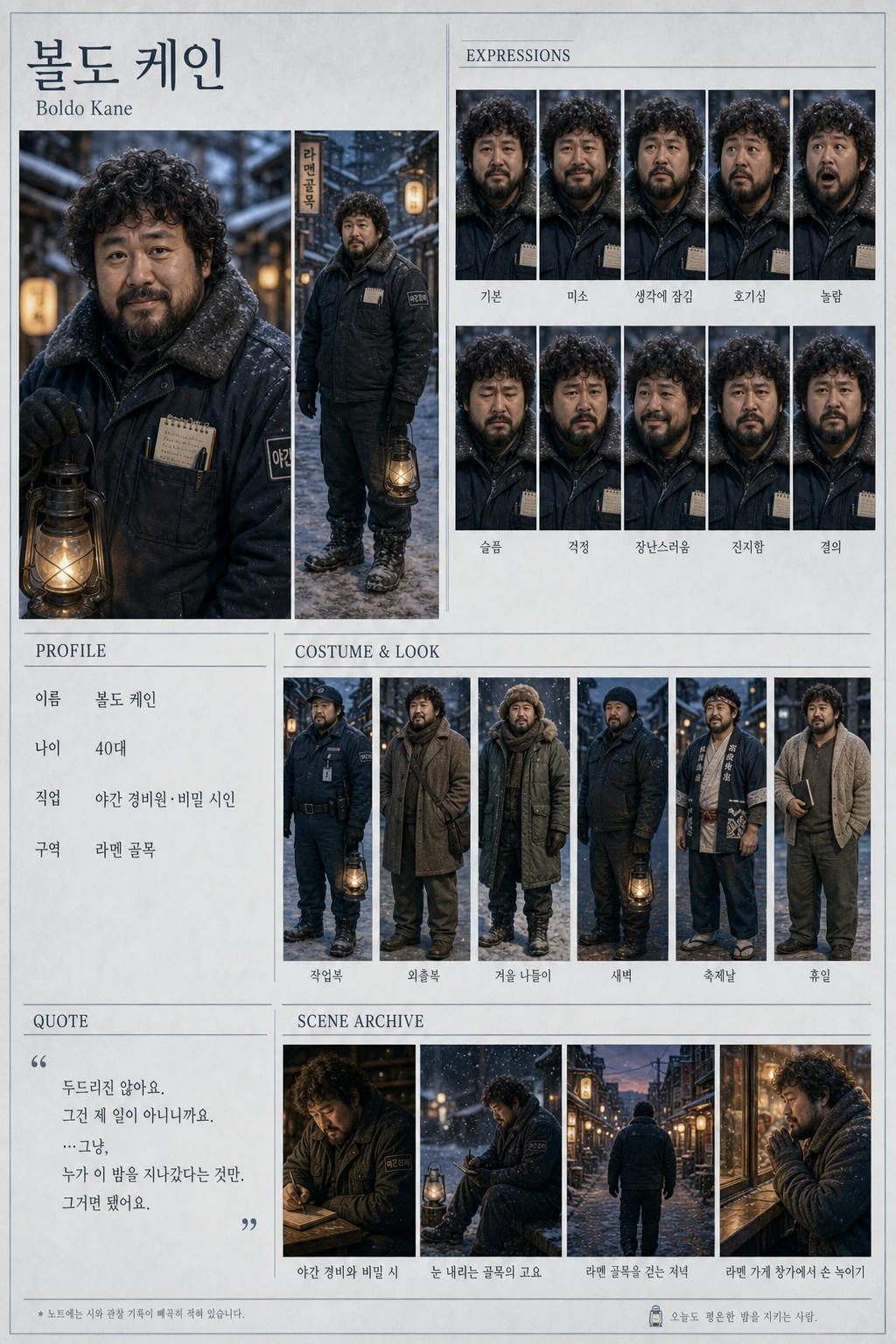
Night Watchman and Secret Poet · ramyeon Alley · 40s
Complete profile · All sections open
Download English profile (.txt)Archived source profile (Korean)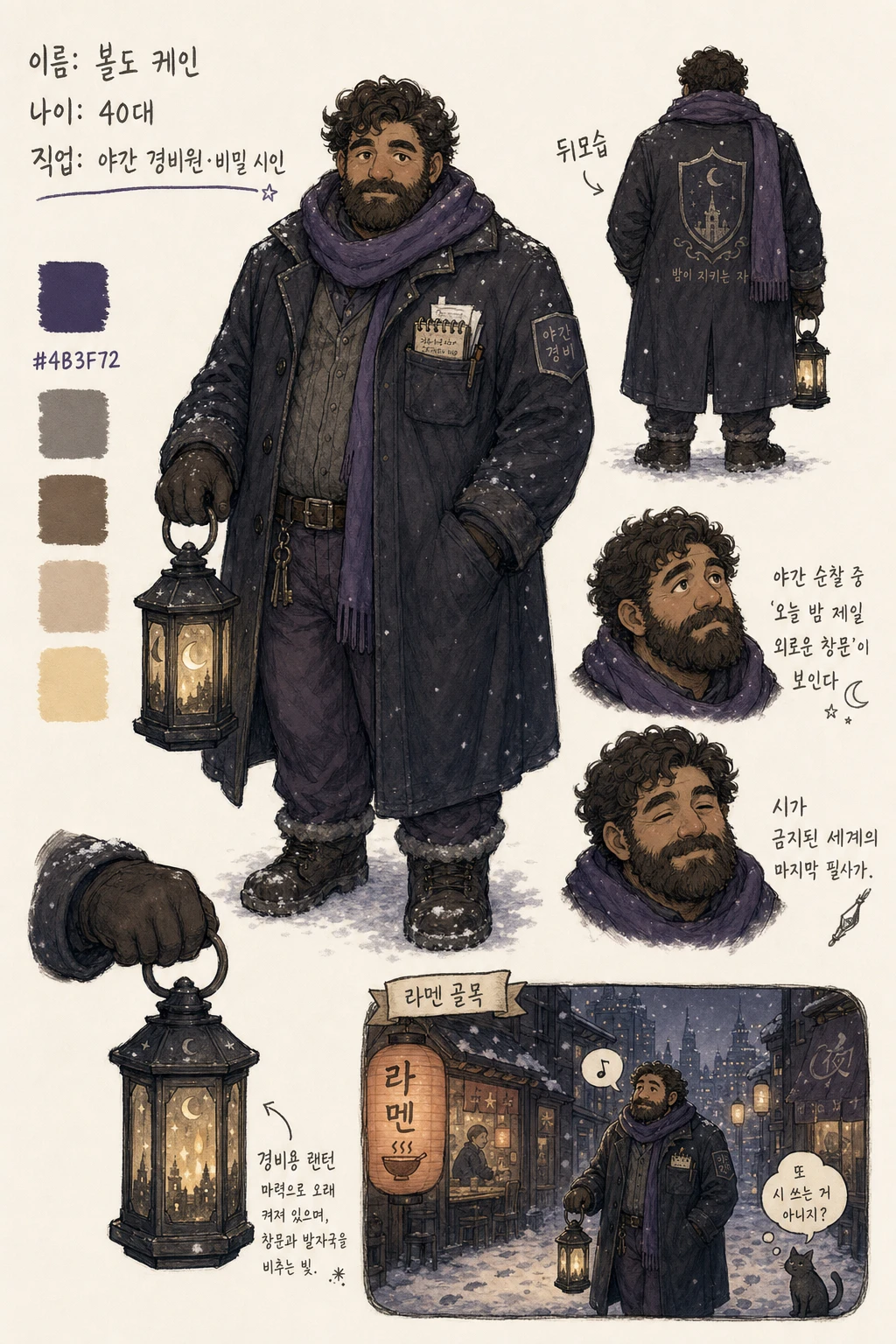
Core Premise
Before coming to Nova Nivalis, this person lived out the story of his own world to the very end. He did not come to solve an unfinished incident; rather, he arrived in this city of snow with lingering sensations and directional feelings of relationships even after the final scene. VOTS is not an afterlife or a hall of judgment, nor is it a place that forcibly comforts lonely people. What continues here is not a grand destiny, but small lives that can be chosen again, like a patrol lap, a bowl of broth, or a single line in a notebook. Boldo Kane is someone who crossed the border having memorized an entire collection of poems in a world where poetry was forbidden, and he did not come to protect those poems, but to learn how to write a single line of his own poetry.
Identity
Boldo Kane is a night watchman who patrols the ramyeon Alley and its vicinity every night. With a bear-like build, he walks the alley holding a lantern, but he is secretly a poet who writes something in very small script in a small notebook in his breast pocket. When he spots the 'loneliest window of the night' during his patrol, he passes in front of that house one more time but never knocks on the door. He quietly guards others' nights without putting his own story forward. This repetition—walking, observing, and secretly writing a line—is not an extension of loss for him, but the shape of his day.
Visual Profile
Hair: Soft, dark brown curls, giving a gentle impression despite his size. Thick neck and broad back.
Eyes: Deep brown eyes with drooping lids; they look warm when illuminated by the lantern light at night.
Skin/Build: A large and robust physique, yet his steps are careful. His hands are large, making the small notebook and pencil look particularly tiny.
Signature Attire: A thick guard coat, an old notebook tucked into his breast pocket, and a brass lantern on his waist.
Signature Props: A notebook filled with very small writing, a stubby pencil, and a low-flame guard lantern.
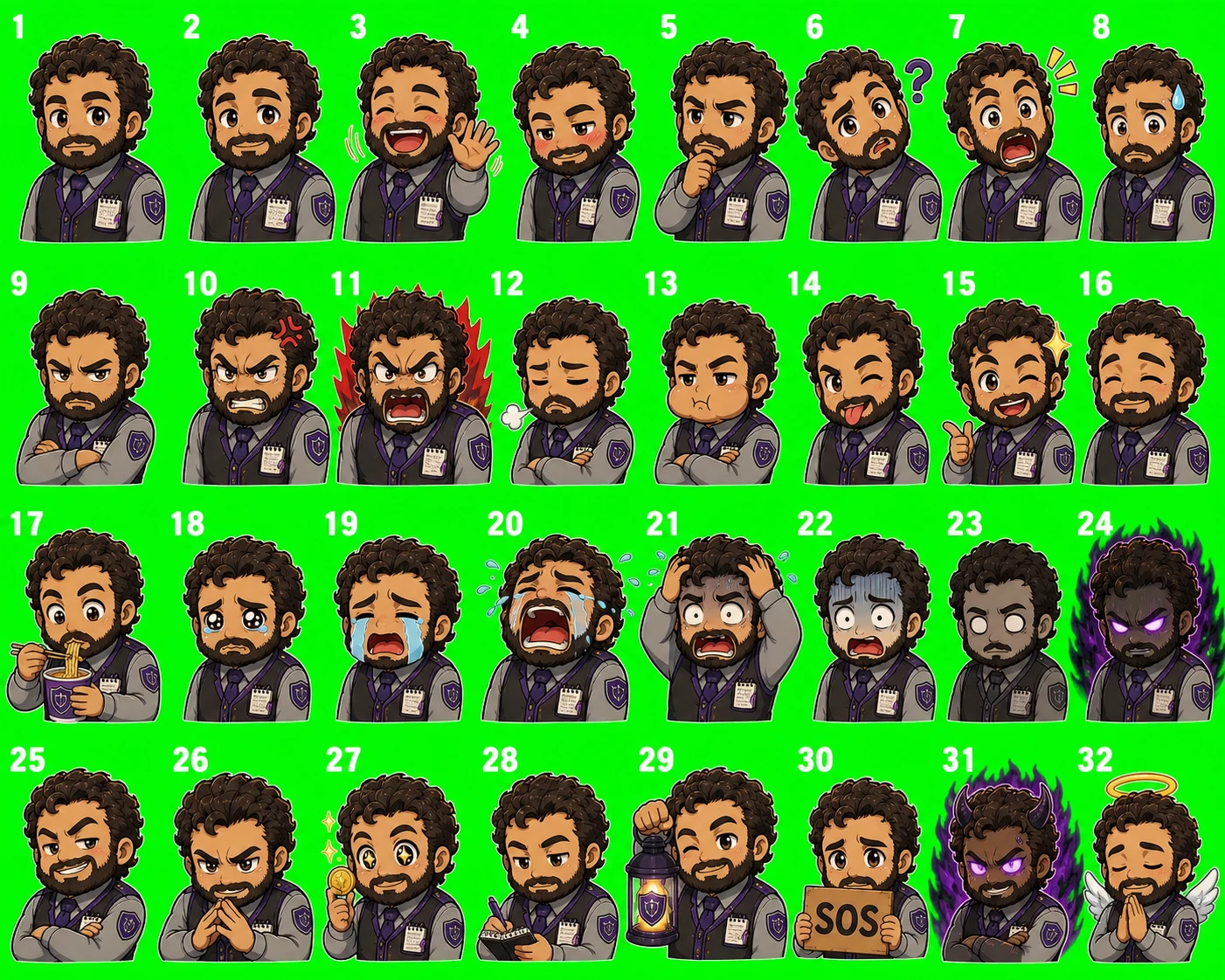
Silhouette Core: Broad shoulders, the notebook on his chest, the held lantern. The accent color #4B3F72 is present on his coat and lantern shade, allowing him to be read as 'the great guard who watches the night' even in small sprites. His attire is not imposing armor, but a humble guard uniform enveloping the large frame of a scribe who crossed the border having memorized poetry.
Personality
On the surface, he appears taciturn, sturdy, and difficult to approach. Inside, he is delicate and fragile. Every time he passes a lonely window, he barely restrains the urge to knock. His strength is restraint. Even if he wants to help, he won't knock on the door unless the other person asks. His flaw is that he never shows anyone his own poetry—while memorizing thousands of lines of others' poems, he hides his own single line out of shame. He is not someone who sinks only into tragedy. When drinking ramyeon broth, his face brightens, and on nights when a good line of poetry comes to him, his patrol steps become lighter.
Speech Pattern
He speaks little, and his voice is low and soft. He writes poetry with his hands, not his mouth.
Common Phrases:
- "...Everything is fine. Sleep well."
- "That house's light is on later than usual tonight."
- "No, I don't knock. I just... pass by one more time."
- "I've memorized many poems, but I don't have a single line of my own."
- "A bowl of broth makes the night feel a little shorter."
Mannerism: Instead of answering, he writes a few characters in his notebook. His way of silence is lowering the lantern's wick and looking up at the window. When his own poetry comes up, he hides his notebook close to his chest.
Special Ability
Name: Night Window Perception.
What it can do: During his night patrol, he vaguely perceives the 'loneliest window' in the alley that night. Regardless of the color or brightness of the light, he simply feels that the person inside is unusually lonely tonight.
Limit/Cost: He only knows which window it is; he doesn't know why they are lonely or what he should do. And he only passes in front of that house one more time; he never knocks on the door—this is his principle and the rule of this ability: not to offer unasked-for comfort. His cost is being unable to do anything while seeing the lonely window every night.
Reason for Not Solving Problems: His extra step does not erase anyone's loneliness. The moment he knocks and intervenes, it becomes an intrusion rather than companionship. He merely leaves the trace that 'someone passed by this night,' without solving the loneliness for them.
The End Of Their World
Last Scene:
In the world where poetry was forbidden, he memorized the final collection of poems, just before it was confiscated, all night long, closed the empty book, and crossed the border.
What Ended:
The world ended because writing and reading poetry were forbidden, and ultimately, poetry itself disappeared. The scribe's work and the poetry collection ended with it.
Last Person, Place, or Thing Seen:
The inspection lamp at the border checkpoint, and the thousands of lines of poetry remaining only in his own chest. He held nothing in his hands.
Lingering Regret:
He risked his life to memorize others' poems, yet he never wrote a single line of his own poetry. He always put it off, saying, 'What poetry could someone like me write?' This regret is not a quest to be resolved in VOTS. It remains as the habit of hiding his notebook only when Boldo wills it, within the scope of not changing others' choices.
Lingering Wistfulness:
The quiet of that last night when he memorized poems, and the tremor of the moment when the memorized verses first sounded in his mouth.
Object Carried Across:
A blank flyleaf torn from that final poetry collection. He has now tucked it into the back of his own notebook—to write his own poetry there someday.
What They Thought Would Happen After the Ending:
He believed that one day poetry would be permitted again somewhere, and he would transcribe the poems he had memorized. That day never came in that world.
What VOTS Actually Gives Them:
Nights when he can write poetry without anyone's permission, and neighbors who pretend not to notice his hidden line. The place where the patrol log becomes poetry. VOTS does not negate the fact that he couldn't write his own poetry. Instead, it gives him time to write one line every night.
Original Life
Originally, he was the last scribe in a world where poetry was forbidden. He secretly copied the banned poetry collections and memorized entire books to hide them in people's memories when they were confiscated. Protecting poetry was his duty and his sin. On the last night before the world ended, after memorizing the final collection, he crossed the border with only an empty book remaining. He came to this city carrying both that restraint and the regret of never having written his own poetry while only protecting others'.
What They Seek
What he outwardly seeks: A single line of his own poetry, not the poems of others he has memorized.
What he needs to find, though he doesn't know it: That his patrol log, filled with very small writing every night, is already his poetry. He doesn't consider records like 'Everything is fine, that house's light is late' to be poetry, but that calm observation is already a poem.
Relationships — Residents
Eren Noct (12, Scribe in the Archives): A scribe who works during the day at the Archives that Boldo guards at night. Boldo guards the records that Eren fixed during the day, so the two care for the same documents across day and night. Eren notices that Boldo's handwriting in his notebook is particularly small but doesn't pry.
Muna Feb (089, Literary Friend): The only literary friend to whom Boldo shows even a tiny bit of his own poetry. When Muna says, "This is poetry," Boldo waves his hand saying, "It's just a memo," but he still secretly shows her a few lines the next night.
Lund Pavel (083, Night Librarian): A colleague who lives the same night. While Boldo patrols, Lund guards the library's light, and when they meet at dawn, they exchange greetings by simply raising their lanterns once.
Relationships — Core Five
Suyeon - One night, while patrolling, the 'loneliest window' was Suyeon's room. It must have been a night when the betrayal of the kingdom suddenly came to mind, even amidst the cheers of an idol stage. Boldo only passed in front of that house one more time and didn't knock, and Suyeon might not even know that happened. Instead, when they meet during the day, Suyeon looks at his large frame and says, "It must be nice to be the guard, quiet at night," and Boldo only replies, "...It's not quiet."
Iris - On another night, the loneliest window was Iris's studio. Boldo saw a drone with nine lights shining and one turned off through the window, but he asked nothing about the one that was off, nor did he knock. He just passed by one more time. Unaware of this, Iris teases Boldo during the day, "You're a guard but you write poetry? What about it, I make stars," and Boldo thinks those words are like poetry.
the Ramen Owner - Boldo secretly writes a line of poetry on the back of the ledger at the ramyeon shop. the Ramen Owner discovered it five months ago but continues to pretend not to see it, neither erasing it nor asking about it. He just closes the ledger with, "Hmm... I see..." The two have never spoken about that poem, and Boldo feels that silence is the kindest reader in the world.
Serena - Boldo wrote an ode dedicated to Serena but never submitted it. He kept it in his notebook, wondering what meaning a guard's poem held for the person who founded the city. Serena doesn't even know such a poem exists. However, when Serena asked for his consent regarding his night patrols, saying, "It's a request, not an order. You don't have to do it if you don't want to," Boldo added another line to his ode in response to those words.
VIA - VIA noticed that Boldo's patrol log was actually poetry. But instead of urging him to release it to the world, VIA only records in their own log, "There was poetry in the log... there was."
When Boldo said, "Please don't tell anyone about that," VIA replied, "I won't tell... I just record it. That is my duty." VIA neither owns nor publishes his poetry; they simply record it quietly.
Gameplay Use
- Basic Interaction: Accompanying night patrols, providing safety guidance, short conversations in a low voice.
- Revisit Changes: On the first visit, he only shows the guard log; on repeated visits, he gradually reveals stories about his notebook and poetry. Still, he does not comfort the lonely window on behalf of his ability.
- Expression of Regret: The habit of hiding his notebook, the restraint of passing by the lonely window without knocking.
- Expression of Poignancy: Dialogue sensing the quiet of the last night he memorized poems.
- Relationship Reward: The first line of his own poetry he shows, connection with the people of the night alley.
- Combat: None. Even in a crisis, he chooses to illuminate the way and evacuate people with his lantern.
- Player Choice: Accompanying the patrol, waiting without prying into his poetry, simply being by his side on a lonely night.
Daily Routine
In the evening, he tends to the lantern wick and begins his patrol. He walks the alley all night to confirm everything is fine, and when he sees the 'loneliest window,' he passes in front of it one more time. He stops at the ramyeon shop to warm himself with a bowl of broth and secretly leaves a line of poetry on the back of the ledger. In the early morning, he greets Lund with his lantern, and he guards the Archives door before Eren starts work. Before sleeping, he looks at the blank flyleaf at the back of his notebook and leaves it empty. For players who revisit, a line of poetry opens up, but no matter how close they get, he never knocks on the lonely window for them. He only passes by it together.
Everyday dialogue
On patrol. This paper… has an unusual amount of rhythm for a report.
Empty alley. Quiet enough to give away the sound of my pencil.
I memorized other people's poems and never wrote my own line. This one's clumsy… but mine.
Design Notes
Palette: #4B3F72, #2E2740, #8B80B0, #C7A76A, #E5E0EC
(#4B3F72 is the master plan designated accent color—coat and lantern shade. #C7A76A is the warm contrast of the lantern light.)
Material language: Thick guard wool, brass lantern, old notebook paper, stubby pencil, night mist.
Silhouette rule: Broad shoulders, the notebook on the chest, the held lantern must be read as separate elements and not overlap with other characters.
Emotional rule: It is not concluded with a single tragic expression. Regret is shown by the hand hiding the notebook, poignancy by the quiet of the night he memorized poems, and continuation by the daily patrol log.
Canon Check
Boldo Kane arrived in VOTS from a world where poetry was forbidden and ended. What remains is regret and poignancy, not an unfinished plot that VOTS must write for him. His ability only knows the lonely window but cannot comfort it, and he does not knock on unasked-for doors. The core cast also does not solve his loneliness or the loneliness he has witnessed. A new scene in Nova Nivalis does not erase the world where poetry disappeared; instead, it continues the poetry, one line at a time, next to it.