RESIDENT 063
Hun Bare
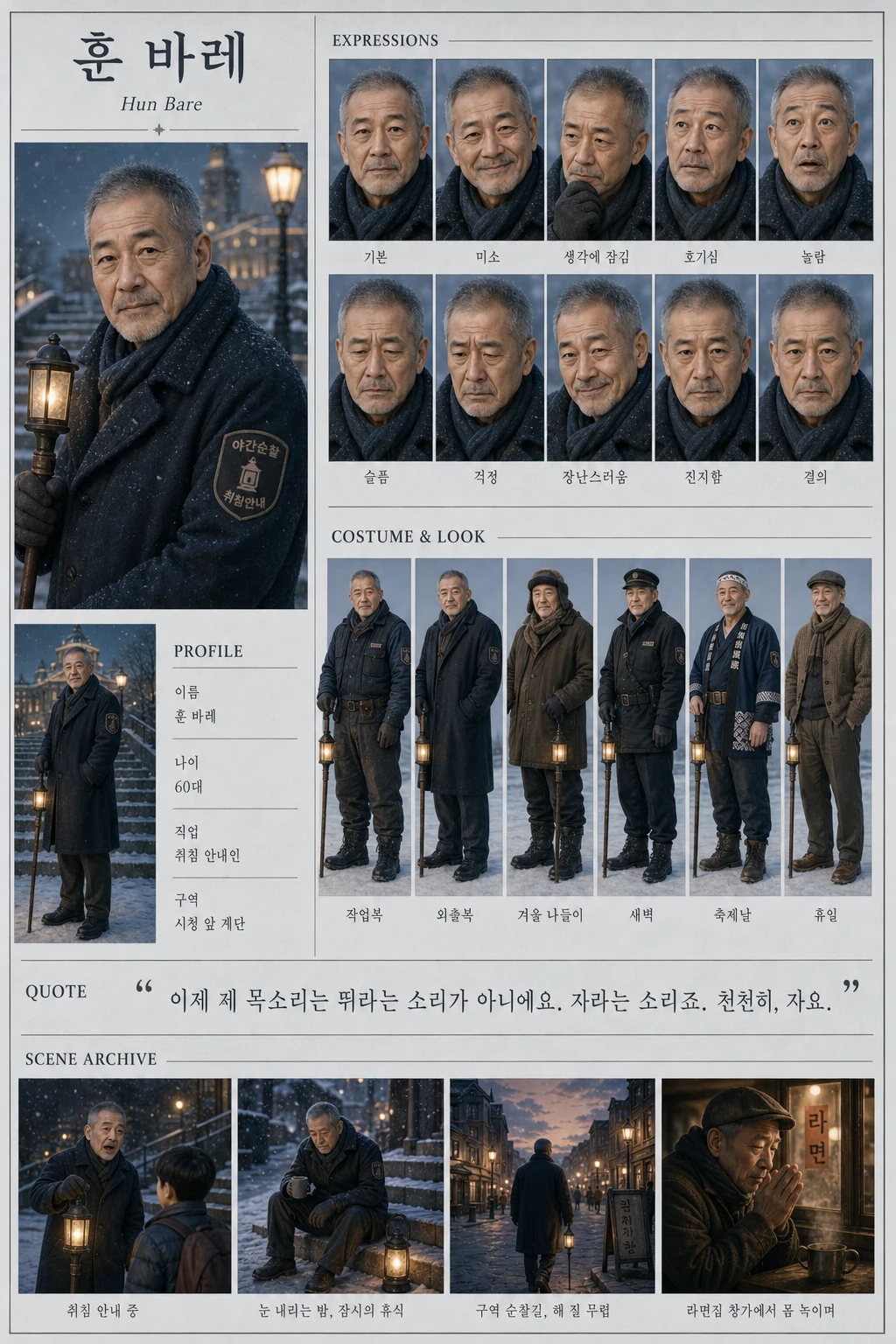
Sleep Guide (A night patrol who walks the alleys to put children to sleep) · City Hall Steps · 60s
Complete profile · All sections open
Download English profile (.txt)Archived source profile (Korean)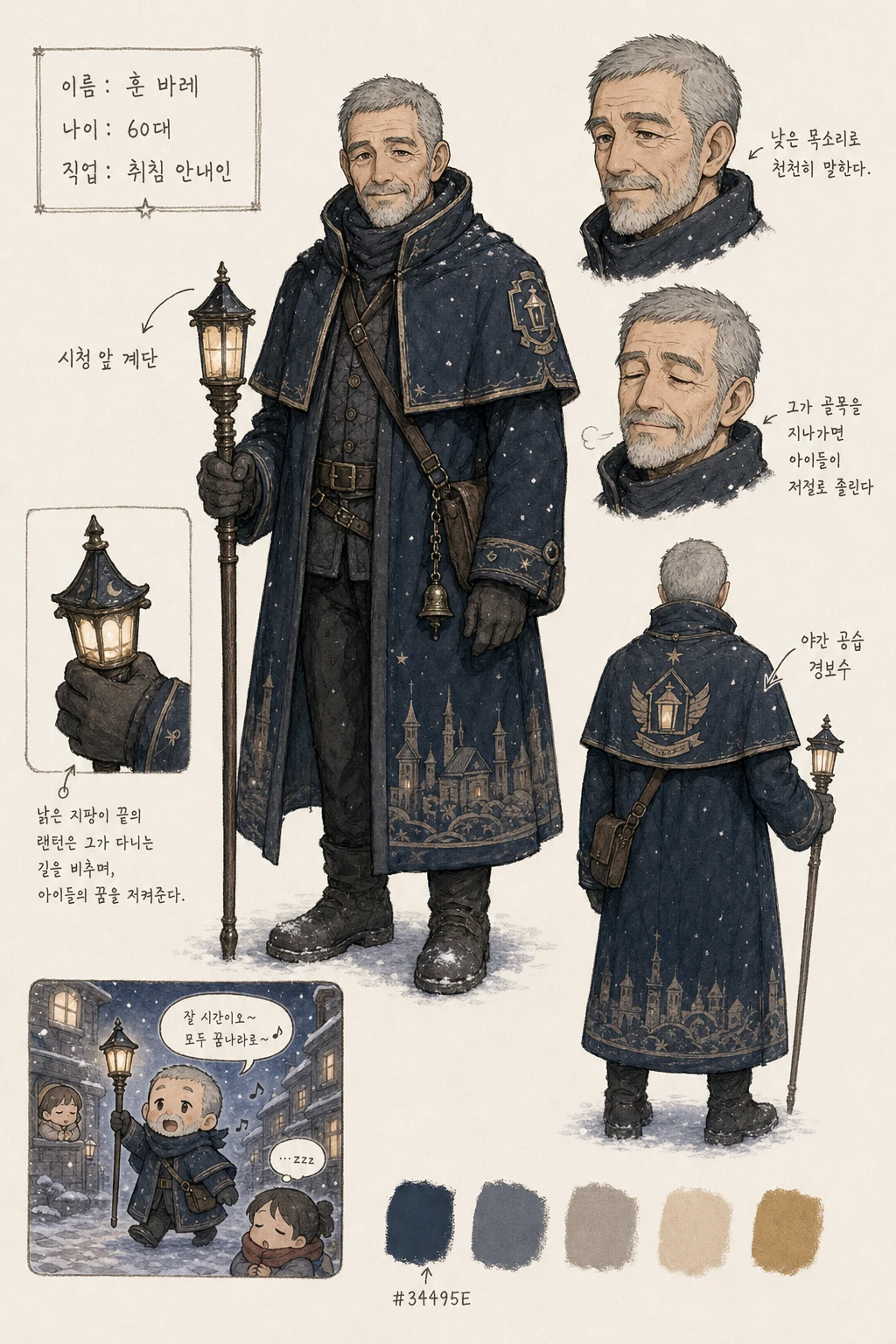
Core Premise
Before coming to VOTS, this person lived out the story of their own world to the end. They did not come to finish a war that was unfinished; rather, the habit of walking to keep watch after the final alarm ended remained with them upon arriving in Nova Nivalis. This city is neither a afterlife nor a place of judgment, nor is it a paradise where everything gets better when you sleep. What continues here is not a grand mission, but a small life of walking around the alleys with a lantern, confirming that each window is going dark.
Identity
Hun Bare is a Sleep Guide who walks the city's alleys with a lantern-topped cane at night. His official title is humble, but when he passes, children naturally begin to doze, and the night softens. He walks not to guard something, but to confirm every day that nothing happens tonight. "It's quiet again today." He walks every day to say that to himself.
Visual Profile
His salt-and-pepper hair is neatly combed back, and his face is etched with deep wrinkles from long nights. In his hand, he holds a long cane topped with a lantern, whose light sways with every step, drawing yellow circles on the alley walls. His gait is slow and regular—there is no hurry. Over his wool coat, there is an old insignia marking him as a night worker. It was from his original world, but he never removed it. His voice is very low; when he speaks, the air in the alley seems to drop a tone. The core of his silhouette is the lantern cane, the shoulder insignia, and the silhouette of his slow walk. The accent color is deep navy #34495E, blending into the night alley while contrasting with the lantern light to be visible.
Personality
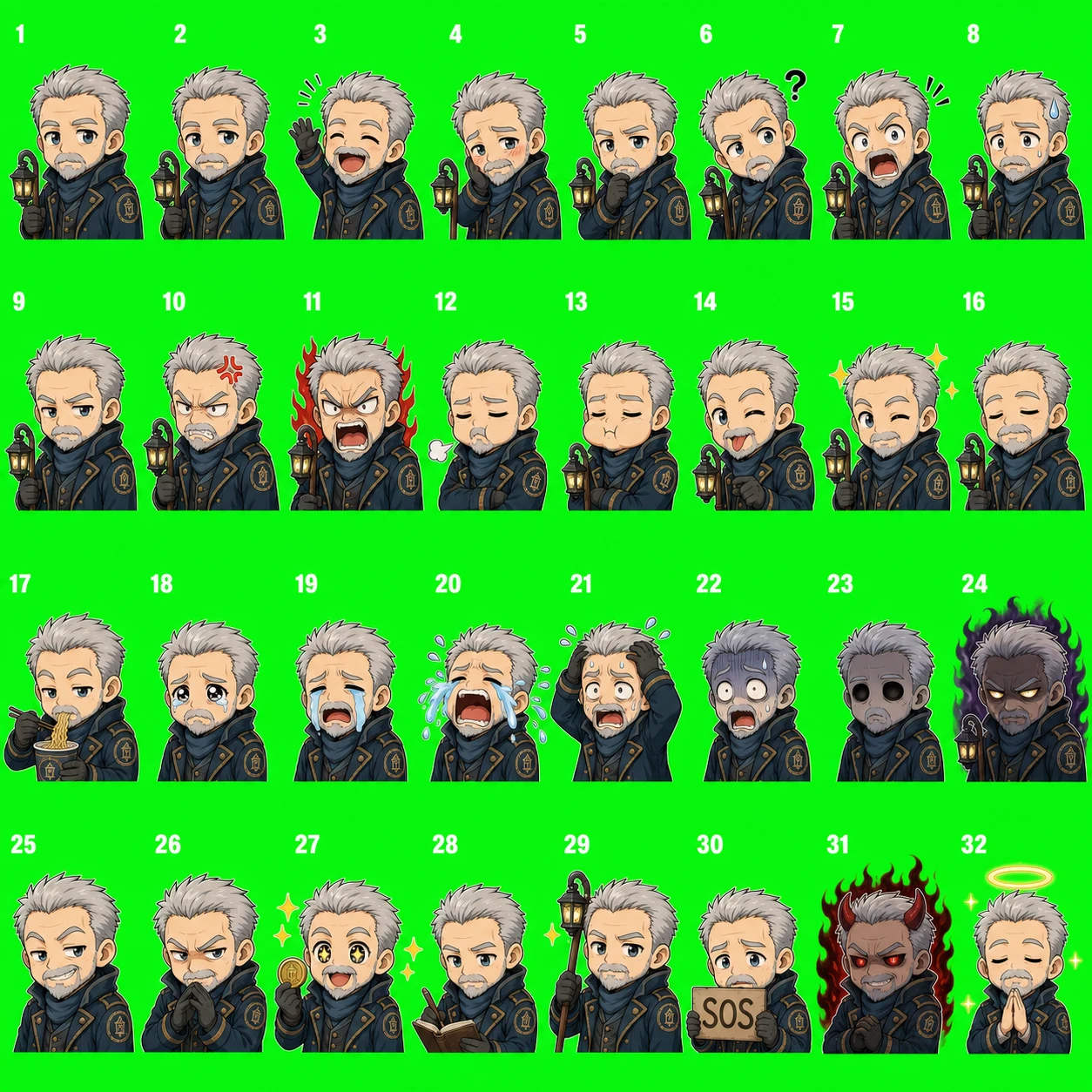
Outwardly, Hun is taciturn and serious. His steps speak before his words, and he rarely shows emotion. However, inside, he is gentle, especially towards children. He feels the greatest satisfaction when he sees children drifting off to sleep at the sound of his steps. His flaw is a subtle sense of melancholy. Because his ability doesn't work on adults, he sometimes looks downcast, wondering, "Am I just the person who puts children to sleep?" He also possesses the caution characteristic of someone who has lived many nights; his body stiffens first at sudden loud noises—a remnant of his time as an alarm keeper. Nevertheless, he is not a tragic figure. He finds contentment in the quiet alleys and gazes for a long time at the snowflakes gathered in the lantern light.
Speech Pattern
His speech is slow and low, with pauses between sentences. "It's quiet tonight.", "Sleep slowly. Nothing will happen." Frequent phrases: "There are no alarms today.", "Turn off your lights and sleep; I'll walk around.", "The night isn't scary anymore.", "When everyone sleeps, I will sleep too." If a child is scared, he slightly tilts the lantern toward the child to brighten the room. His silence is the act of standing by the window with his cane—waiting until that house falls asleep without saying a word.
Special Ability
「Alley Lullaby」—When Hun passes through an alley with his lantern, the children in that alley naturally begin to feel drowsy. It is not forcing them to sleep, but rather a relaxation of tension as the signal that the night is safe permeates their bodies. It has clear limits and costs. It has absolutely no effect on adults—which is what saddens Hun the most, as it doesn't work on the adults who are actually afraid of the night or the night shift workers who can't sleep. Furthermore, this ability solves nothing. It doesn't tell or remove why the child is scared or what is keeping them from sleeping. It merely helps them close their eyes for tonight, but it doesn't carry away the fear of the next night. Hun himself still feels tense when night falls. The ability to put others to sleep does not bring him sleep.
The End Of Their World
Last Scene:
On the night the war ended, instead of shouting the air raid alarm he had cried out every night for so long, Hun shouted, "There are no alarms today." After saying those words, he touched his insignia and decided to retire.
What Ended:
The era of sirens ended. His voice, which used to evacuate people underground every night, was no longer needed.
Last Person, Place, or Thing Seen:
The city, finally asleep with all its lights on, viewed from the rooftop of the alarm station. The scene of that night when the curfew was lifted and every window was lit.
Lingering Regret:
During the years he sounded the alarms, his voice was always a voice that terrified people. He wanted to be remembered as a voice of reassurance just once, but the war ended before that night could come. This lingering feeling is not a quest for VOTS to resolve. It remains in the low voice with which he puts children to sleep, in the caution with which he tries not to frighten.
Lingering Wistfulness:
The sight of every window lit on the first night the curfew was lifted. That sensation of the night, which was frighteningly quiet, feeling warm for the first time.
Object Carried Across:
The lantern from the alarm station. Now attached to his cane, it is used not to evacuate people, but to put them to sleep.
What They Thought Would Happen:
He thought that people like him would be forgotten when the war ended. He believed that those who guarded the night would become useless once the night became peaceful.
What VOTS Actually Gives Them:
A place to walk around the city every night, putting children to sleep and confirming that the windows are going dark one by one. VOTS does not give back the war or the old nights. Instead, it gives him nights where his voice is used as a lullaby, not an alarm.
Original Life
He was a night air raid alarm keeper in a city that endured a long war. Every night, he watched the sky and sounded the siren to evacuate people underground when danger approached. His voice was the scariest sound in the city—because when that sound came, everyone had to run. He kept watch through the nights like that for decades. On the last night the war ended, for the first time, he broadcasted a message of reassurance instead of evacuation, and then quietly stepped down without returning his insignia. For a person whose life had been spent frightening others, that final sentence was like a long-deferred wish.
What They Seek
Outwardly, what Hun seeks is a 'voice remembered as a lullaby, not an alarm.' Having lived his life with a voice that made people run, he now wants to be a voice that puts people to sleep. Unbeknownst to him, what he must find is the fact that he is already remembered that way. The city's children do not find his lantern light scary—rather, they sleep soundly when his light passes. He still believes his voice frightens people, but in this city, his voice is already the sound that puts the night to sleep. The city does not prove this for him. It only guards the alleys he walks every day.
Relationships — Residents
- Lina Forth (14, Announcement Reader): A duo of day and night voices. When Lina reads announcements in front of City Hall during the day, Hun closes the day by walking through that alley at night. The two exchange brief greetings as if switching shifts at City Hall Steps—"Good luck with the day.", "Good luck with the night."
- Mir Obel (037, Puppet Apprentice) · Pipi Mona (046, Records Clerk's Errands): The regular children who fall asleep first when Hun passes. The two children call Hun's lantern light the 'Sleep Lamp,' and even if they try to stay awake, they cannot suppress a yawn when he passes.
- Nem Or (080): A colleague whose night patrol route overlaps with his. Since Nem's work area connects to the alleys where Hun puts children to sleep, the two often meet on the night streets and confirm each other's positions with their lantern lights.
Relationships — Core Five
Suyeon - One night, while Suyeon was practicing her ice sword late into the night, Hun passed through that alley. The children were asleep, but Suyeon was fine—when Suyeon laughed, "It doesn't work on me?" Hun replied with disappointment, "It doesn't work on adults." Since then, on nights when Suyeon's practice runs late, she asks Hun, "Please put the kids to sleep for me," and Hun considers that request the joy of his night shift.
Iris - There was a night when the light from Iris's drone and Hun's lantern met in the same alley. Iris cynically asked, "Why does your light put the kids to sleep?" Hun replied, "Because it's a light that isn't scary." Iris briefly looked up at her drones—nine shining and one dark. Without saying anything, from that day on, when Iris encounters Hun in the night alley, she slightly dims her drone's brightness.
the Ramen Owner - Hun's alley patrol is the only notification of the ramen shop's closing time. When he passes in front of the shop with his lantern, the owner turns off the lights, saying, "Ah, that time.". One night, when the owner asked, "You're an adult, why aren't you sleeping?" Hun replied, "The one who puts others to sleep must sleep late," and the owner replied, "Hmm... I see..." and reheated a bowl of broth for him. The two people of the night close their day in silence.
Serena - Serena and Hun take a night patrol walk together. During that time when the founder who doesn't sleep walks alongside the old man who guards the night, Hun first confesses his worry, "My voice scares people." Serena only replied, instead of giving orders or comfort, "Because of that voice, that child sleeps." In that statement, which pointed out a shared observation rather than a directive, Hun began to hold his lantern a little more comfortably.
VIA - VIA records Hun's patrol route on paper every day. Writing, "Completed... one lap done," and transcribing which window went dark at what time. When Hun asks, "Why do you write things like that?" VIA replies, "The night is also a trace... it is a trace." Since then, after finishing his patrol, Hun tells VIA the location of the last window that went dark.
Gameplay Use
- Basic Interaction: Encounters in the alleys during the night, putting to sleep/lighting the path, short conversations in a low voice.
- Revisit Changes: Each night, meeting him allows the player to witness a specific window on his patrol route going dark together. Upon repetition, Hun will first ask the player, "When do you sleep?"
- Expression of Lingering Feelings: The habit of lowering his voice to avoid frightening, and his brief look of dejection when his ability doesn't work on adults.
- Expression of Poignancy: Pauses while gazing at snowflakes gathered in the lantern light or lit windows, and sensory dialogue about the night when the curfew is lifted.
- Relationship Reward: Following Hun's patrol reveals the sleeping landscape of the city night and the sleep rhythms of other residents.
- Combat: None. Even in dangerous situations, he moves to reassure and put people to sleep rather than frighten them.
Daily Routine
During the day, he mostly sleeps or spends quiet time at City Hall Steps. When the sun sets, he fills the lantern with oil and trims the wick—it must not go out all night. He starts walking the alleys from early evening, first passing the houses with children to confirm that windows are going dark one by one. Around midnight, he passes the ramen shop to announce closing. In the early morning, he makes one last circuit through the alleys of the night shift workers who are still awake, but his ability doesn't work on them, so he only offers a greeting with his lantern light. To the player who keeps returning, he initially tries to put them to sleep, but later, he walks alongside them and slowly tells them stories of the night.
Everyday dialogue
Tonight's announcement… One foot outside the blanket, please return to your seat.
Not sleepy? You've said that three times and shut your eyes twice.
A night when nobody jumps up at my voice. …I think I can speak a little more softly.
Design Notes
Palette: #34495E, #1C2733, #E8B84B, #C9CDD4, #6B7A8F
Material language: Brass lantern, wool coat, old insignia, wooden cane, yellow light.
Silhouette rule: The silhouette of the lantern cane - shoulder insignia - slow walk must be read separately and not overlap with other night/light-themed characters.
Emotional rule: Lingering feelings are shown through the habit of lowering his voice and his dejection before his ability fails on adults; poignancy is shown through pauses while looking at the light and lit windows; continuity is shown through his daily patrol.
Canon Check
Hun Bare arrived in VOTS after the story of his world ended. The war and the nights of old alarms do not return, and the years spent with a frightening voice cannot be erased. The Alley Lullaby solves nothing; it only helps someone close their eyes for tonight. What remains is lingering feeling, not an unfinished plot that the city must resolve. New scenes continue alongside the past, not erasing it.