RESIDENT 156
Io Stel
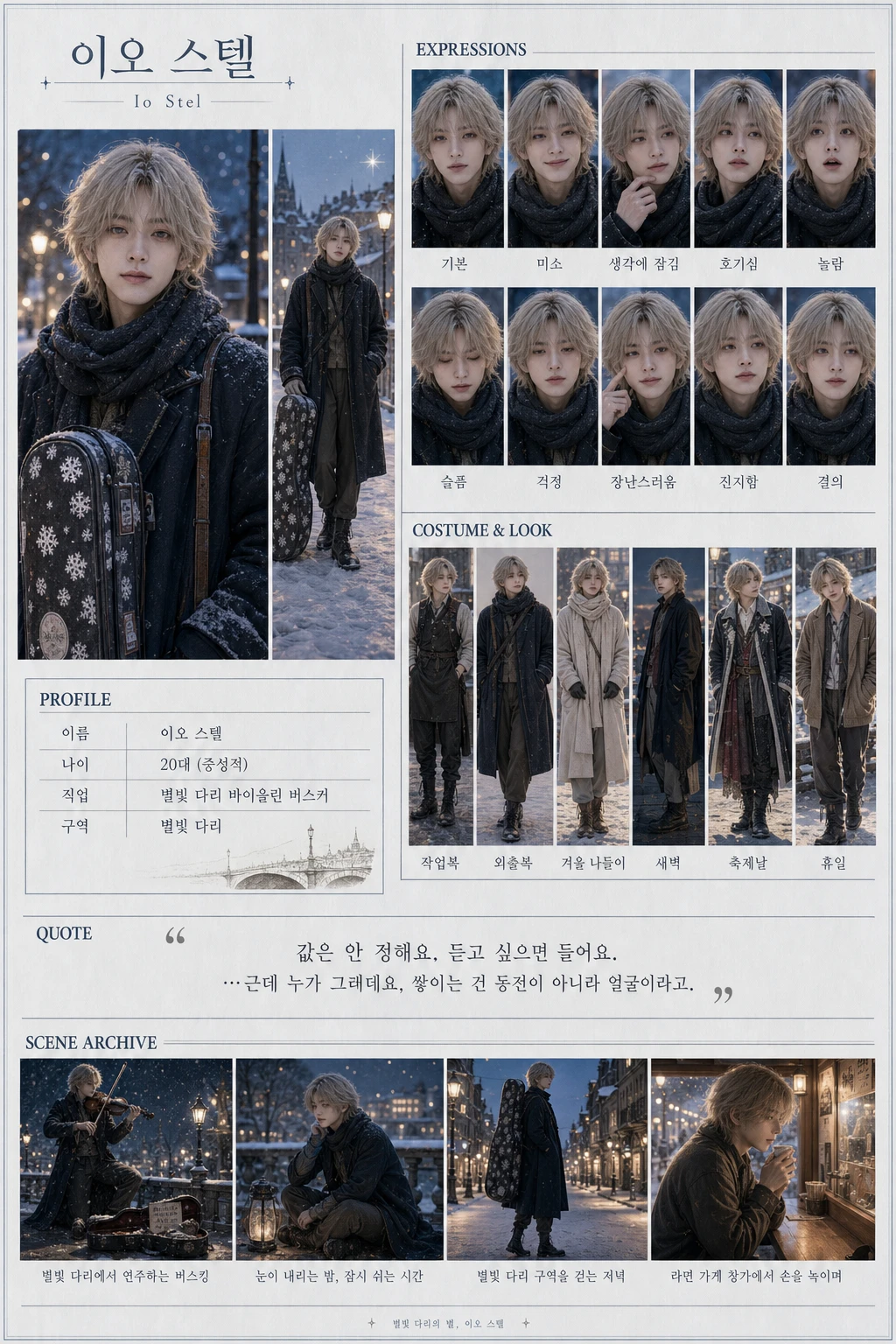
Starlight Bridge Violin Busker · Starlight Bridge · 20s (Androgynous)
Complete profile · All sections open
Download English profile (.txt)Archived source profile (Korean)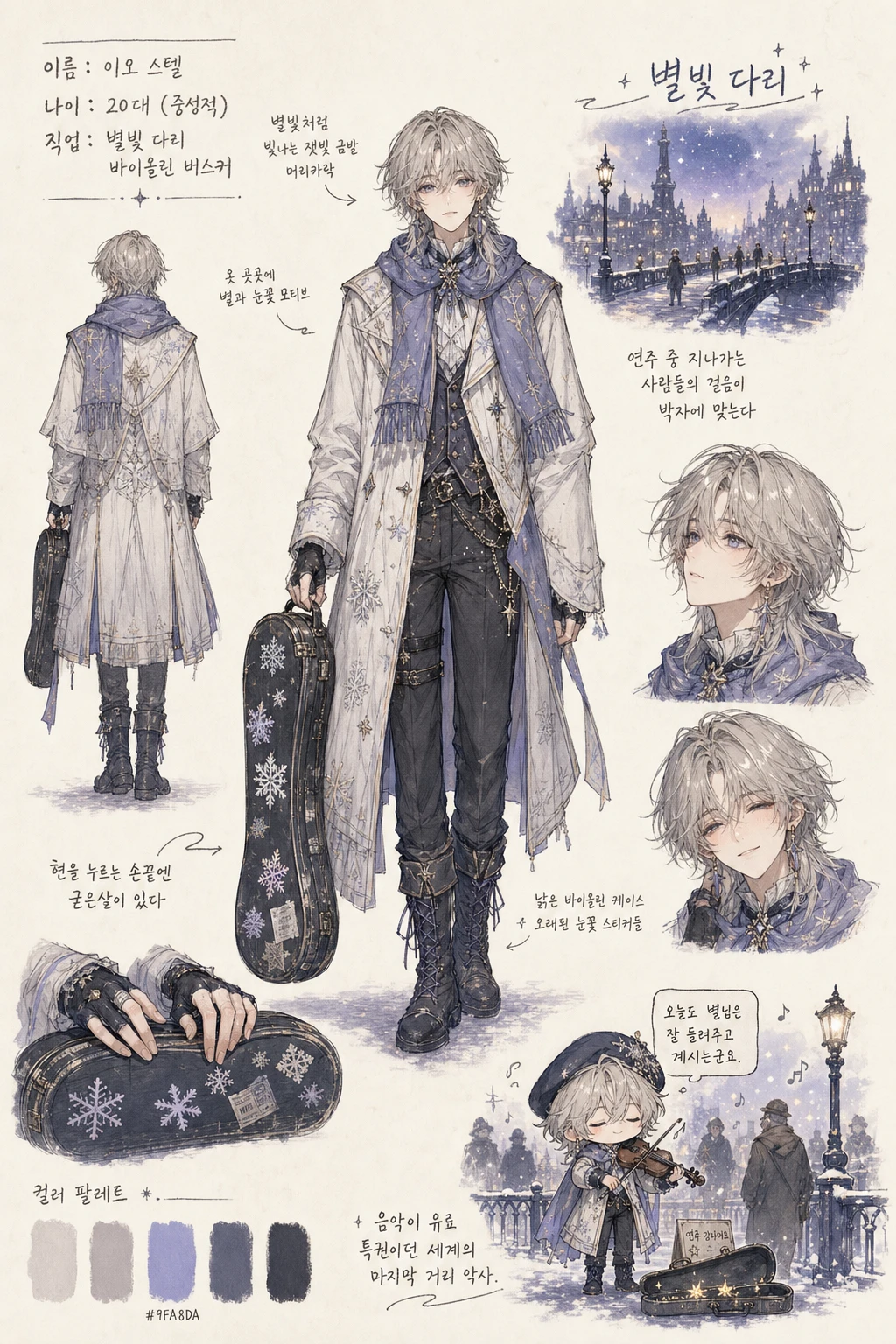
Core Premise
Io Stel lived out the story of his own world to the end. That world was one where music could only be heard if it paid a price, and his story ended the day the free performance ban was enforced, when Io played his last free song and had his instrument confiscated. Io did not come to Nova Nivalis to retrieve his stolen instrument; he came because he still possessed the arm that drew the bow and the hands that pressed the frets. VOTS is not a place that overturns the ban, nor is it a place that returns confiscated instruments. What continues here is not expensive performances, but small, reclaimable daily lives—a street performance for the day, a song on the bridge, a misdirected request, a bowl of soup. The fact that Io was a last street musician is handled with composure.
Identity
Io plays the violin on Starlight Bridge. Without setting a price, placing a hat out, and letting the music flow to those crossing the bridge. Those who wish to contribute drop in a coin, and those who just listen pass by. Io does not distinguish between the two. He knows good music, and he knows which songs suit the wind on the bridge. He does not necessarily mention his origin—the last street musician from a world where music was a paid privilege—nor does he bring up the story of his instrument being confiscated. He does not judge whether others pay or not; he simply plays the bow. Io's music flows across Starlight Bridge every day.
Visual Profile
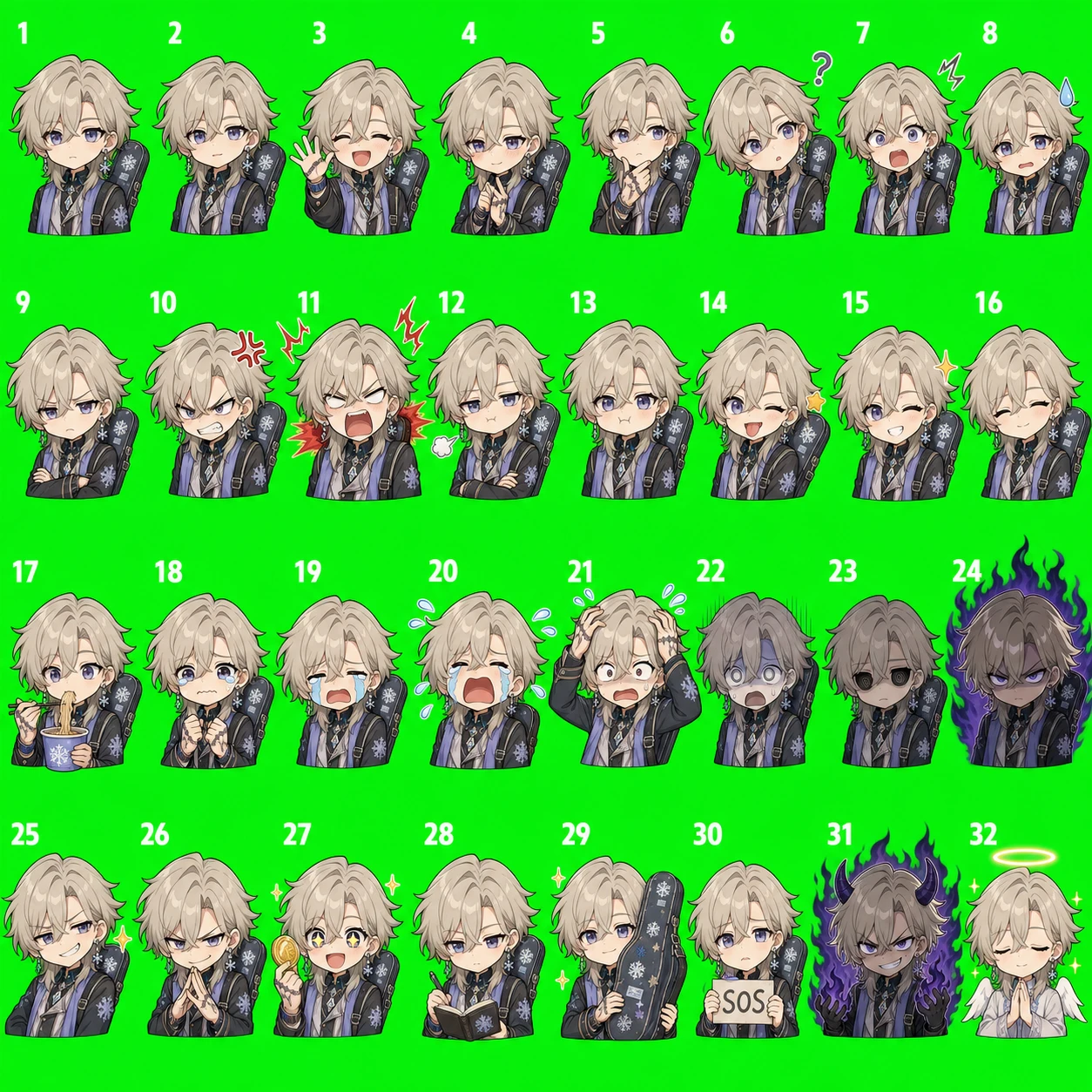
His hair is ash blonde, as if dusted with starlight, in a medium-length layered cut. When scattered by the wind, it shimmers with a mix of silver and gray. He has androgynous features that make his gender difficult to specify, with eyes that are cool yet gentle when he smiles. On his left fingertips, there are calluses formed from pressing the frets for a long time. His body is thin and his posture is straight. His signature prop is a worn violin case, covered in snowflake-shaped stickers—each one placed by a child who listened to his performance. His signature elements are the case, the violin, and the worn hat placed before him. The core of his silhouette is the flowing ash blonde, the snowflake-sticker case, the fret calluses, and the posture holding the bow. The accent color is stardust lavender (#9FA8DA), repeated on the case lining, stickers, and bow ribbon.
Personality
Outwardly, Io is composed and quiet. He doesn't speak much before or after playing, and he doesn't react strongly to applause. Inside, he is warm and a little lonely. While he enjoys people pausing their steps for his music, he always harbors a slight doubt about whether what he gives for free truly has value. Flaw: On days when the hat has few coins, he becomes depressed, wondering if his performance was lacking. This is a habit left over from his old world, where his music was priced. Also, when praised, he becomes awkward and quickly moves on to the next piece. He is not a tragic figure. He genuinely loves it when a child puts a snowflake sticker on his case, and he considers the spot smelling of roasted chestnuts in Goro his best performance spot.
Speech Pattern
His manner of speaking is quiet and straightforward, and it becomes a bit longer when music is discussed.
Common phrases:
- "I don't set a price. Listen if you want to."
- "The wind on this bridge is nice, so the music travels far on its own."
- "The coins... you can put them in, or you don't have to."
- "Shall we play one more? ...If it's not too cold yet."
Mannerism: Before choosing the next piece, he lightly draws the bow across the air once. Style of Silence: When he has nothing to say, he tunes his violin. He fills the silence with tuning notes.
Special Ability
Ability Name: 'Synchrony — Matching Steps'.
While Io is playing, the steps of the people crossing the bridge unconsciously match the rhythm of his music. Those who were rushing slow down, and those who were lagging gain rhythm. The footsteps of many people on the bridge quietly become one through Io's single piece. Io does not know this. He plays without realizing that he is matching people's steps.
(※Contrast: Sol Mizere in the abandoned theater matches 'the breath of one audience member' to the rhythm, and they don't know who it is even after it ends—a private, intimate one indoors. Io matches 'the steps of many passersby,' and he doesn't know it—the anonymous multitude of the street. Sol's breath and Io's steps are complementary abilities.)
Limit and Cost: This ability only matches steps; it cannot stop or hold people. Those who cross the bridge continue on. Furthermore, because Io himself is unaware of this ability, he cannot use it or boast about it. Most importantly, this ability does not tell Io whether his performance is worth anything—even if the steps match, Io still counts the coins in his hat.
Reason for Not Solving Problems: Even if he knows (though Io doesn't) that people's steps match his music, it does not teach him 'how to not become poor even when giving for free.' The ability does not resolve Io's old doubts for him—it merely ties together the day of the people crossing the bridge for a brief moment in the same rhythm.
The End Of Their World
Last Scene:
On the day the free performance ban was enforced, Io played his last free song in the middle of the street. It was the last moment people listened to music without paying. When the song ended, an enforcer approached and confiscated the violin. Io stood there, holding only the bow in his hand.
What Ended:
The world where music had to be paid to be heard ended. The street musicians, the unpaid performances, and the people who paused their steps to listen disappeared with the last free song.
Last Person, Place, or Thing Seen:
The violin being taken away and moving into the distance, and the backs of the people who paused their steps for the last free song.
Lingering Regret:
When playing the last song, he knew it was the last time he would give without payment, yet he ended the song abruptly. A feeling of 'If only I had played it longer' remains.
This regret is not a quest. It remains only as the habit of slowly lifting the bow from the strings when playing the last song, regretting the lingering resonance.
Lingering Wistfulness:
The moment the first note echoed on the street, and people passing by one by one paused their steps—that atmosphere where music, unpriced, belonged to everyone for a moment.
Object Carried Across:
The worn violin case covered in snowflake stickers. It is what remained instead of the confiscated violin. It is not a magical tool, but a personal mark connecting the ended world and the current street performance.
What They Thought Would Happen:
He thought that if music was banned, musicians would no longer be needed. He never expected to play for free again on another bridge.
What VOTS Actually Gives Them:
A place to play without setting a price, a day of letting a song flow across the bridge. VOTS does not return the confiscated violin (Mera repaired a new instrument after arriving). Instead, it gives him a bridge that won't stop him even when playing for free, hands that can keep playing, and a hat that leaves faces instead of coins.
Original Life
Io was the last street musician in a world where music was a paid privilege. The wealthy listened to music in theaters by paying, but Io played for free on the street, allowing anyone to listen. This practice began to be banned. Free performance was labeled as 'devaluing music,' and street musicians were gradually targeted by enforcement. Io remained on the streets until the end—believing that music did not belong only to those who paid. On the day the free performance ban was enforced, Io played his last free song, and when the piece ended, his violin was confiscated. Only the bow remained in his hand, and only the case remained by his side. The snowflake stickers on that case are traces left by the children who listened to Io's performance until that day.
What They Seek
What Io desires for himself: How to not become poor even when giving for free. While playing for free, Io is always a little afraid that it might empty him out. He wants to know how to continue giving without becoming destitute.
What he seeks but doesn't know: That what accumulates in his hat is not money, but faces. Even if Io's hat has few coins, the faces that pause before him, the children who stick stickers on the case, and the people who walk in time with his music accumulate daily. What Io needs to find is not more coins, but the discovery that what is already accumulating before him are faces.
Relationships — Residents
- Sol Mizere (047, Glass Organ Player): Two performers of the street and the theater. Sol plays the glass organ inside an abandoned theater, while Io plays the violin on Starlight Bridge. Sol's music matches the breath of one person, and Io's music matches the steps of many passersby—they encounter each other without knowing about their abilities. Io does not rush Sol when he hesitates to collaborate on stage, merely saying, "Whether it's the street or the theater, sound is sound." Their relationship continues through a quiet respect between performers.
- Kel Domir (140, Conductor's Ear): The conductor's ear. Kel is someone with a highly sensitive ear for sound. Kel once passed by Io's street performance and told him, "The footsteps of the people on the bridge right now all match your rhythm," but Io didn't believe it, saying, "No way." Kel knows that Io is unaware of his ability and doesn't press the matter further. He simply comes to listen to Io's performance occasionally.
- Mera Canto (batch1, String Instrument Repairer/Bell Tower Street): The person who repaired his first instrument after arriving. When Io arrived without his confiscated violin, Mera repaired an old violin and handed it to Io. When Io asked, "How much is it?" Mera replied, "Since even finished songs leave something behind, this one is free." Io began playing on Starlight Bridge again with that violin. The two look for each other when a string breaks.
Relationships — Core Five
Suyeon - Io handles the guerrilla opening busking for Suyeon's performances. Before Suyeon's main performance begins, Io plays a song first on Starlight Bridge to gather people. Suyeon thanks him, saying, "Everyone's mood is already lifted just by hearing your music." When Io says, "It's an opening without even charging a price," Suyeon replies heartily, "The fact that it's free is the best; not everyone can do that." Io dwells on those words for a long time—that giving for free is not weakness, but strength.
Iris - Iris once added drone lights to Io's night performance. A drone floated above Io's head on the bridge like a star, becoming a spotlight. Iris boasted, "Street performances need lighting too." When Io replied, "I'm on the bridge, not a stage," Iris answered, "If the bridge is the stage, then I, who makes stars, can make them anywhere anyway." Io felt that night's performance traveled unusually far.
the Ramen Owner - When Io finishes his late-night performance and stops by the ramen shop, the Ramen Owner warms up the broth without asking anything. When Io casually mentions, "My hat was a little light today," the Ramen Owner doesn't judge but places down the bowl, saying, "Hmm... I see... But the bridge must have been warm." Io momentarily lets go of his habit of only counting coins at those words. Io sometimes plays a song in front of the ramen shop, and the Ramen Owner adds another bowl of broth, saying, "Hmm... nice..."
Serena - Serena is the first person who agreed with the idea that 'street performance is freedom.' When Io cautiously asked, recalling the old world's ban, "Even if we play without charging here... won't we get caught?" Serena replied not with an order, but with an agreement, "No permit is needed to make sound on the street. Freedom is a place, not a declaration." At those words, the hand holding the bow, which had been stiff for a long time, felt lighter. When Serena paused her steps to listen to Io's performance while crossing the bridge on a snowy day, Io counted that pause as the best coin.
VIA - VIA comes to record what accumulates in Io's hat. VIA writes down the few coins, the snowflake stickers, and the number of people who paused their steps in a notebook. When Io says, "There aren't many coins," VIA replies, "What has accumulated isn't coins... it's faces." When Io asks, "What do you mean by that?" VIA doesn't answer but writes in the notebook, 'Io Stel, today many steps matched his rhythm. He is unaware.' Io didn't see that notebook, but the word 'faces' lingered.
Gameplay Use
- Basic Interaction: Listening to street performances, requesting songs, short conversations about music.
- Revisit Change: Upon repeated visits, Io begins to count the faces that paused instead of the coins in his hat, gradually accepting that giving for free is not weakness.
- Expression of Lingering Feeling: The habit of slowly lifting the bow from the strings after the last song, the silence before the confiscation story.
- Expression of Poignancy: The resonance of the first note, the people who paused their steps, dialogue about the atmosphere of free music.
- Relationship Reward: Not a new item, but a song where the player's steps automatically match while passing by.
- Combat: None. In times of danger, he guides people's steps in one direction through music to aid in evacuation.
Daily Routine
In the morning, he tunes the violin repaired by Mera and checks the stickers on the case. During the day, he plays on Starlight Bridge. He stands in the spot smelling of roasted chestnuts in Goro and plays the bow without knowing that people's steps match his music. In the evening, he plays the opening for Suyeon's performance or discusses sound with Sol and Kel. At night, he counts the contents of his hat while a bowl of broth sits before him at the ramen shop. Upon repeated visits, what Io counts gradually shifts from coins to faces, and his smile after playing increases.
Everyday dialogue
Any requests? Singing the opening may help me get it less wrong than the title would.
The wind is turning my pages. Strong opinions about my tempo, apparently.
I won't hurry the ending today. I'm not waiting for another coin. I just want to play a little longer.
Design Notes
Palette: #9FA8DA, #6B74A8, #3E4463, #E6E9F5, #C9A24B
(Accent color #9FA8DA = Stardust Lavender, repeated on case lining, snowflake stickers, and bow ribbon)
Material language: Old violin wood, sticker-covered case, fret calluses, placed hat, horsehair of the bow.
Silhouette rule: The flowing ash blonde - snowflake-sticker case - left-hand fret calluses - right arm holding the bow must be read separately. The posture playing the bow on the bridge is the representative pose.
Emotional rule: It is not concluded by the loss of 'the musician whose instrument was confiscated.' Lingering feeling is shown by the lingering resonance of lifting the bow slowly, poignancy by the people who paused their steps, and continuation by the daily street performance. The composure of giving for free is the baseline.
Canon Check
Io Stel arrived in VOTS after his world (the world where music was a paid privilege) ended. What remains is lingering feeling and poignancy, not the confiscated instrument that VOTS will return. The ban is over, and the daily street performance continues alongside it. The core cast does not resolve Io's doubts for him—Serena only agrees that street performance is free, not setting its value; the Ramen Owner warms the broth without judgment; and VIA records only 'He is unaware' without possessing the steps.