RESIDENT 143
Kana Uru
Kintsugi Artisan (Golden Joiner) · behind Threshold Market · 50s
Complete profile · All sections open
Download English profile (.txt)Archived source profile (Korean)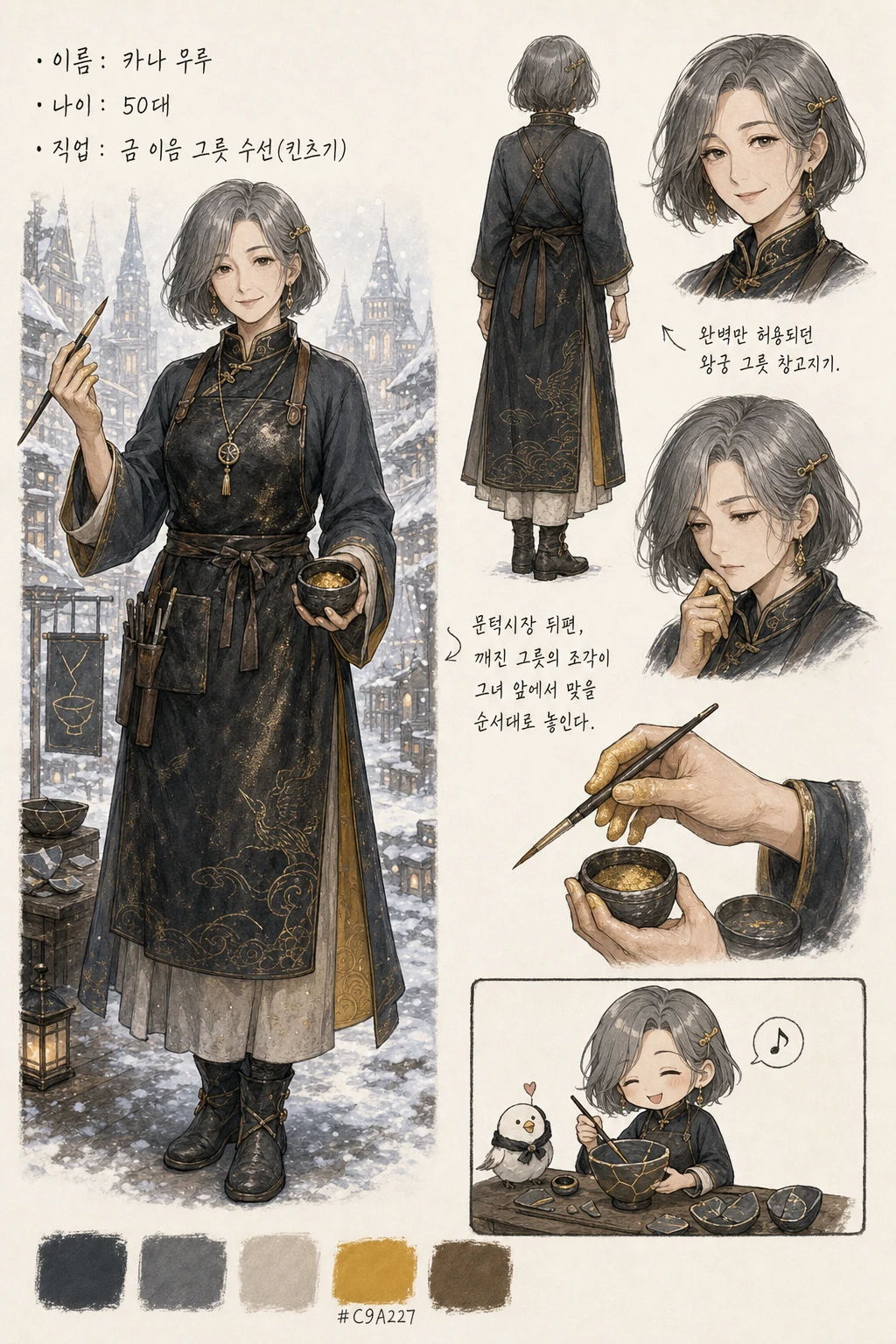
Core Premise
Kana Uru arrived at Nova Nivalis after living out the story of her own world until the very last scene. She did not come to resolve unfinished events, but rather, the sensation of the brushstrokes left in her hands and the habit of not being able to discard what was broken, led her to this city of snow. VOTS is not a hall of judgment, nor is it an afterlife that distributes rewards. What continues here is not a grand destiny, but small daily life—a single teacup, a plate gilded with gold leaf, or an afternoon spent fitting pieces together. With the hands that carried the cup she defied the order to discard, she joins the broken vessels of this city with gold.
Identity
Kana Uru joins broken vessels with gold in her small workshop behind Threshold Market. People bring her vessels broken to the point of being disposable, and she fits the pieces, adheres them with lacquer, and dusts the seams with gold powder. The repaired vessels have seams that are more noticeable than before they were broken, and that is the entirety of Kintsugi—it does not hide the broken places, but reveals them with gold. Her function is not decoration, but the labor of daily life that allows the city's cherished vessels to continue being used. She does not restore the vessels to like-new condition. She leaves the fact that they were broken as a pattern on the vessel.
Visual Profile
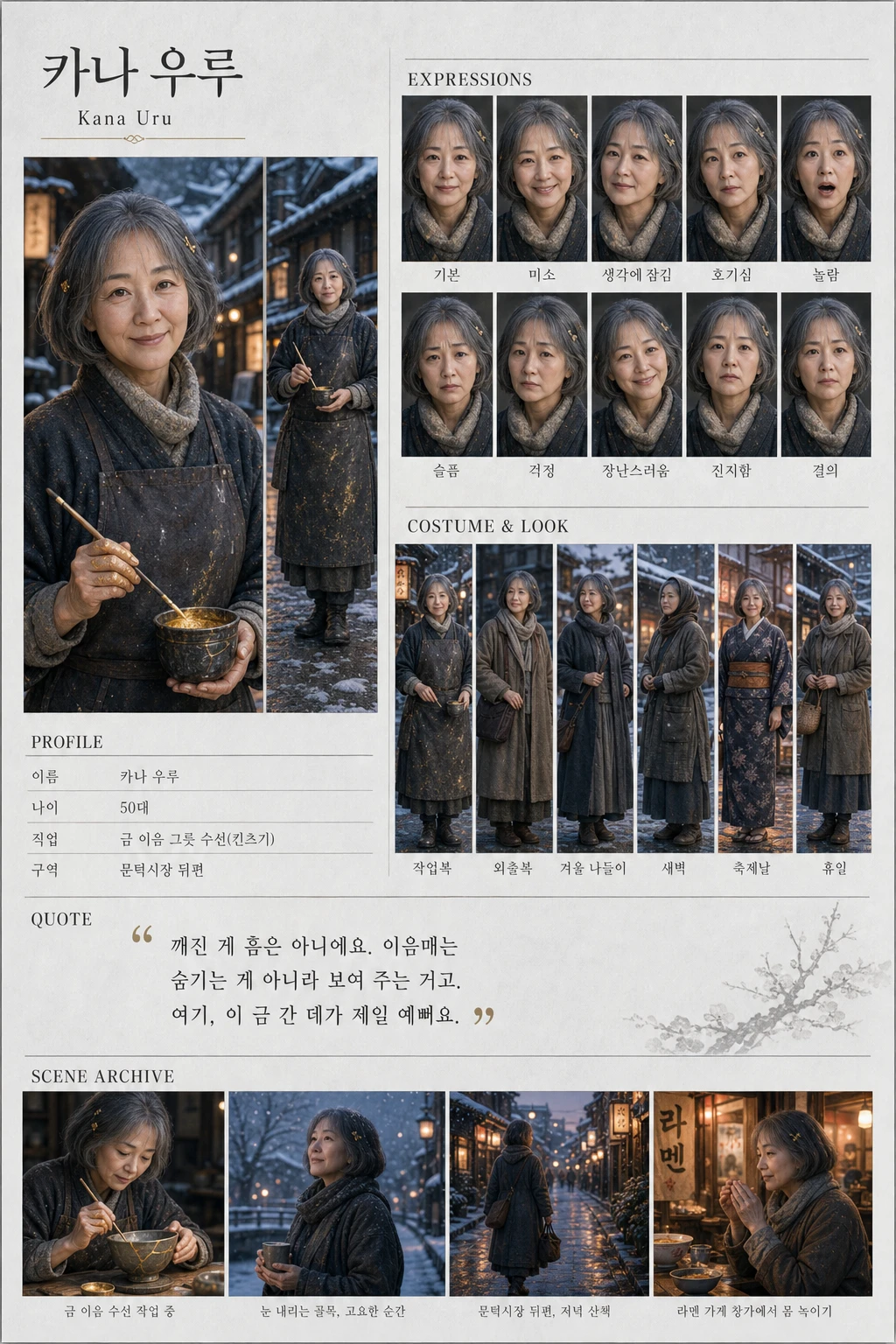
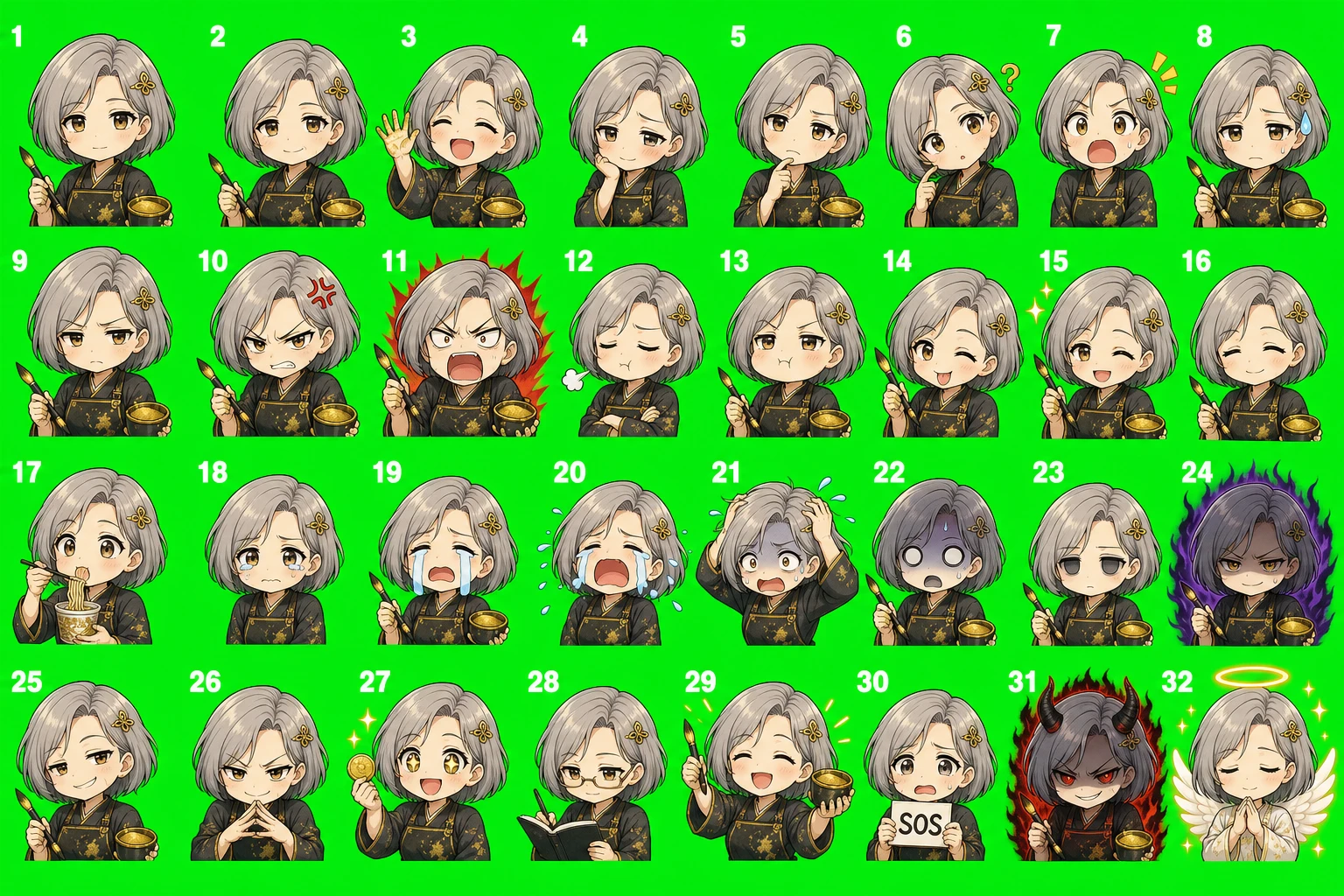
Her ash-gray hair is cut into a neat bob, and she wears a single gold hairpin in the back of her head as her only adornment. Gold leaf dust always faintly sparkles on her fingertips, and her apron is layered with dark stains of dried lacquer—the lacquer is difficult to erase, accumulating like her years. There are faint scars on the back of her hands from brushing against lacquer pots. Her signature props are a very fine brush and a small container of gold powder; the tip of the brush is as thin as a few strands of hair. The core of her silhouette is the posture of sitting with a straight back, the gold hairpin, the hand holding the fine brush, and the small container of gold powder on her lap. The strong accent color is the gold of the seams, #C9A227, which informs even small sprites that she is 'the person who joins the broken with gold.' Her attire is a form of modest workwear derived from the neat garments of a royal warehouse where only perfection was allowed.
Personality
Outwardly, she is calm and speaks slowly. She never rushes, and even if it takes an entire day to fit one piece, her posture does not falter. Her strength is her ability to see broken things not as flaws, but as history. To her, a gold-joined vessel is not something that became unusable, but something that remained after going through something. Because of the years spent living under the pressure of perfection, she is particularly strict with herself—while saying the flaws on others' vessels are beautiful, she rarely forgives her own mistakes. She is not someone who carries only tragedy. On days when the gold sits beautifully, she gazes at it contentedly alone for a long time, and when a customer says, "This is even more beautiful," the corners of her eyes soften, treating even this discarded cheap vessel as if it were precious.
Speech Pattern
Her sentence endings are low and refined. She speaks little, but every word carries weight. Frequent phrases: "The brokenness is not a flaw." "The seam is not hidden, it is shown." "The pieces know where they belong, not me." "Gold flows along the wound." As a habit, when receiving a vessel, she first gauges its weight with both hands and scans the seam with her eyes. Her way of silence is to place the pieces in her palm and gaze at them for a long time—weighing them instead of answering. If someone is ashamed of a flaw, instead of comforting them, she says, "Here, this gold-joined spot is the most beautiful." That is the kindest sentence she knows.
Special Ability
Ability Name: The Order of Fitting.
If the pieces of a broken vessel are scattered on the workbench before her, the pieces arrange themselves in the order they should fit. The pieces tell her which piece comes first and where it should be attached. But that is all—the act of joining must be done entirely by her hands and time. Preparing the lacquer, adhering the pieces, waiting for it to dry, and applying the gold takes several days. There are clear limits. If the pieces are broken into very fine fragments or if some pieces are missing, the order will not appear. The cost is damage to her hands from lacquer irritation and age, and above all, this ability does not restore anything. Just because it shows where the pieces belong does not mean the vessel returns to how it was before it broke. Even when joined with gold, the mark of the break remains as a pattern, and that is the way she desires. (This clearly diverges from 043 Selin Moors. Selin's torn document fragments are drawn together to restore the original sentence, but Kana's pieces only reveal the order, highlighting the seam with gold. Selin makes the flaw disappear as if it never happened, while Kana leaves it as a mark emphasized by gold.) The ability only tells where to start, it does not erase the fact that it was broken.
The End Of Their World
Last Scene:
On the night the final order came down to smash all the cracked vessels in the royal warehouse, which only displayed perfect vessels, she defied the order and held a cracked teacup in her arms.
What Ended:
The royal court that only allowed perfection faded, and the rule to discard the flawed, as well as the display case she guarded, ended with it. The world where broken things could be saved never came to that world.
Last Person, Place, or Thing Seen:
The sight of shattered vessel pieces glittering on the warehouse floor, and the weight of the cracked teacup, cold as a heart, in her arms.
Lingering Regret:
There was only one she could hold in her arms, and the rest of the cracked vessels shattered before her eyes. She could have saved them, but she only had one hand. This lingering attachment is not a quest that VOTS must resolve. It remains in the pace of her brushstrokes, leaking out only when she wills it, and within the bounds of not changing others' choices.
Lingering Wistfulness:
The coolness of the porcelain and her own heartbeat beneath it at the moment she defied the order and held the teacup. It remains in temperature and touch, briefly reviving when she weighs a new vessel in her hands, before blending with the cold air of the city of snow.
Object Carried Across:
The single teacup she carried across that day, now filled with gold seams. It is neither an artifact nor a magical tool, but a personal mark connecting the world that demanded perfection and the present that cherishes flaws.
What They Thought Would Happen:
She thought that when the royal court collapsed, she would be free from the rules of perfection. But she remained as strict with her own mistakes as the royal court had been.
What VOTS Actually Gives Them:
A workbench to receive and join broken vessels with gold every day, and customers who cherish those vessels even more. VOTS does not bring back the vessels that shattered that day. Instead, it slowly shows her, through the repetition of daily life, that she can see broken things not as flaws, but as patterns, and that she can do the same for herself.
Original Life
She was the keeper of the royal vessel warehouse, where only perfection was allowed. Only vessels without a speck of dust were placed on the display shelves, and any vessel with a crack or a chipped tooth was immediately discarded. Her job was to find and select the flaws, but she could not bring herself to throw away the selected vessels and secretly gathered them in a corner of the warehouse. At night, she would take out those vessels and trace the seams in her imagination. In the last season before the royal court faded, an order came down to smash everything flawed. She pretended to obey the order, holding a cracked teacup in her arms, and left the warehouse while hearing the sound of the rest shattering behind her. There was no night when she resented having only two hands more. And the story after that day did not remain in her world.
What They Seek
What she believes she seeks: Someone with whom to share the conviction that the broken is more beautiful. She hopes her own view of flaws as patterns is not lonely, and that someone will say, "Yes," beside her.
What she actually needs but doesn't know: That this entire city is a collection of gold-joined vessels. In this place, where people who carry finished stories live with their own patterns of brokenness, the conviction she seeks is already walking down every alley.
Relationships — Residents
- Selin Moors(043 Selin_Moors): With Selin, the document restorer from the Archives, she claims to be 'Comrades in Restoration,' but their methods are diametrically opposed. On Selin's desk, torn document fragments are drawn together to recover the original sentence, and the seams are seamlessly glued so they are invisible. On Kana's workbench, the pieces only reveal the order, and the seams are highlighted with gold. Selin says, "Restoring it as if it never happened is an apology," while Kana says, "Beautifully preserving what happened is an apology." They repeat this debate several times over tea, but they respect each other completely. At some point, Kana offered to join the cover of that one book Selin carried, the water-stained part, with gold—Selin has yet to answer.
- Vezim Nol(058 Vezim_Nol): With Vezim, the antique dealer from the night market, they are a pair of antiques and repairs. When Vezim shows Kana the 'unfulfilled purpose' of an old vessel brought in broken, Kana joins that vessel with gold so it can be used again. They envy each other's sight, saying, "You see utility, and I see scars."
- Ivo Senn(2 Ivo Senn): With Ivo, the locksmith neighbor from behind Threshold Market, they share the alley. Ivo handles what is locked, and Kana handles what is broken; the narrow path between their workshops is always mixed with the smell of metal and lacquer. On nights when Kana's work runs late, Ivo hangs an extra lantern.
Relationships — Core Five
Suyeon - The quiet contrast between the hand that breaks and the hand that joins. When Suyeon accidentally broke a neighbor's jar while practicing with her ice sword, she gathered the pieces and came to Kana. Suyeon was anxious, saying, "It's my fault; what if it can't be fixed?" Kana showed her the pieces scattered on the workbench and the order they would take, saying, "If the one who broke it gathered all the pieces, half of it is already fixed." Since then, Suyeon has developed a habit of bringing broken things to Kana instead of discarding them.
Iris - A brief conversation about revealing flaws. When Iris asked Kana to repair a cracked stage prop mirror, she said, "Please make it unnoticeable." Kana replied, "I fix it so it's noticeable, with gold." Iris hesitated for a moment, but then put the cracked mirror on stage as is, and changed her mind when she saw the gold of the seam glittering under the lights. Kana never asked anything about a drone that was always turned off.
the Ramen Owner - The relationship that made her cherish the discarded vessel. Kana took several vessels that were pushed aside with chipped teeth at the ramen shop and joined them with gold. As a result, those vessels became the owner's most cherished items—he always used those gold-joined vessels when serving a special broth to a customer. Instead of saying thank you, the Ramen Owner pours broth into the vessel and gives it to Kana, saying, "Hmm... I see..." Kana knows that he never puts peaches in it.
Serena - The fine gold of the first teacup. There is a very fine line of gold on the teacup Serena first used in the city. When Kana asked, "Shall I join it?" Serena replied, "I want to leave it as is"—it was an agreement about her own cup, not an order. Kana did not insist on filling that gold, nor did she ask why Serena left it. The two silently agreed that whether to leave the flaw or fill it was the owner's choice.
VIA - The record of the broken. When VIA saw the pieces scattered on Kana's workbench, she wanted to record where each piece came from. "This piece was from a jar... it was a jar." Kana arranged the order of the pieces, and VIA wrote down that history. VIA drew the gold pattern on the fully joined vessel last and wrote, "It was broken... and that is why it is beautiful." Kana kept that sentence for a long time.
Gameplay Use
- Basic Interaction: Receiving a broken vessel, showing the pieces arranging in order, conversation about the progress of the gold joining.
- Revisit Changes: Initially, she only accepts vessels, but on the second visit, she takes out a piece of the royal warehouse story, and subsequently, she cautiously asks about the 'broken things' the player possesses.
- Expression of Lingering Attachment: The habit of weighing the vessel with both hands, a brief pause only when facing her own mistakes.
- Expression of Poignancy: A line where she briefly closes her eyes when feeling the coolness of the porcelain in her hands.
- Combat: None. Even in dangerous moments, she picks up broken things, gathers pieces, and examines where they should be joined again.
- Player Choice: Entrusting the vessel, waiting for it to be joined, deciding whether to leave the flaw as gold, or coming back to find out.
Daily Routine
In the morning, she first checks her fine brush and gold powder container, and checks if the lacquer on the vessel joined the day before has dried properly. This is the ritual that opens her day. In the morning, she scatters the pieces of newly arrived broken vessels on the workbench to establish the order, and begins to mix the lacquer and adhere them. Around noon, when the noise of the Threshold Market and the smell of lacquer are at their thickest, the coolness of the royal warehouse briefly overlaps and passes. In the afternoon, she performs the delicate task of applying gold powder to the dried seams, bending her back until her neck aches. At night, she washes her brush and places the teacup she carried in her arms in its place. She leaves it not to hide it, but to see it again tomorrow. If the player visits repeatedly, she shows the order of the pieces for longer than before and adds more words about the royal warehouse.
Everyday dialogue
I look at the crack first. Pretend it isn't there and it breaks there again.
However much you like gold, don't drop it on purpose. It makes my work sadder.
I carried only one out that day. Now I begin by laying out every fragment you've brought.
Design Notes
Palette: #C9A227, #3A342A, #7A6A4E, #E4D8B8, #4E4638
Material language: Gold leaf powder, dark stains of dried lacquer, porcelain, fine brush, wooden workbench damp with moisture.
Silhouette rule: The straight back - gold hairpin - hand holding the fine brush - small container of gold powder on the lap are read as separate elements and do not overlap with the representative forms of other characters.
Emotional rule: Lingering attachment is shown by the habit of weighing with both hands, poignancy by the coolness of the porcelain, and continuity by the seams joined with gold every day. It is not concluded with a single 'tragic expression.'
Canon Check
Kana Uru arrived in VOTS after the story of her own world ended. What remains is the lingering attachment to the vessels she couldn't save and the poignancy of that day she held the teacup, not an unfinished plot that the city must resolve. Her ability only tells the order in which the pieces fit, not that the brokenness is erased, and her vessels do not join by themselves. The new seams in Nova Nivalis do not erase the world that demanded perfection; they quietly join alongside it with gold.