RESIDENT 037
Mir Obel
Apprentice puppeteer and prop collector at Closed Theater Street · Closed Theater Street · 10-year-old girl
Complete profile · All sections open
Download English profile (.txt)Archived source profile (Korean)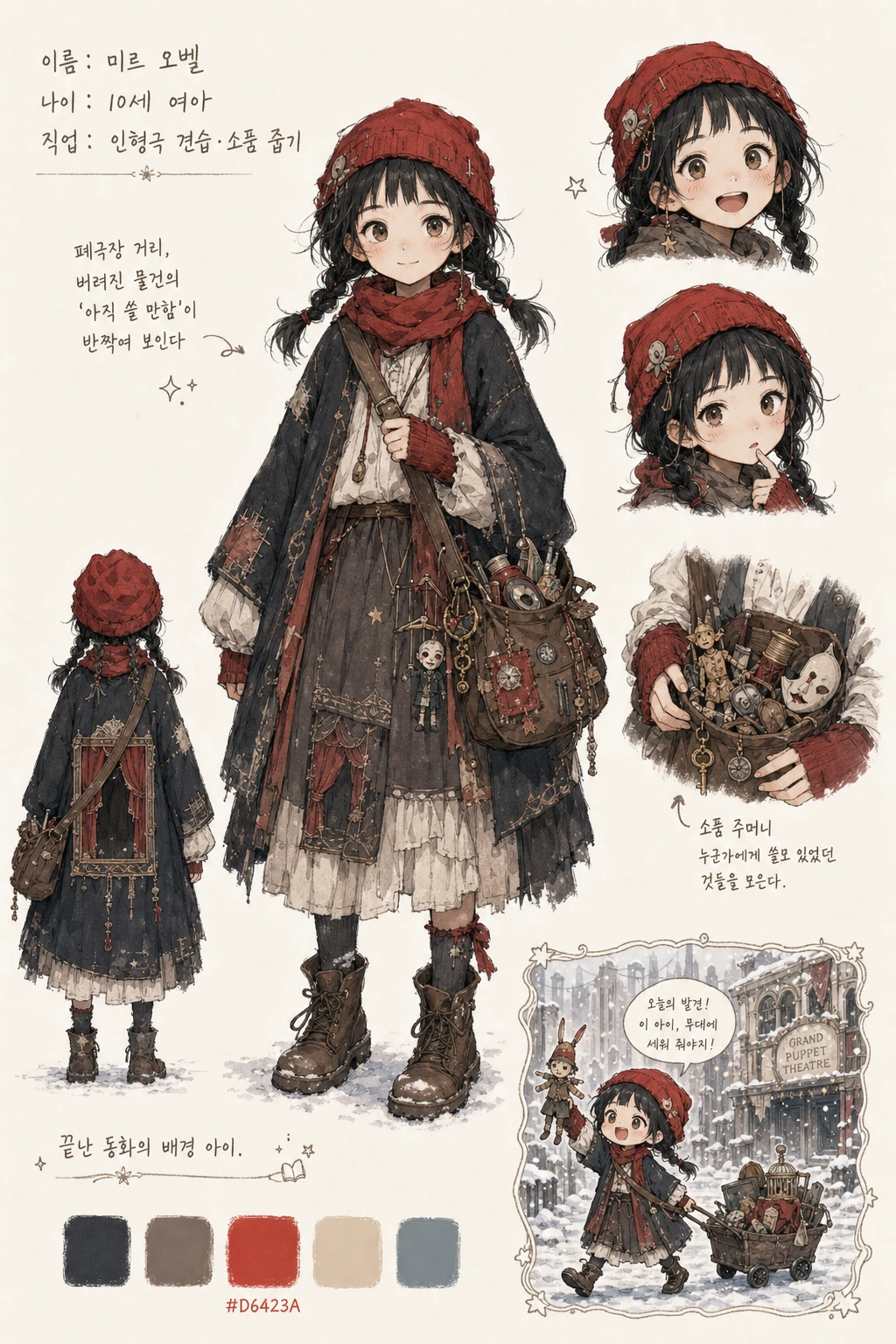
Core Premise
Mir Obel lived out the story of her own world to the very end. That world was a children's book, and Mir was not the protagonist of that story, but a child standing in the background of a village festival scene. Even after the book was closed, Mir remained standing in that festival spot, and it is because of that remaining space that she arrived in Nova Nivalis. VOTS is not a place that reopens closed books, nor is it a place that turns background children into protagonists. What continues here is not a grand adventure, but small, repeatable daily life—picking up props, mending dolls, ramen with a single egg, watering the greenhouse. The fact that Mir was a background child in a fairy tale is treated lightly, depicted with childlike brightness.
Identity
Mir is an apprentice helping with Komo's puppet theater on Closed Theater Street. Her job is to pick out things that are still usable among discarded objects. Buttons, scraps of fabric, broken umbrella ribs, and old ribbons become the eyes of puppets and stage props when they pass through Mir's hands. Mir knows she was a 'child without lines,' but rather than being sad about it, she firmly says, "Now I'll have a role with lines." She doesn't take things from others carelessly; she only chooses from what has been discarded. Her eyes find utility in the city that adults overlook.
Visual Profile
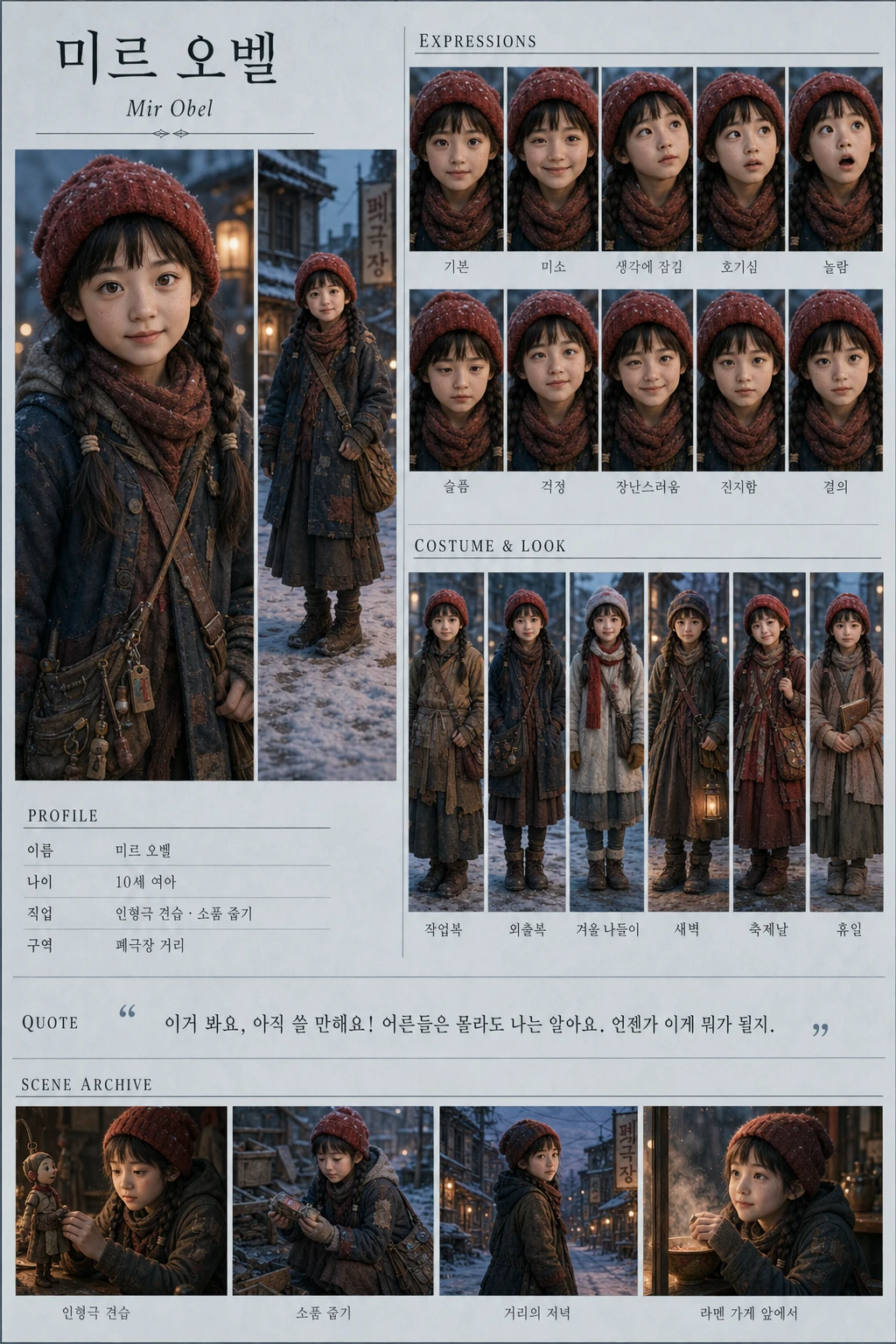
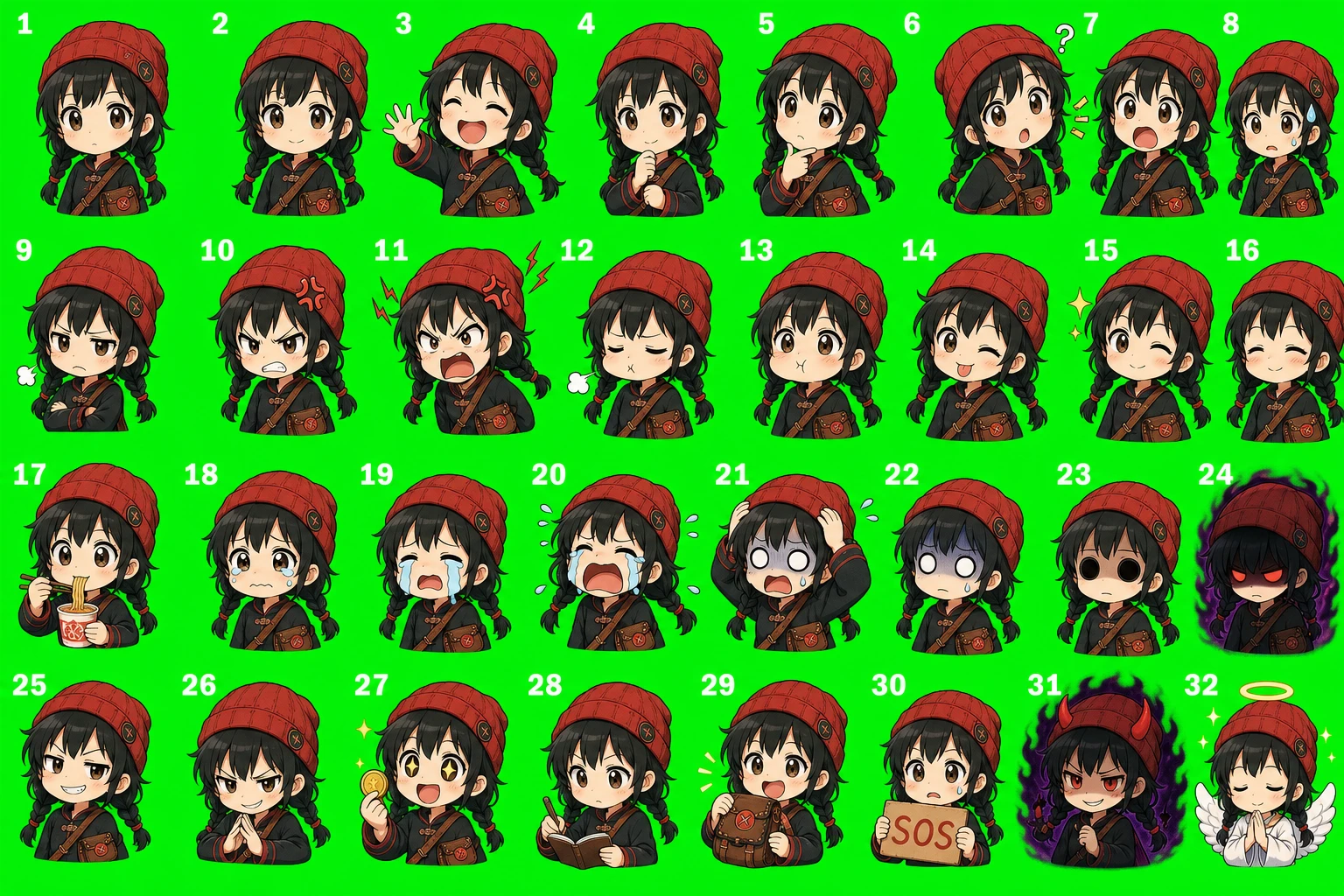
She has black hair braided low in two pigtails, and her bangs are uneven, as if she cut them herself. She wears a red fur hat pulled down over her eyebrows, and beneath it, her dark brown eyes are unusually large. She is small in stature, and her pockets are always bulging from stuffing things in. Her signature prop is her prop pouch—a large cloth bag worn around her waist, filled with collected items. Her clothing includes a large vest, seemingly inherited from Komo's troupe. The core of her silhouette is the red fur hat, the uneven bangs, the two braids, and the bulging prop pouch. The accent color is vivid red (#D6423A), repeated on the fur hat, pouch strings, and collected ribbons.
Personality
On the surface, Mir is capable and spirited. She doesn't shrink away in front of adults and confidently explains the usefulness of the things she has picked up. Inside, she is a little impatient. Because she has only ever stood in the 'background,' she is anxious to have a 'role with lines.' Flaw: She gets pouty if an adult doesn't recognize the items she chose. She puffs out her cheeks, saying, "This is still usable!" She also wants to skip the apprenticeship and be on stage due to her impatience. It is not tragic. When she finds something useful, she jumps up excitedly, and when playing with her best friend, she chatters like a child her age. Rather than mourning being in the background, her heart is focused on what might come next.
Speech Pattern
Her way of speaking is clear and fast, like a child's.
Common phrases:
- "Look at this, it's still usable! Don't throw it away, it's a waste."
- "I wasn't in the background. Now I'm going to have a role with lines, just watch."
- "Unnie Hero! I picked this up because it seemed like it would match your sword."
- "Even if it's crooked, I cut it myself. Without going to the hair salon."
Habit: When she picks up an item, she lifts it with both hands and makes a "Sparkle!" sound. Silence style: When she pouts, she pulls her fur hat down even further over her eyes and says nothing. She hides her silence with her hat.
Special Ability
Ability Name: 'Still-Good Gleam'.
Mir can see the 'still-goodness' in discarded objects. Among things others pass off as trash, only in her eyes do objects with remaining utility shine. A broken umbrella rib, a button whose mate is missing, a faded ribbon—the remaining usefulness shines within them.
Limitation and Cost: Adults do not understand the 'value' of the gleam. No matter how brightly it shines in Mir's eyes, it is often ignored by adults as mere trash. She still lacks the words to explain that utility. Furthermore, the gleam only indicates 'still-goodness'; it doesn't tell her what to make of it—that must be done by hand. And things that are completely broken, truly past their use, do not gleam. That is also sad for Mir.
Reason for not solving problems: This ability is not directly helpful to Mir, who is searching for a 'role with lines.' She can see the utility of objects, but not her own utility. The ability does not make her the protagonist; it only allows her to find remaining utility among the discarded things.
The End Of Their World
Last Scene:
On the last page of the fairy tale, a village festival scene was drawn. The protagonists were dancing in front, and Mir stood with other children in the background. Even after the book closed and the story ended, Mir remained standing in that festival spot.
What Ended:
The fairy tale ended. The protagonists' adventure, the village, the festival, everything on that page stopped when the book closed.
Last Person, Place, or Thing Seen:
The colorful flags of the festival scene, and the back view of the protagonist who stopped dancing at the end of the page.
Lingering Regret:
Mir couldn't say a single word at that festival. Because a background child has no lines. The feeling of, "I wanted to shout something at the festival too," remains.
This attachment is not a quest. It remains only in the way she puffs out her cheeks when an adult doesn't recognize her items.
Lingering Wistfulness:
The air of that one page, filled with the sparkling flags and lanterns of the festival scene, and the sound of children's laughter. The sensation of being there, even without dialogue.
Object Carried Across:
The prop pouch. It is the small pouch Mir held in the fairy tale festival scene, now filled with collected items. It is not a magic pouch, but a personal marker connecting the finished fairy tale and the current alley.
What They Thought Would Happen:
She thought that when the book closed, the background child would just remain on that page and be forgotten. She never thought she would end up picking up props and making dolls in another city.
What VOTS Actually Gives Them:
The work of finding utility in discarded things, and the day of preparing for a role with lines while learning puppet theater. VOTS does not reopen the closed fairy tale. Instead, it gives her a place where she doesn't have to be in the background, an alley where her name is called every day, and hands that use utility through creation, not ownership.
Original Life
Mir was a background child in a village festival scene from a children's book. In the scene where the protagonists returned after their adventure to hold a festival, Mir stood in the back, holding a flag. Without dialogue or a name, she was simply depicted as 'one of the village children.' When the story reached the final festival after passing through several pages, Mir stood in that spot, just like any background figure. And the book was closed. The protagonists' story ended, but Mir remained in the festival spot, still holding her flag—because no one told her, "You can go now." That spot, left as background, brought Mir to Nova Nivalis.
What They Seek
What Mir wants for herself: A role with lines. She wants to be the one speaking her lines on stage, not just in the background. She believes she is preparing for this as Komo's apprentice.
What she doesn't know she needs to find: That daily life is already dialogue. Her shouting, "This is still usable!" to the Ramen Owner, greeting them with "Enjoy your meal," and chatting with her best friend—all of those words are already her dialogue. What she needs to find is not stage dialogue, but the realization that the words she speaks now are already dialogue.
Relationships — Residents
- Tori Namu (batch1, Sewing Apprentice): A fellow apprentice who is like an older sister. Since Tori is also an apprentice, Mir constantly asks Tori, "When will you become a real seamstress, unnie?" Tori replies, "You can take your time," and while Mir finds that answer frustrating, she cherishes the pouch Tori sewed for her.
- Komo Rici (036, Street Puppeteer): Mir's master. Komo makes puppets and props from the items Mir collects. Komo respects Mir, saying, "Your eyes are better than mine, truly," and Mir wants to stand on stage someday instead of Komo.
- Som Ire (064, Greenhouse Watering Duty): Her best friend. Since both are young, when Mir goes to Glass-Lantern Greenhouse Lane to collect props, she plays with Som. When Som sneezes in front of a thirsty pot, Mir laughs heartily, saying, "You reported again!"
Relationships — Core Five
Suyeon - The person Mir calls 'Unnie Hero.' Mir admires Suyeon, knowing she was a real hero. When she picks up something shiny that seems to match an ice sword, she brings it to Suyeon. Suyeon initially pretends to be annoyed, but she actually attaches the old star-shaped button Mir found to a stage costume. Suyeon gruffly admits, "You gave this to me," and Mir boasted about it all day long.
Iris - Mir envies Iris's sparkling stage. When she sees Iris's drone shining like a star and says, "That sparkles too!" Iris brags, "That's a star I made; it's different from just anything that sparkles." When Mir doesn't back down, saying, "I can find sparkling things too," Iris smiles and points to a powered-down drone, saying, "Then show it to me if you find something sparkling."
the Ramen Owner - When Mir comes to the ramen shop, the Ramen Owner silently adds one more egg. When Mir asks, "Didn't I order that egg?" the Ramen Owner doesn't judge but only says, "Hmm... I see... Since there was one left, I added it." In fact, one is always 'left over.' Even though Mir knows it's for her, she pretends to be fooled every time and greets loudly, "Enjoy your meal!"
Serena - Mir is both intimidated by and fond of Serena. One day, when Serena passed through Closed Theater Street on a snowy day, Mir showed her the items she had collected and asked about each one, "What could this become?" Serena didn't command or tell her to organize; she listened to Mir's explanation until the end. From that day on, Mir wants to show Serena any particularly shiny things she finds.
VIA - VIA is the entity that understands Mir's objects the best in the city. Since VIA also records trivial things, it writes down every single item Mir collects in its notebook, saying, "This was here too... It's usable." Because only VIA recognizes the gleam that adults miss, Mir likes VIA the most. VIA regularly counts the items in Mir's prop pouch with her.
Gameplay Use
- Basic Interaction: Bragging about collected items, running errands for puppet props, short childlike conversations.
- Revisit Change: Upon repeated visits, Mir experiences moments where she begins to realize that what she is doing now is dialogue, rather than seeking a 'role with lines.'
- Expression of Attachment: Pouting and pulling down her hat when adults don't recognize her items; the impatience to be on stage.
- Expression of Poignancy: Sensory dialogue regarding the festival flags, lanterns, and children's laughter.
- Relationship Reward: Instead of new items, she brings the player items that suit them.
- Combat: None. In danger, she hides behind an adult or finds useful items for escape (umbrella, cloth, etc.).
Daily Routine
In the morning, she turns over her prop pouch to organize what she collected the day before. It is a ritual, like a game of sorting, separating what is usable from what is not, rather than a compulsion. During the day, she wanders through Closed Theater Street, the greenhouse lane, and the market, picking up shiny things. If she finds something usable, she runs to Komo to show it off. In the evening, she helps with Komo's performance, passing props from the front or the side. At night, she sometimes falls asleep with her pouch held—so she can organize it again in the morning. With repeated visits, her impatience to be on stage gradually shifts to a sense of ease, finding joy in what she is doing now.
Everyday dialogue
I have a line today! 'The gates are opening!' That's more than three words. It's a big role.
You're throwing that box away, right? Now I've checked, it's a castle wall. Call it rubbish and admission doubles!
I wasn't allowed to make a sound at that festival. Can I shout the opening announcement today? Just once!
Design Notes
Palette: #D6423A, #F0837C, #2E2A28, #F3E7D0, #4E7A46
(Accent color #D6423A = Vivid Red, repeated on fur hat, pouch strings, collected ribbons)
Material language: Red yarn hat, cloth prop pouch, collected buttons and ribbons, broken umbrella ribs, old vest.
Silhouette rule: The red fur hat - uneven bangs - two braids - bulging prop pouch must be read as distinct elements. Emphasize the contrast between her small body and large pouch.
Emotional rule: Do not end with the sadness of a 'background child.' Attachment is shown through puffed cheeks when ignored, poignancy through festival flags and lanterns, and continuation through the daily collection of items and big greetings. Childlike brightness is the default setting.
Canon Check
Mir Obel arrived in VOTS after her world (the finished fairy tale) was closed. What remains is attachment and poignancy, not a book that VOTS must reopen. The fairy tale is over, and a new daily dialogue continues beside it. The core cast does not make her the protagonist—the Ramen Owner adds eggs without judgment, Serena speaks with questions rather than commands, and VIA only records her items without owning them.