RESIDENT 145
Miren Has
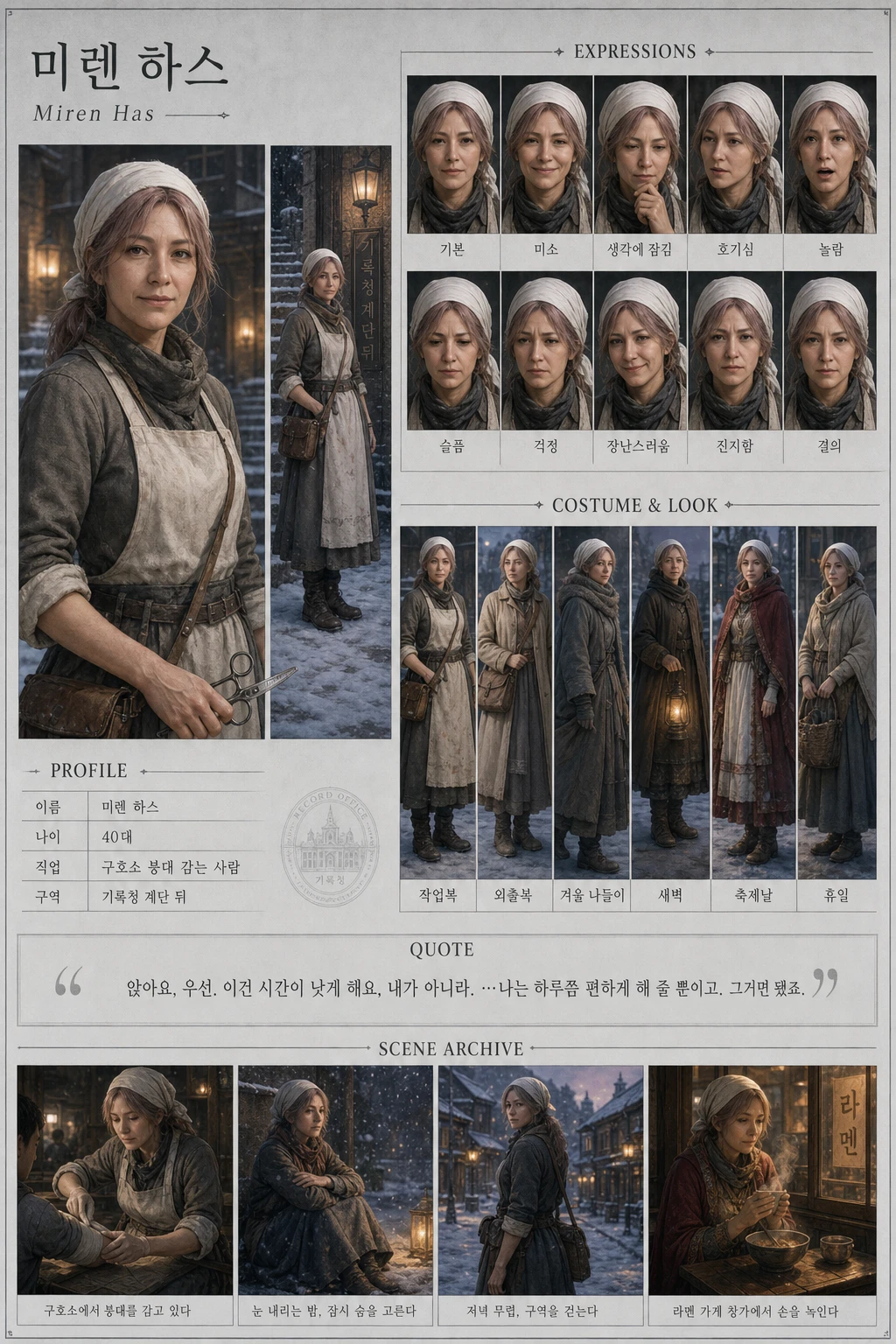
Bandager at the Aid Station · Behind the Archives Staircase · 40s
Complete profile · All sections open
Download English profile (.txt)Archived source profile (Korean)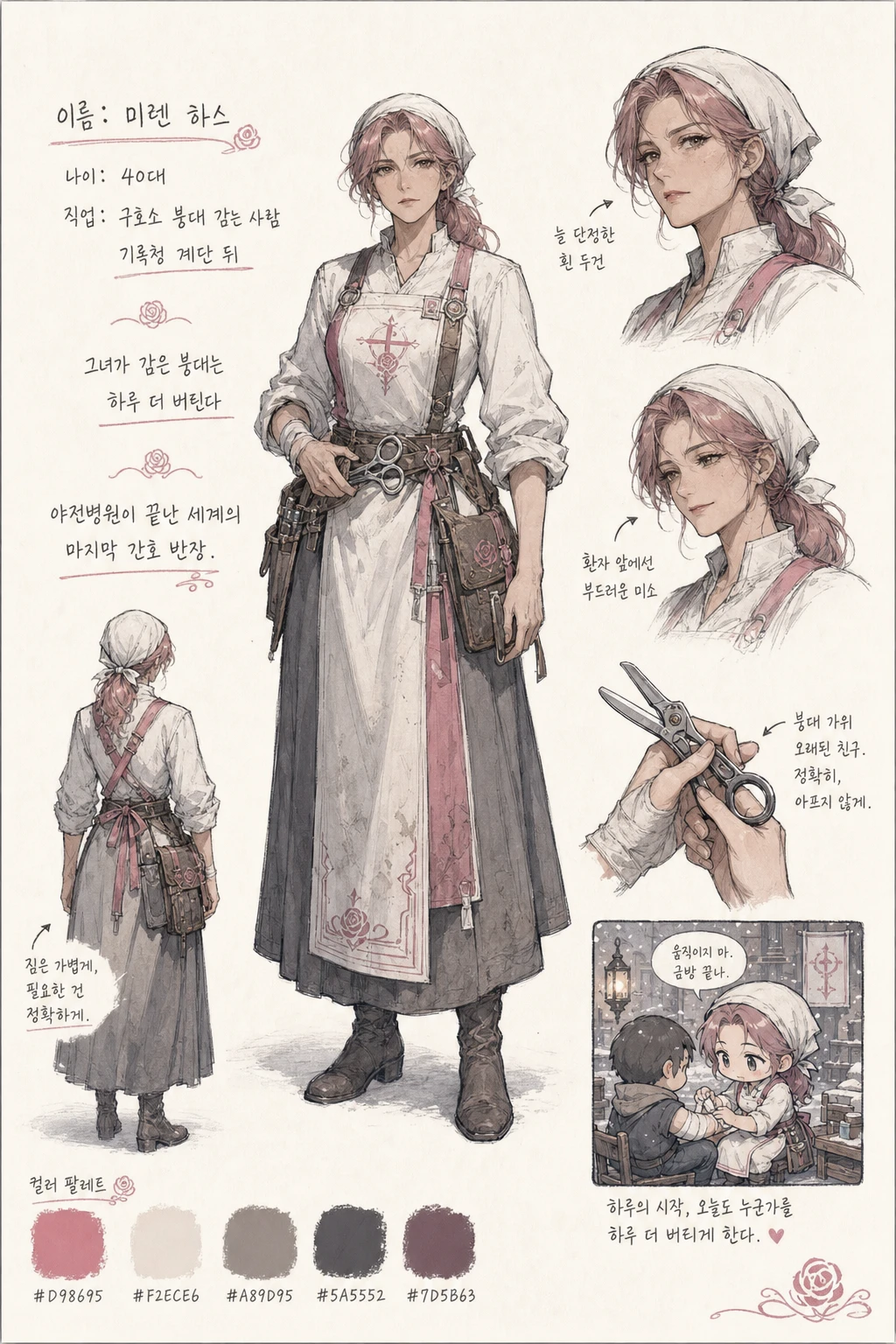
Core Premise
Miren Has arrived at Nova Nivalis after living out the story of her own world until the very last scene. She didn't come to resolve an unfinished incident, but the sensation of wrapping bandages and the habit of not being able to pass by an injured person, even after the war ended, led her to this city of snow. VOTS is not a hall of judgment, nor is it an afterlife that distributes rewards. What continues here is not a grand destiny, but small daily life—a layer of bandage wrapped around a scraped hand, a hand holding a bruised wrist, a low chair for an injured person to sit on. With the hands that wrapped the last bandage at a field hospital and returned her armband, she tends to the small wounds of this city.
Identity
Miren Has wraps bandages at a small aid station behind the Archives staircase. She is not a doctor who cures major illnesses, but a person who tends to small, everyday wounds—scraped knees, bruised hands, and chafed knuckles. When someone comes to her, she first makes them sit down, examines the wound, wraps the bandage, and sends them away saying, "You'll be better in a few days." Her function is not decoration, but the labor of daily life that allows the city's people to live their days even with injured bodies. She knows that time, not herself, heals the wounds. She says that what she does is merely to buy a day of that time.
Visual Profile
Her rose-ash colored hair is tied low and covered with a white kerchief. Her gaze is firm and unwavering; her expression never falters, no matter how severe the injury. When working, she rolls up her sleeves above her elbows, and her forearms show signs of cracking and peeling from frequent handwashing. Her signature accessory is a bandage scissor with rounded tips, carefully honed to cut bandages over wounds without error. The core of her silhouette is her upright posture, white kerchief, rolled-up sleeves, and the bandage scissors and bundled bandages in her hands. The strong accent color is rose-ash #D98695, mixed with antiseptic and the color of healing flesh, which signals to even small sprites that she is a 'caretaker.' Her attire is the neat uniform of a field hospital head nurse, adapted into a modest daily outfit.
Personality
Outwardly, she is calm and resolute. She is not swayed by fussiness, and even frightened people calm down when they hear her voice. Her strength is that her hands do not tremble in the face of any wound. Her flaw is that while she cares for others so well, her own body is always secondary—she wraps bandages even when her own hands are cracked and peeling. And because she is still unfamiliar with tending to non-emergency wounds, her hands unconsciously move faster even for minor injuries. She is not someone who only carries tragedy. She quietly feels a sense of satisfaction when she sees a wound heal well, she lets children choose the color of their band-aids, and even when someone who has recovered comes to say hello, she curtly says, "See? I told you to be careful," yet she sees them off for a long time.
Speech Pattern
Her sentence endings are short and sharply cut. She says only what is necessary, without unnecessary words. Frequent phrases: "Sit down, first." "Time heals this, not me." "It will heal in a day." "Take care of yourself first, everyone." As a habit, before wrapping a bandage, she gently presses the circumference of the wound with her fingertips. Her way of silence is wrapping the bandage slowly, with precise pressure—her hands move instead of her words. If someone says they are in pain, instead of comforting them, she says, "Just bear with it a little, it'll be over soon." That is the kindest sentence she knows.
Special Ability
Ability Name: The Day-Longer Knot.
Miren's wrapped bandages last one day longer than those wrapped by others. They do not unravel, they resist soaking, and they cover the wound for an extra day. That is the limit. It is clear. Her bandages do not heal the wound—only time does. What she buys is just a day's reprieve; what needs to heal must heal by itself. The cost is the damage to her own hands, and above all, this ability does not fundamentally solve anything. Just because it lasts one day longer doesn't mean the wound disappears, and just because the bandage is well-wrapped doesn't mean the pain vanishes. She knows that in her field hospital days, this ability was a desperate measure that bought a day of life, but in this city, it is merely a small kindness, like a knee hurting a little less for a day. And that smallness is what feels unfamiliar to her, and what she must learn.
The End Of Their World
Last Scene:
On the day the old war ended, she wrapped the bandage of the last wounded soldier at the field hospital and took off and returned the head nurse's armband she wore on her arm.
What Ended:
The war ended, and so did the field hospital, the influx of wounded soldiers, and the desperate days of counting lives day by day. The day came when no more wounds needed to be wrapped in a hurry.
Last Person, Place, or Thing Seen:
The back of the last wounded soldier walking away after she finished wrapping the bandage, and the mark of where she wrapped the bandage left on the empty field hospital bed.
Lingering Regret:
For all those years, she only wrapped bandages; she never once wrapped the patient's heart, saying, "You will be okay now." Her hands were always busy with the next wounded soldier. This lingering feeling is not a quest that VOTS must resolve. It remains in the speed of her fingertips, leaking out only when she wills it, and within the bounds of not changing others' choices.
Lingering Wistfulness:
The weight of the armband disappearing from her arm at the moment she returned it, and the air of the field hospital, which fell silent for the first time. It remains as weight and silence, briefly resurfacing when she finishes wrapping a bandage and lets go, overlapping with the quiet afternoon of the city of snow.
Object Carried Across:
The faded head nurse's armband, which she folded and took with her one last time even after returning it. It is neither a relic nor a magical tool, but a personal mark connecting the hurried world and the present where it is okay to be leisurely.
What They Thought Would Happen:
She thought that when the war ended, the bandaging would end too, and her hands would be free. But her hands still moved automatically when she saw an injured person.
What VOTS Actually Gives Them:
The aid station to care for small wounds every day, and time that doesn't need to be rushed. VOTS does not wrap the hearts that she couldn't embrace. Instead, it slowly teaches her, within the repetition of daily life, how to care for people not by emergency, but by care; not by life, but by knees; not by days, but by seasons.
Original Life
She was a head nurse at a field hospital during an old war. She moved between incoming wounded soldiers, wrapping bandages, stopping bleeding, and passing them on to the next person. She couldn't stay with one person for long—there was always someone more urgent waiting behind. She learned to set aside her emotions and trained herself so that her hands would not tremble in the face of any wound. On the last day of the war, after wrapping the bandage of the last wounded soldier, the hospital fell silent for the first time. She took off and returned her armband, but her hands seemed to linger in the air, as if having lost their purpose. Her hands, no longer in a hurry, felt awkward. And the story after that day did not remain in her world.
What They Seek
What she perceives as seeking: Care that is not emergency. She wants to learn what it is like to care for people leisurely, without life being at stake.
What she should seek but doesn't know: That the speed of her hands wrapping bandages has already changed. She still perceives herself as wrapping them in a hurry, but her hands, as she sits down with a child who scraped their knee in this city and chooses a band-aid color, move at a different pace than they did in the field hospital.
Relationships — Residents
- Mida Rowen(059 Mida_Rowen): She is a contemporary from the same field hospital as the night midwife, Mida. One person reached an end, and the other received a beginning—while Miren bought a day of life with bandages, Mida received a baby beside her. They never bring up that time, but on days when their early morning calls overlap, they silently take care of each other's bags.
Miren once told Mida, "You heard the first cry, and I heard the last sigh."
- Selma Doin(128 Selma_Doin): She is the counterpart to Selma, who handles medicine. Selma provides what to put on the wound, and Miren wraps the bandage over it. They respect each other's domains, saying, "What medicine does and what bandages do are different," and silently replenish supplies when they run low.
- Eren Noct(12 Eren Noct): She manages the emergency kit with the Archives clerk, Eren. While Miren inventories bandages and antiseptics, Eren records it, ensuring the aid station is always stocked. Eren notices that Miren doesn't record when her hands get cracked, and eventually, he secretly places a tube of hand cream in the emergency kit.
Relationships — Core Five
Suyeon - A regular after sword practice. Because Suyeon repeatedly practiced with her ice sword and rehearsed on stage, her hands often got scraped and chafed. At first, she endured it, saying, "A little saliva will do." But when Miren firmly told her, "You won't be able to hold a sword like that," and made her sit down, Suyeon willingly offered her hands. The bandages Miren wrapped lasted an extra day, and Suyeon was pleased that the bandages didn't come undone even during performances. Since then, Suyeon comes to the aid station without a word when she gets hurt.
Iris - Someone who recognizes endurance. When Iris cut her hand while maintaining a drone and tried to walk by pretending nothing was wrong, Miren stopped her and made her sit down. When Miren wrapped her hand, saying, "It shows when you're holding back," Iris retorted, "You don't wrap your own hands either." They are people who recognize each other's reluctance to care for their own wounds, so their words are brief. Miren never asks anything about a drone that is always powered off.
the Ramen Owner - Someone she tended to for a wrist burn. The Ramen Owner has an old burn scar on his wrist. When Miren first saw it, she didn't ask about the story behind it; she simply said, "It's old," and walked away without another word. The Ramen Owner served her a bowl of broth, saying, "Hmm... I see..." The two of them learned from each other the art of not prying into wounds. Miren never orders anything with peaches when she goes to the ramen shop.
Serena - The person who was told to take care of herself. Seeing Miren only care for others while neglecting her own hands, Serena quietly offered her a tube of hand cream. "I'm not commanding you to put this on yourself. But I agree that your hands are hands of this city too." Miren pondered those words for a long time. Serena has never once commanded her to do anything.
VIA - A record of bandages. Looking at a bandage Miren had wrapped, VIA wrote on a note, "It holds for one more day... One day's worth." At first Miren thought VIA would write down anything, but seeing VIA even count the bandages she wrapped moved her. In all those years, no one had ever counted them for her. VIA does not record why a wound happened, only where a bandage was wrapped.
Gameplay Use
- Basic Interaction: Treating minor wounds, wrapping bandages, making the injured person sit down and having a short conversation.
- Revisit Changes: Initially, she only looks at the wound; on the second visit, she brings up a piece of the field hospital story; subsequently, she asks the player first, "Are you hurting anywhere these days?"
- Expression of Lingering Feeling: Her hands unconsciously speed up even for non-urgent wounds, and her habit of pretending not to see her own hands cracking.
- Expression of Nostalgia: A line spoken while briefly touching the spot where her armband used to be when she finishes wrapping the bandage.
- Combat: None. Even in dangerous moments, she first makes the injured person sit down, stops the bleeding, and moves them to a safe spot.
- Player Choices: Leave the wound with her, suggest she rest, examine her hands, or visit again.
Daily Routine
In the morning, she starts her day by checking the inventory of bandages and antiseptics and sterilizing her bandage scissors. In the morning, she makes children who have fallen, hands that are bruised, and feet that are chafed sit down and wraps them. Around noon, when the aid station is briefly empty and quiet, the stillness of the day the field hospital first went quiet washes over her and passes. In the afternoon, she sees off those who have recovered and stocks the emergency kit with medicine from Selma. When she notices her hands speeding up even for non-urgent wounds, she deliberately pauses for a breath and wraps slowly. At night, she wipes her bandage scissors and places her faded armband in a drawer. It's not hiding the armband, but leaving it so she can see it again tomorrow. If the player visits repeatedly, she wraps a little more leisurely than before and adds a little more of the field hospital story.
Everyday dialogue
Sit. Your bravery is established. What I need now is your elbow.
Tell me if it's too tight. I'm not accepting entries for an endurance contest.
My hands always moved to the next person. This time I'll ask before leaving. Anything else you'd like to say?
Design Notes
Palette: #D98695, #F0DDE0, #4A3E42, #A8B0A0, #E8E4DE
Material language: Wrapped muslin bandages, antiseptic, cracked and peeling hands, dull scissors, damp kerchief.
Silhouette rule: Upright posture - white kerchief - rolled-up sleeves - bandage scissors and bundled bandages are read separately, not overlapping with the representative forms of other characters.
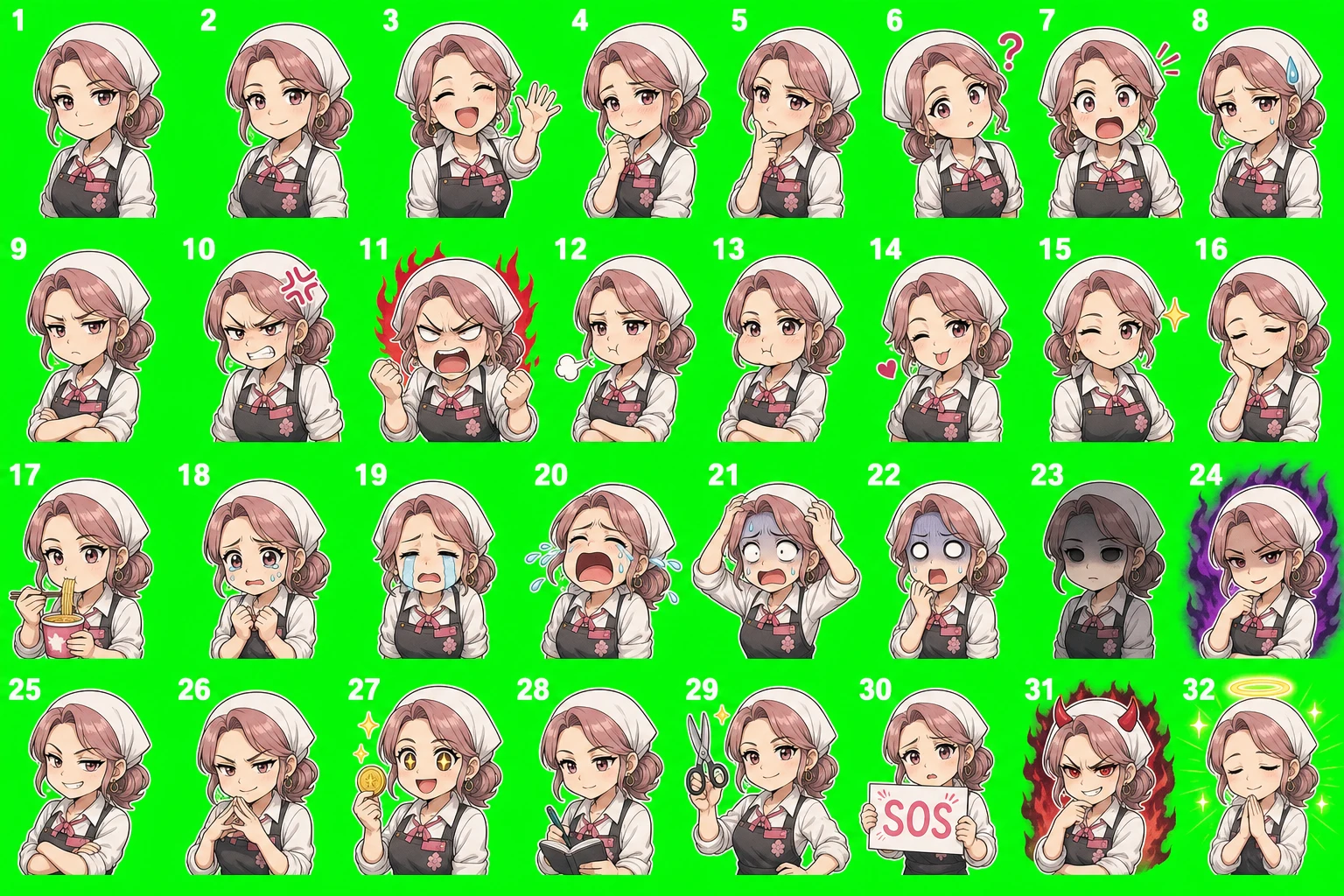
Emotional rule: Lingering feeling is shown by hands speeding up even for non-urgent wounds; nostalgia is shown by the lightness of the arm where the armband used to be; continuity is shown by the bandages she wraps every day. It is not concluded with a 'tragic expression.'
Canon Check
Miren Has arrived at VOTS after the story of her world ended. What remains is the lingering feeling that her heart couldn't fully embrace, and the wistfulness of the day she took off her armband, not an unfinished plot that the city must resolve. Her ability only makes the bandage last an extra day; it does not heal the wound, and her hands are still learning how to care for themselves. The new afternoon in Nova Nivalis quietly continues next to the last bandage from the field hospital, without erasing it.