RESIDENT 044
Ove Rendt
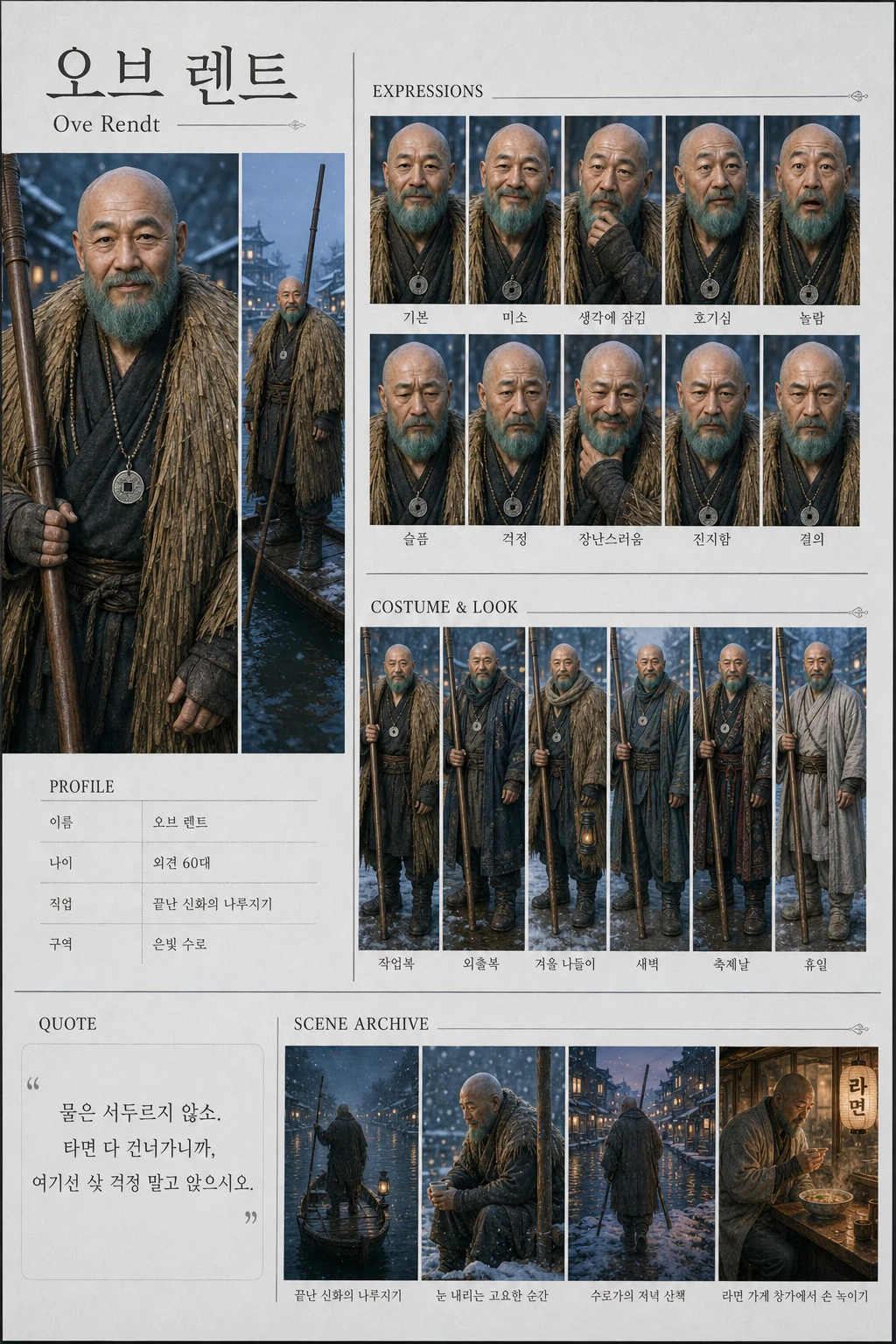
Ferryman of the Waterway (Boatman of a Finished Myth) · Silver Canal · Appears to be in his 60s
Complete profile · All sections open
Download English profile (.txt)Archived source profile (Korean)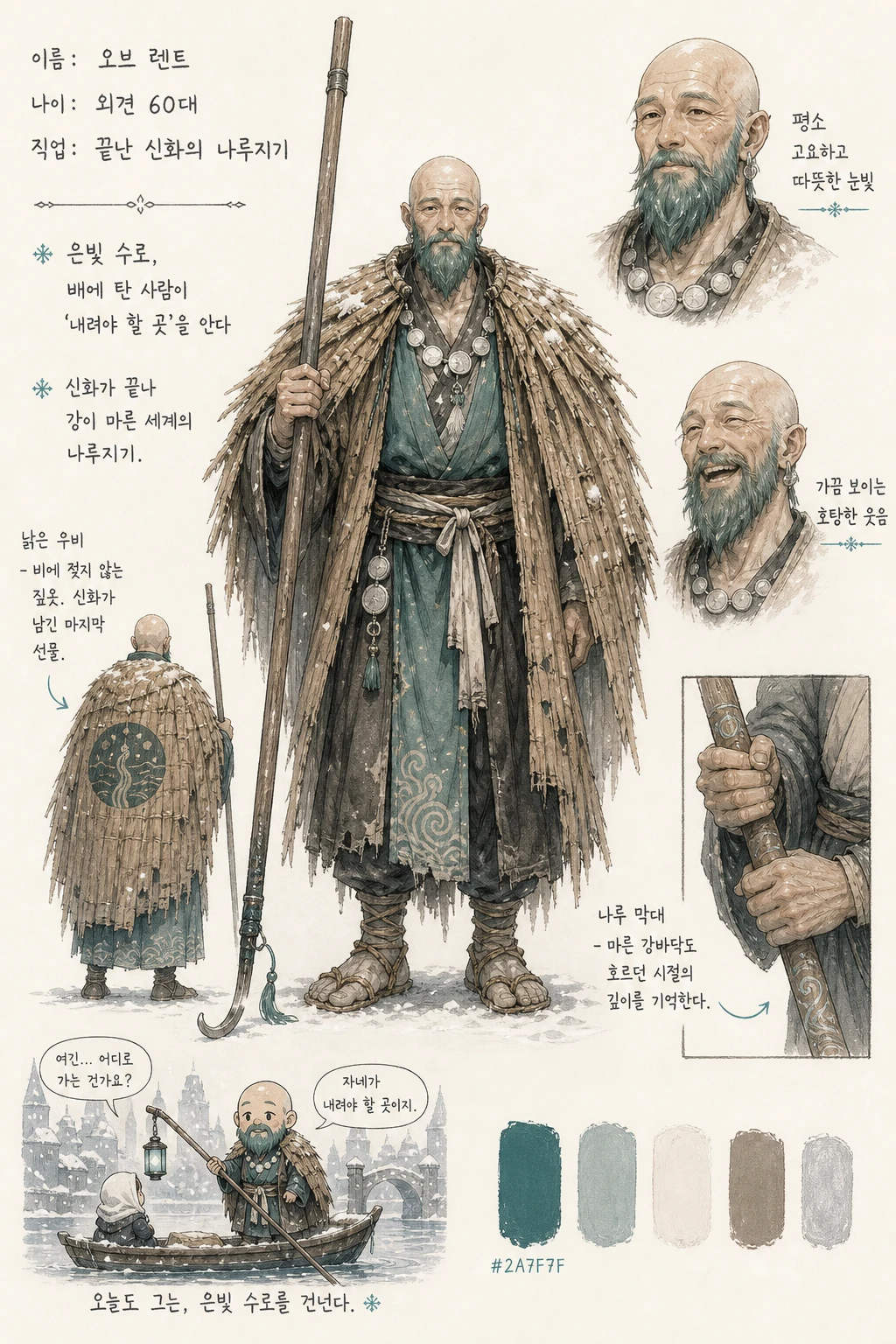

Core Premise
Ove Rendt came to Nova Nivalis after the story of his own world ended. As the myth he belonged to concluded, the river dried up, and the river that carried people, and the river that carried them, vanished. He did not come to refill the dried river, but the rhythm of the hands that carried people and the rhythm of pushing the boat remained in him and flowed into the canals of this city. Nova Nivalis is neither the river of the underworld nor a crossing point of judgment. What continues here is not the final crossing, but the repetition of quiet labor: carrying people across the narrow waterways, pushing the punting pole, and watching the tide.
Identity
He is a boatman who rows a small ferry on the Silver Canal. In seasons when the waterway is not frozen, he uses a boat; when it is frozen, he uses a pushing staff instead of his punting pole. He carries people across to the other side—those who are not in a hurry, elderly people who have difficulty walking, and merchants with heavy loads. His job is the essential labor of movement that the city actually needs. He does not flaunt that he was a boatman of a myth, and apart from trying not to accept fares, he lives no differently from any other boatman.
Visual Profile
His hair is shaved, and the beard covering his chin and cheeks is a turquoise color like aquatic weeds. That mossy color tells of how long he has been by the water. His eyes are a hazy turquoise, close to the color of water. Around his neck hangs a necklace with an old silver coin, which is his former fare. He wears an old oilskin coat that does not get wet; even when rained on, the water beads and runs off. His signature prop is a punting pole longer than his height. The core of his silhouette is the long punting pole, the silhouette of the oilskin coat, and the silver coin swaying in his chest. The accent color is the turquoise of wet aquatic weeds, #2A7F7F, which lets people know from afar that he is a man of the water.
Personality
He is leisurely and rarely speaks. Even if a hurried customer urges him, he simply pushes the punting pole to the rhythm of the current. Having carried people for a long time, he does not look surprised or pry into whatever stories they tell on the boat. His awkwardness lies in feeling uncomfortable accepting fares. When money is offered, he rows, yet he never removes the silver coin necklace, knowing the contradiction himself. He is not steeped in tragedy. He makes children laugh with sounds mimicking water birds and sometimes plays with the water using his punting pole.
Speech Pattern
His voice is low and slow, like a ripple. "Get on." "Shall you disembark here?" "It is fine to go slowly." He mixes polite language with archaic speech, and his sentences are not long. His frequent phrases are, "The water does not rush," "The boat knows where to land," "The fare is unnecessary," and "If you ride, you will cross." When silent, he gauges the depth by tapping the water bottom with his punting pole, or rubs the silver coin with his thumb. He does not speak of the dried river, nor does he utter the word myth.
Special Ability
The name of his ability is 'The Landing.' He knows where a person on his boat truly 'needs to land' by the weight of the current. People go to the destination they stated, but there are times when what he feels is different from their stated landing spot. His limit is cautious. He does not force it; he only quietly mentions it when it differs from the destination. If the customer still wishes to disembark at their original destination, he lets them off as is. The cost is himself. He knows everyone else's landing spot, but he does not know where to put his punting pole himself. The ability does not reverse any conclusion. The dried river does not flow again; he merely ferries people across these narrow waterways.
The End Of Their World
Last Scene:
On the last day when the river visibly receded as the myth ended, he dropped off his final customer on the other side. Then, returning with an empty boat, he stuck his punting pole deep into the riverbed so it wouldn't be pulled out and sat by the water.
What Ended:
The entire myth he belonged to ended. The river he rowed dried up, the footsteps of the people crossing ceased, and the custom of counting fares ended with it.
Last Person, Place, or Thing Seen:
The silhouette of the last customer receding over the diminishing current, and the shadow of his own punting pole standing alone on the riverbed.
Lingering Regret:
Even for the last customer, he habitually accepted the coin. He could have taken that passenger across for free, but he didn't, and this still bothers him now that the river is dry. This lingering attachment remains not as a quest to be resolved, but as the contradiction of refusing fares while being unable to untie the silver coin necklace.
Lingering Wistfulness:
The sensation of the punting pole gently sinking into the muddy bottom of the water, and the low sound of the boat gliding as it cuts through the current. When that sensation comes, for a moment, the width of the old, vast river overlaps.
Object Carried Across:
A single silver coin around his neck. It is the fare received from the last customer, and the knot he has yet to untie.
What They Thought Would Happen:
He thought he would end along with the river when it dried up. He believed that a ferryman had nothing left if there was no river.
What VOTS Actually Gives Them:
A narrow but unfrozen waterway, and people he can carry even without receiving a fare. The city does not return the dried river. Instead, it gives him the waterway to hold his punting pole again, and passengers who offer greetings instead of fares.
Original Life
Ove Rendt was a ferryman on a mythical river. On a river that divided one side from the other, he carried people across for a fare. When the myth reached its conclusion and the river began to dry up, the people needing to cross gradually dwindled. On the last day, he dropped off his final customer on the other side and returned with an empty boat. He stuck his punting pole into the riverbed and sat by the dried river, watching the water completely disappear. That was his last crossing in that myth.
What They Seek
On the surface, he seeks the joy of carrying people without a fee. He wants to do the work of the boatman satisfied only by the act of delivering, without counting fares. However, on a level he does not know, what he must learn is that he can take off the silver coin necklace around his neck. That he is still a boatman even if he lets go of the last fare—he has not yet accepted this, and his lingering attachment is shown only by the hand that rubs the coin.
Relationships — Residents
- Solenne Vey (batch1, Night Laundry Shop·Silver Canal): A nightly neighbor on the waterway. When Solenne sends laundry across on his boat, Ove uses his boat, and Ove receives a basin of warm water instead of a fare late at night to warm his hands. The two of them, being in a state of traveling through the night with the water, silently check each other's lights.
- Pet Janson (045, Ice Fisherman): A boatman and a fisherman using the same waterway. They sometimes bicker because Pet's spot for drilling ice holes overlaps with where Ove docks his boat, but Ove subtly points out where the fish bite well, and Pet leaves one of the fish caught that day on the edge of the boat.
- Gondo Rif (068, Waterworks·Hot Water Meter Reader): They exchange consultations about the water routes. Gondo borrows Ove's sense when inspecting the water level and flow of the waterway, and Ove informs Gondo about changes in the current in certain sections. They are two people who read the water in their own ways.
Relationships — Core Five
Suyeon - Someone he watched an ice-plate contest with on the waterway. When Suyeon competed with Pet on the ice plate, Ove sat by the boat, acting as a judge, though not officially. When Suyeon said, "Uncle judges it," he laughed and replied, "The water does not count winners or losers." Suyeon found that answer both irritating and pleasing, and whether they won or lost, they rode around the boat once.
Iris - Someone who kept silent on the boat. When Iris boarded the boat with a drone cradled on her lap, Ove realized it was a drone that wouldn't turn on, but he asked nothing. He said, "The boat knows where to land," and simply rowed. When Iris asked, "Why doesn't this boat take a fare?" Ove only replied, "Because I haven't found a reason to yet." Iris did not act cynical on that boat, and on quiet nights, she often rode around without any destination.
the Ramen Owner - Someone who refuses fares for each other. When the owner sends ingredients across, and Ove offers a fare, he rows, and instead, the owner brings him hot broth to his spot by the water in the evening. The owner glances at the silver coin necklace, saying, "Hmm... I see..." but says nothing, and Ove does not respond to that gaze.
Serena - A regular who greets him on every waterway walk. Every time Serena passes while walking the morning waterway, she nods to Ove, and Ove responds by raising his punting pole. Once, when Serena boarded the boat, Ove cautiously mentioned, "It doesn't seem like the City Hall is the landing spot," but Serena smiled and said, "Still, I'll get off at City Hall. Thank you for letting me know." He did not force it, and Serena chose to disembark on her own.
VIA - A passenger who pays with records instead of fares. When VIA boards the boat, she offers a note instead of a coin, which contains records such as, "The current today is slow... it is slow." Ove puts that note in the fare box, and every time VIA looks at Ove's silver coin necklace, she only writes, "That is still a knot... it is a knot," and never tells him to untie it.
Gameplay Use
- Basic Interaction: Waterway crossing service, short conversations on the boat.
- Revisit Change: As the player carries more people, he occasionally offers a 'Landing' comment, but lets them disembark where they wish. He does not decide the destination for them.
- Expression of Lingering Attachment: The habit of rubbing the silver coin necklace while refusing fares, the silence that swallows up stories of the dried river.
- Expression of Poignancy: The sensation of the punting pole sinking into the water bottom, sensory dialogue about cutting through the current.
- Relationship Reward: Not new items, but the connection of carrying a resident who has difficulty walking to someone on the other side.
- Combat: None. Even in a crisis, he chooses to carry people to a safe place on the other side.
Daily Routine
In the morning, he checks if the boat froze overnight or if the punting pole cracked. This check is not a compulsion but a small ritual separating the dried old river from today's waterway. During the day, he ferries people back and forth. Around noon, when the light spreads widest over the waterway and the current sparkles, his poignancy rises briefly. At night, he sits by the water, rubbing the silver coin with his thumb, and then puts it back on his neck. For players who visit repeatedly, his mimicry of water birds gradually increases, and the time he spends touching the coin gradually decreases. Even if they become quite close, he does not offer the journey back to the dried river as a reward.
Everyday dialogue
Step aboard. The boat rocking is normal. Worry when I start rocking.
Can we go faster? I'll send the river a stern letter. Its replies tend to be slow.
I held out my hand to the last passenger too. Not the one holding the oar. The one collecting the fare.
Design Notes
Palette: #2A7F7F, #7FBFBF, #1E4A4A, #D9CBB0, #8A6E4B
Material language: Waterproof oilskin coat, long wooden punting pole, old silver coin, water-stained boat edge, aquatic weeds.
Silhouette rule: The head-oilskin coat-long punting pole-chest coin must be read as separate elements, and must not overlap with the silhouettes of other water residents (Solenne, Pet).
Emotional rule: Lingering attachment is shown through the hand rubbing the coin and the habit of refusing fares; poignancy is shown through the sound of the current and the feel of the punting pole; continuation is shown through the daily labor of crossing.
Canon Check
Ove Rendt arrived in VOTS after his myth ended and the river dried up. What remains is lingering attachment and poignancy, not a river that VOTS must refill for him. The city does not return the dried river, and his ability does not decide the passengers for him. The new scene continues from the narrow waterway, punting with the pole, not erasing the finished crossing.