RESIDENT 024
Pino Galda
Bird Feed Vendor · Snowflake Market · 60s
Complete profile · All sections open
Download English profile (.txt)Archived source profile (Korean)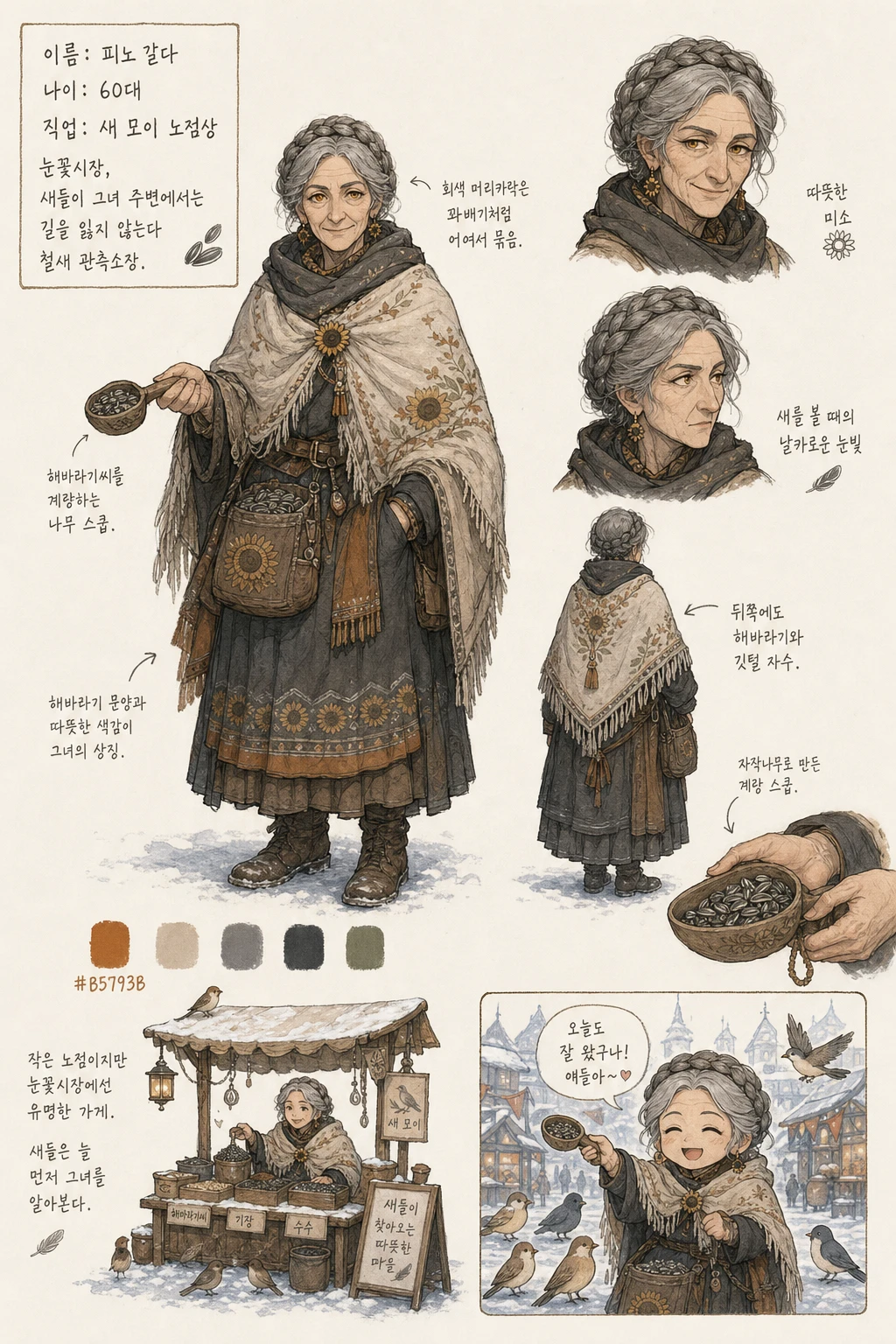
Core Premise
Pino Galda lived out the story of his own world until the very last scene before coming to Nova Nivalis. He did not come to call back the birds that left; rather, the habit of counting and the heart of waiting, which remained even after the end, led him to this city of snow. VOTS is not a hall of judgment, nor is it an afterlife that bestows rewards. What continues here is not a grand destiny, but a handful of sunflower seeds in a bowl, a few sparrows landing on his stall, a small confirmation that the records of the remaining ones are not in vain—a life like that.
Identity
Pino Galda is a street vendor selling bird feed in the Snowflake Market. He sells sunflower seeds, millet, and dried berries in a bowl, and even if no one comes to buy, he scatters a little in front of his stall. Strangely, birds never get lost around his stall. There are days when there are more birds than customers. His function is the labor of life that adds sound and wingbeats to the market mornings. He does not own the birds; he feeds them and lets them go, and when they return, he feeds them again.
Visual Profile
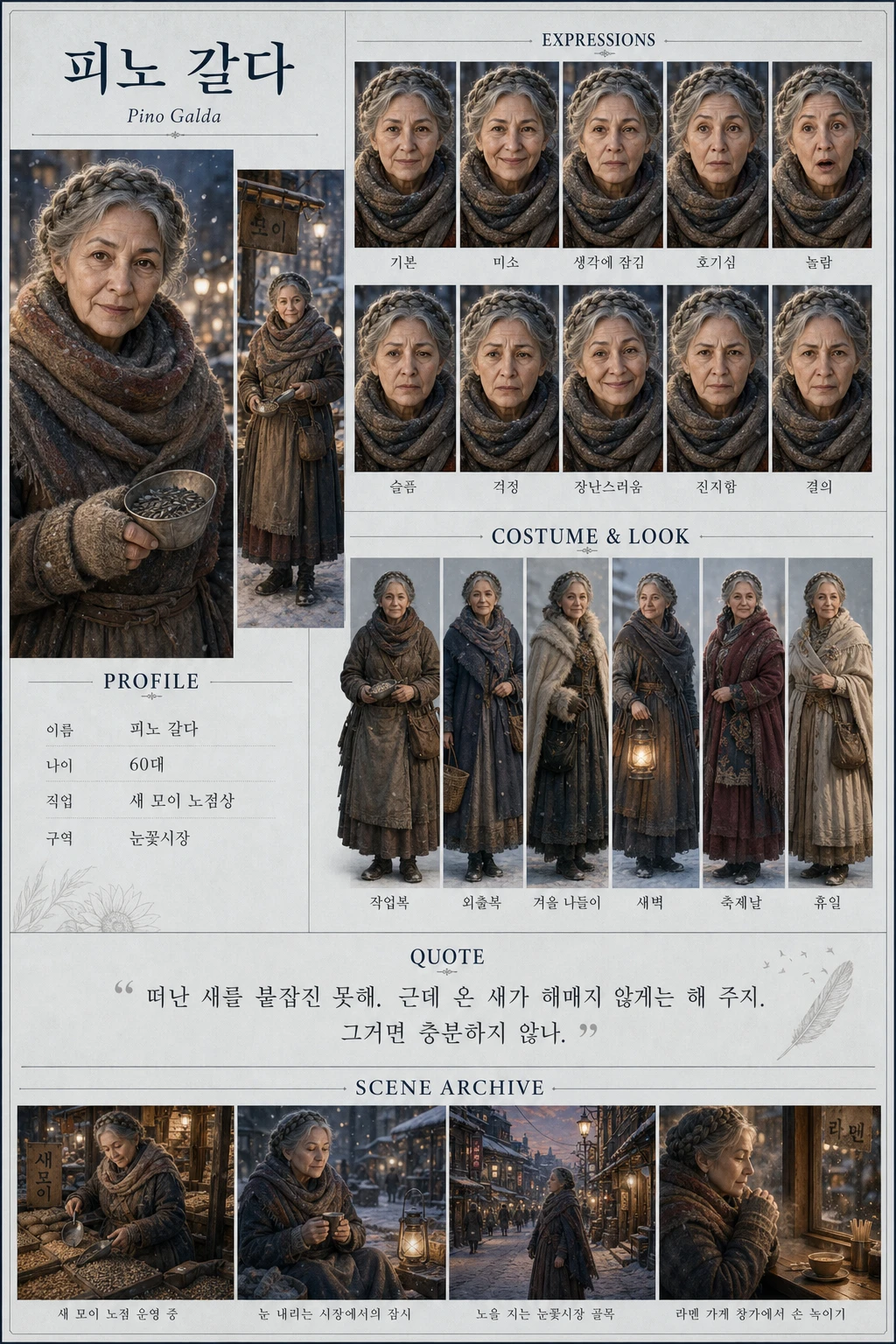
He has gray hair braided up like a crown, and possesses a hooked nose and deep amber eyes. A shawl is wrapped around his shoulders in multiple layers, like layers of tree rings. His signature prop is a brass bowl of sunflower seeds—one that is polished smooth from long use. The core of his silhouette is the crown braid, the layers of the shawl, the bowl held in one hand, and the birds on his shoulders and stall. The strong accent color is a tawny brown, like seed husks (#B5793B), which lends a warm glow amidst his gray appearance. His attire is a remnant of his thick winter coat from his time as an observatory director, divided into a shawl and an apron.
Personality
On the surface, he is indifferent and generous. He gives an extra handful to the birds and to people, and counts change carelessly. His strength is his ability to wait a long time—he never packs up his stall even on days when no birds come. His flaw is that he is directionally challenged. While he helps the birds not get lost, he himself gets confused in the market alleys, sticking only to the paths he usually takes. However, he is not someone who is always downcast. He starts his mornings by enjoying the fun of counting bird footprints, enjoys hearing boasts about others' grandchildren, and briefly clears his stall when he smells fish-shaped bread.
Speech Pattern
His speech is slow and drawn out. He uses endings like "-ji," "-ryeona," and "-gumeon." Frequent phrases include: "I'll give you an extra handful." "The birds don't get lost. I don't lose them." "The ones that left, they'll eat somewhere, right?" "How many might have come today?" As a habit, he shakes his bowl once to make the sound of seeds before speaking. His way of being silent is gazing at the sky until all the birds have flown away. If someone mourns those who have left, he says, "What's gone isn't forgotten."
Special Ability
Ability Name: No-Lost Roost.
Around his stall, birds never get lost. Even in a blizzard, they land precisely toward the sound of his bowl, and migratory birds who have lost their way rest at his spot for a night. The limit is very clear. This ability only works on the birds; he himself is terribly lost. If he steps ten paces away from his stall, he gets confused in the alley. It is not a cost, but ironically, while he guides others' paths, he cannot find his own. This ability cannot hold onto departed birds or bring them back. It only ensures that all the birds do not wander; coming and going is up to the birds. This is why the ability does not solve the problem.
The End Of Their World
Last Scene:
He recorded until the end from the observatory window as the last flock of migratory birds departed south, wrote the final number, and closed the observatory door.
What Ended:
The sky path where the migratory birds used to pass closed entirely. The observatory had no more flocks to count.
Last Person, Place, or Thing Seen:
The silhouette, like a dot, as the last flock disappeared below the horizon, and the number written in the last square of the observatory logbook.
Lingering Regret:
He wrote down the number without loudly saying "Goodbye" to the departing flock. This regret is not a quest to be resolved. It remains in the habit of shaking his bowl only when he wishes, within the limit of not changing others' choices.
Lingering Wistfulness:
The sound of the wind and the scent of feathers when the flocks of migratory birds flew up all at once. It briefly revives when the birds gather and fly from his stall, only to blend with the sounds of the market morning.
Object Carried Across:
A logbook containing the count of the last flock. It is neither a relic nor a magical tool, but a personal mark connecting the ended world and the current stall.
What They Thought Would Happen:
He thought that when all the birds left, the counting would also end. But in the city of snow, there were birds that remained even in winter.
What VOTS Actually Gives Them:
A stall to feed and count birds every day, and mornings when those birds come without wandering. VOTS does not return the departed flocks. Instead, it shows that the records of the remaining ones are not in vain, through the act of counting how many come each morning.
Original Life
He was the director of a migratory bird observatory. Sitting by the window, he counted the passing flocks and recorded the direction, date, and number in a logbook. He worried when the birds were late, and his hands were busy when the flocks were large. In the last season as the world faded, the sky paths closed one by one, and the flocks dwindled. On the day the last flock departed south, he counted until the end and wrote the number, closing the logbook knowing it would be the final record. Then, he locked the observatory door.
What They Seek
What he believes he is seeking: Confirmation that the records of the remaining ones are not in vain, by watching those who leave. He wants to convince himself that counting is a way to endure parting.
What he actually needs to find but doesn't know: That those who left remember him. He always thinks he is only remembering the birds, but the migratory birds that wander and descend toward the sound of his bowl do so because they remember him.
Relationships — Residents
- Tessa Wren(Tessa_Wren): A neighbor who trades seeds. The dried flower seeds Tessa sells overlap with the types of bird feed Pino sells, so they borrow and exchange goods. If birds make a mess up to Tessa's seed stall, Pino shakes his bowl to bring them back.
- Noa Kiln(040 Noa_Kiln): A young man who cares for the clock tower pigeons. While Noa cleans the bells, pigeons come to his stall to eat. Pino teases Noa, saying, "How can you not know the birds' hearts when you know the ten seconds before the bell rings?"
Relationships — Core Five
Suyeon - The warrior who wrestles with birds. A commotion occurred when birds carried away seeds scattered during Suyeon's performance practice right up to the stage. Pino shook his bowl to gather the birds back to his stall and said, "These aren't your side or my side; they're the food side." Since then, Suyeon does not practice near the seeds.
Iris - Sharing the sky with drones and birds. When Iris's drone circles its trajectory, the birds are briefly startled and scatter, but they settle back down at the sound of Pino's bowl. When Iris says, "Your birds are blocking my drone's path," Pino only replies, "The sky is wide." Pino noticed that a deactivated drone wouldn't scare the birds, but he didn't say anything.
the Ramen Owner - The exchange of morning broth and seeds. On cold mornings, the Ramen Owner sends a bowl of hot broth to the stall, and Pino repays the favor by filling his bowl with seeds (for the sparrows on the ramen shop's eaves). The Ramen Owner just writes the number of sparrows in the corner of his ledger, saying, "Hmm... I see..." without asking why.
Serena - The one who knows why birds perch on her shoulder. Birds often land on the shoulders of Serena's white long coat. People find it strange, but Pino knows—it's because Serena doesn't call the birds; she just stays still. Pino said, "It's a shoulder that doesn't give orders, so the birds perch," and Serena left after discussing the seed price with a smile.
VIA - A companion for recording footprints. When VIA tried to count and record the bird footprints in the snow in front of the stall, Pino briefly held the birds with his bowl to help keep the footprints from being erased. VIA wrote, "The footprints remain... they remain." Pino has also shown VIA the old numbers in his logbook.
Gameplay Use
- Basic Interaction: Buying bird feed, watching birds, short daily conversations about how many came today.
- Revisit Changes: Initially, he only sells feed, but on the second visit, he shares a piece of the observatory story, and subsequently, he asks the player first what birds they saw.
- Expressing Lingering Feelings: A habit of only shaking his bowl while swallowing "Goodbye" when the flock flies away, and a brief pause while looking at the sky.
- Expressing Poignancy: A line that sounds like smelling old feather scent when the birds gather and fly away.
- Combat: None. Even in dangerous moments, he calls the birds to guide the way or creates direction with the sound of his bowl.
- Player Choice: Scattering feed, waiting for birds to land, counting footprints together, coming back again.
Daily Routine
In the morning, he checks his brass bowl and the leftover seeds from the previous day, scattering a handful in front of his stall to call the first birds. Counting how many come is the ritual that opens his day. In the morning, he sells feed to the market people, and around noon, when the Snowflake Market is most crowded with people and birds, the sound of wingbeats from the old observatory briefly overlaps and passes by. In the afternoon, when the birds become sparse, he records the day's count in his logbook. At night, he packs up his stall and returns only to the path he always took to his home, which is only ten paces away (a way of trying not to get lost). If you visit him repeatedly, he gives an extra handful of seeds and shares a little bit of the observatory story.
Everyday dialogue
Watch that plump one. It's come by looking like it missed breakfast three times already.
Have another handful. Your small hands are a problem for my business, not for the birds.
Today I said goodbye before writing down the numbers. My voice cracked a little.
Design Notes
Palette: #B5793B, #6B6258, #C9B79C, #E8DFCB, #4A4038
Material language: Brass bowl, dried seeds, layered worn shawl, winter coat, footprints in the snow.
Silhouette rule: Crown braid - layered shawl - bowl - birds on shoulders are read separately and do not overlap with the representative forms of other characters.
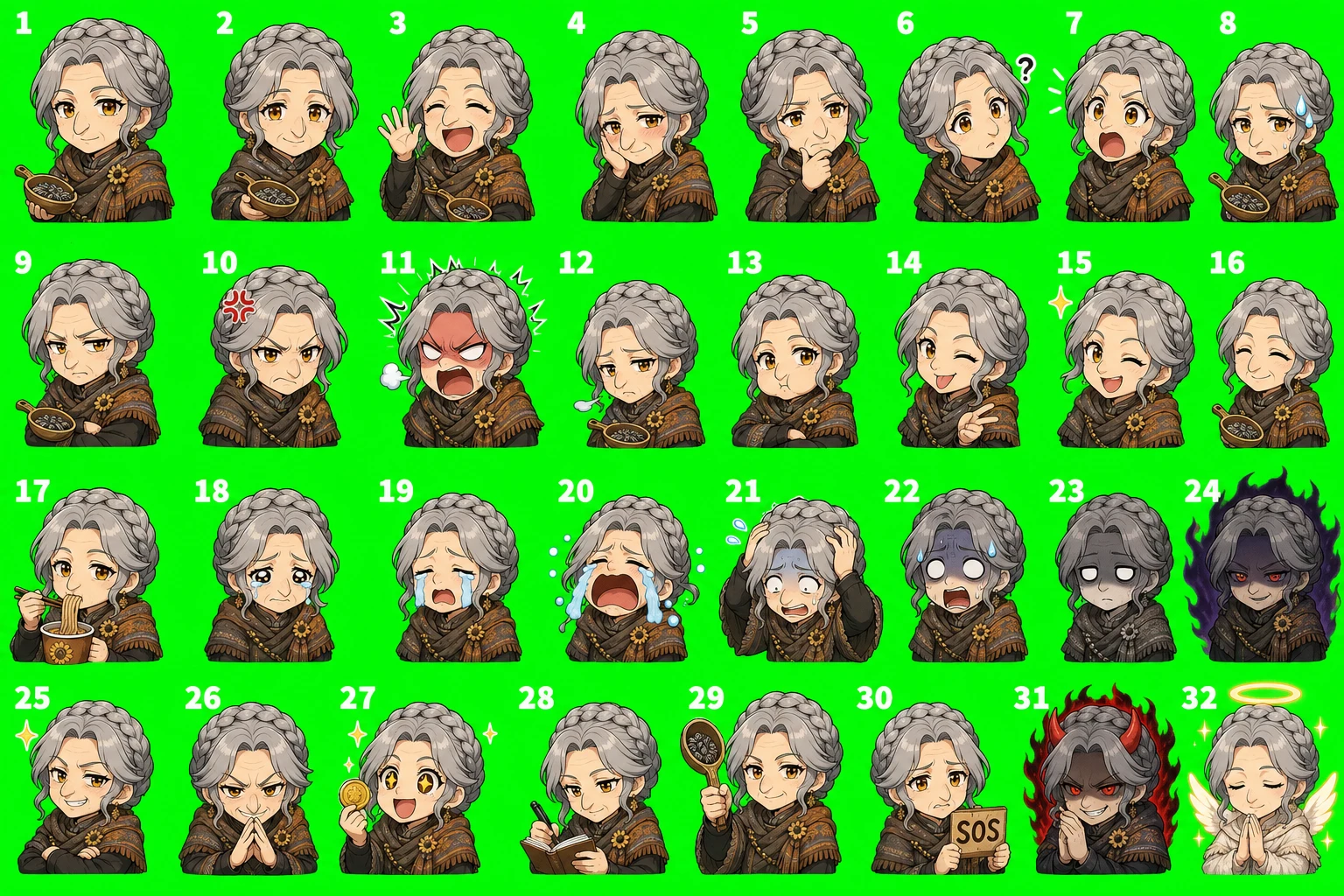
Emotional rule: Lingering feelings are shown by shaking the bowl while swallowing "Goodbye," poignancy by the sound and scent of the flock's wingbeats, and continuity by the daily count of birds.
Canon Check
Pino Galda arrived in VOTS after the story of his own world ended. What remains is the regret of unsaid farewells and the poignancy of flock wingbeats, not an unfinished plot that the city must resolve. His ability only ensures that all the birds do not wander; it cannot call back the departed birds, and he himself is lost. The bird mornings in Nova Nivalis continue alongside the day the last flock left, without erasing it.