RESIDENT 023
Duvan Karo
Snowman Sculptor · Rainshield Square · 30s
Complete profile · All sections open
Download English profile (.txt)Archived source profile (Korean)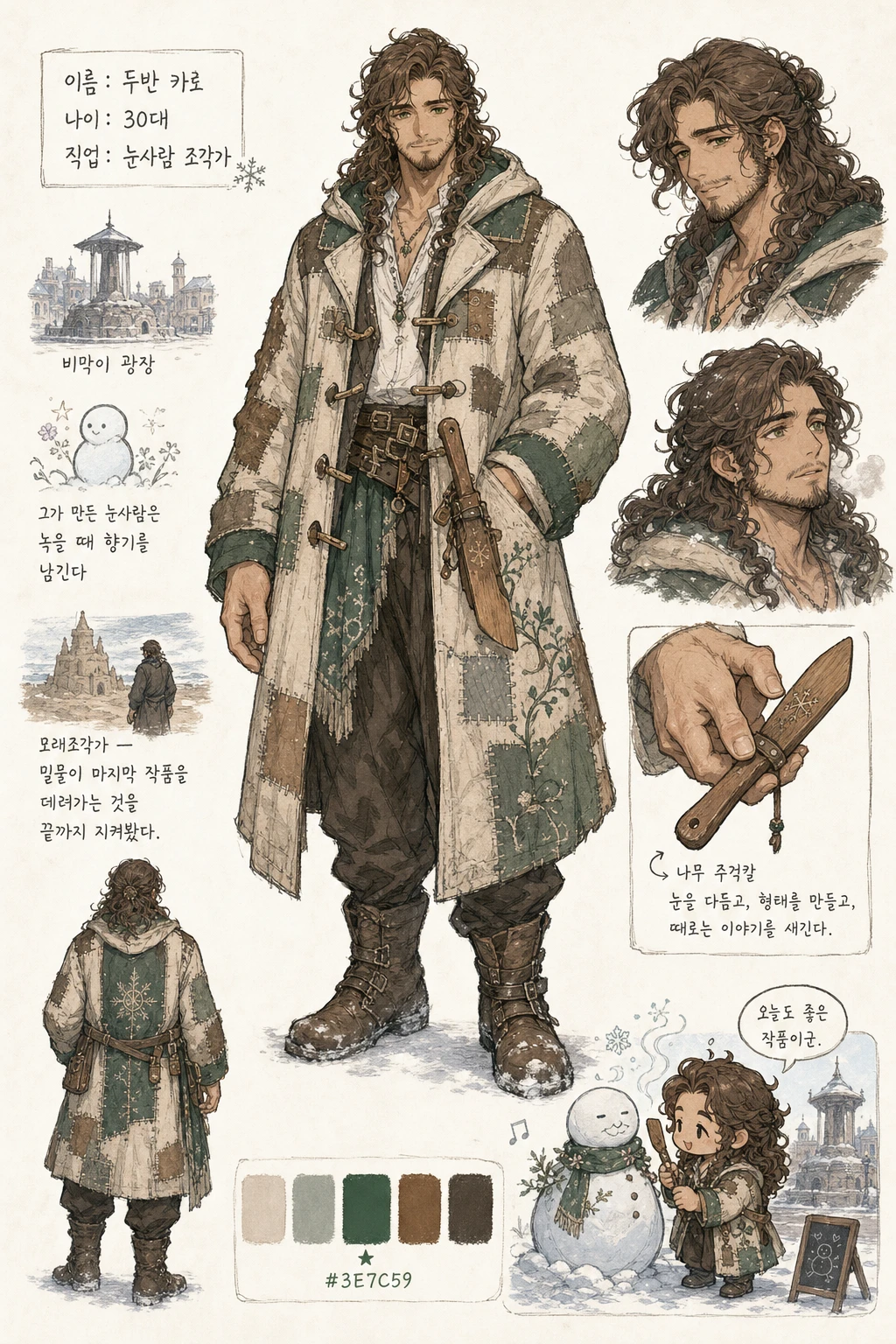
Core Premise
Duvan Karo came to Nova Nivalis after living out the story of his own world until the very last scene. He didn't come to retrieve a lost work, but the habit of creating and the feeling of watching that remained with him even after it ended led him to this city of snow. VOTS is not a hall of judgment, nor is it an afterlife that bestows awards. What continues here is not a grand destiny, but small life—sculpting a single snowman, watching it melt in the afternoon, or someone noticing the lingering scent in the evening.
Identity
Duvan Karo is a sculptor who carves snowmen in Rainshield Square. From those the size of a child to those that two adults must hold, he gathers and carves snow to create the day's work. They melt within a few days. He creates them with care even knowing they will melt, and he watches the melting until the very end. His function is the manual labor of erecting temporary forms in the square. People take pictures of his snowmen, eat lunch beside them, and smell the faint scent left behind after they melt.
Visual Profile
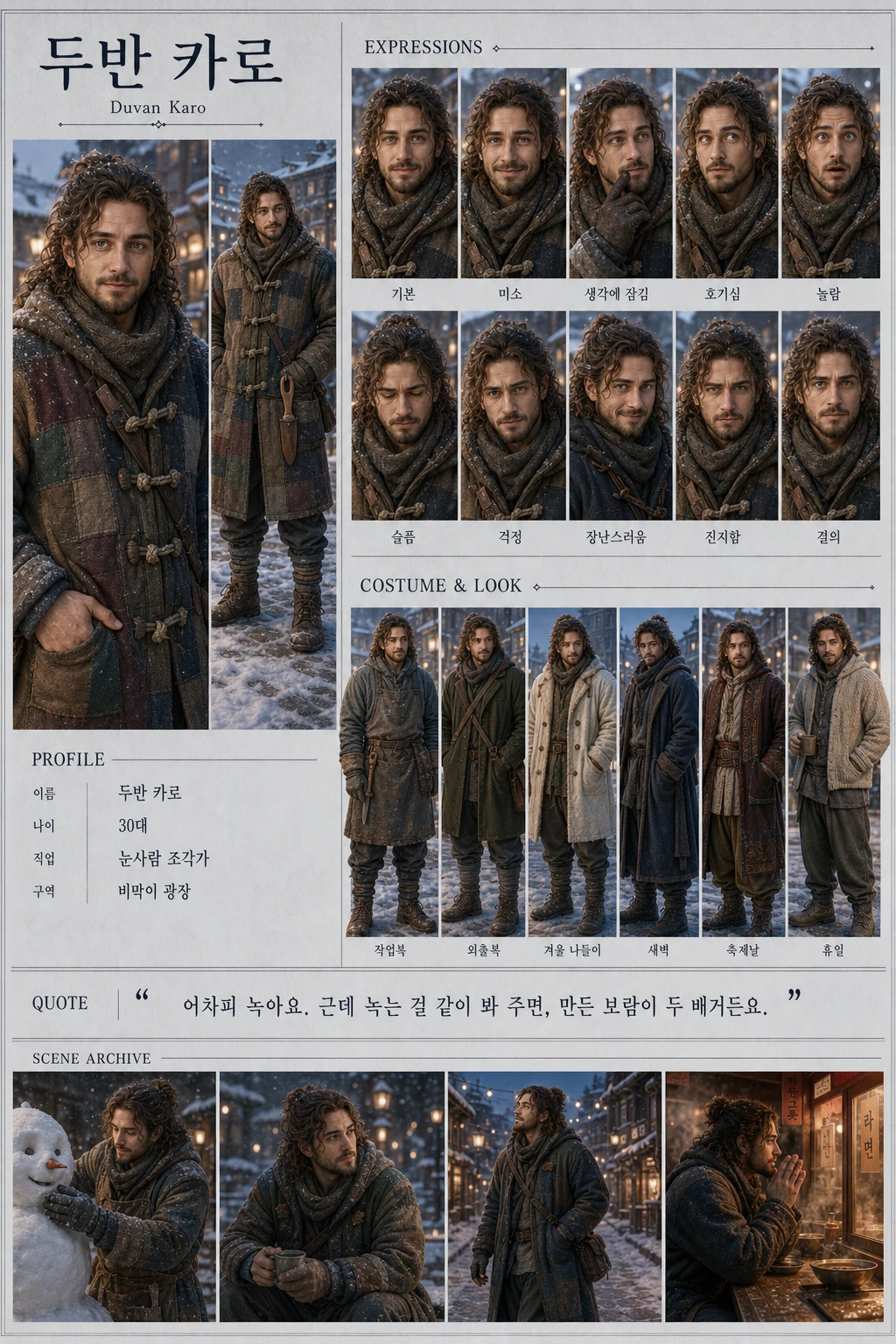
He has long, dark brown curly hair tied back halfway, clear green eyes, and unusually large hands. His patchwork duffel coat is made of pieced-together scraps of various colors, making it a mark upon the snowfield itself. His signature prop is a wooden spatula knife—a well-worn tool for carving and shaping snow. The core of his silhouette is the half-tied curly hair, the large, open hands, the wooden spatula knife in his hands, and the snow mound at his feet. The strong accent color is mossy green #3E7C59, which allows him to be found even in the snowfield and gives him the impression of 'the person who makes things disappear.' His attire features the loose sleeves from his days as a sand sculptor, adapted into winter wear.
Personality
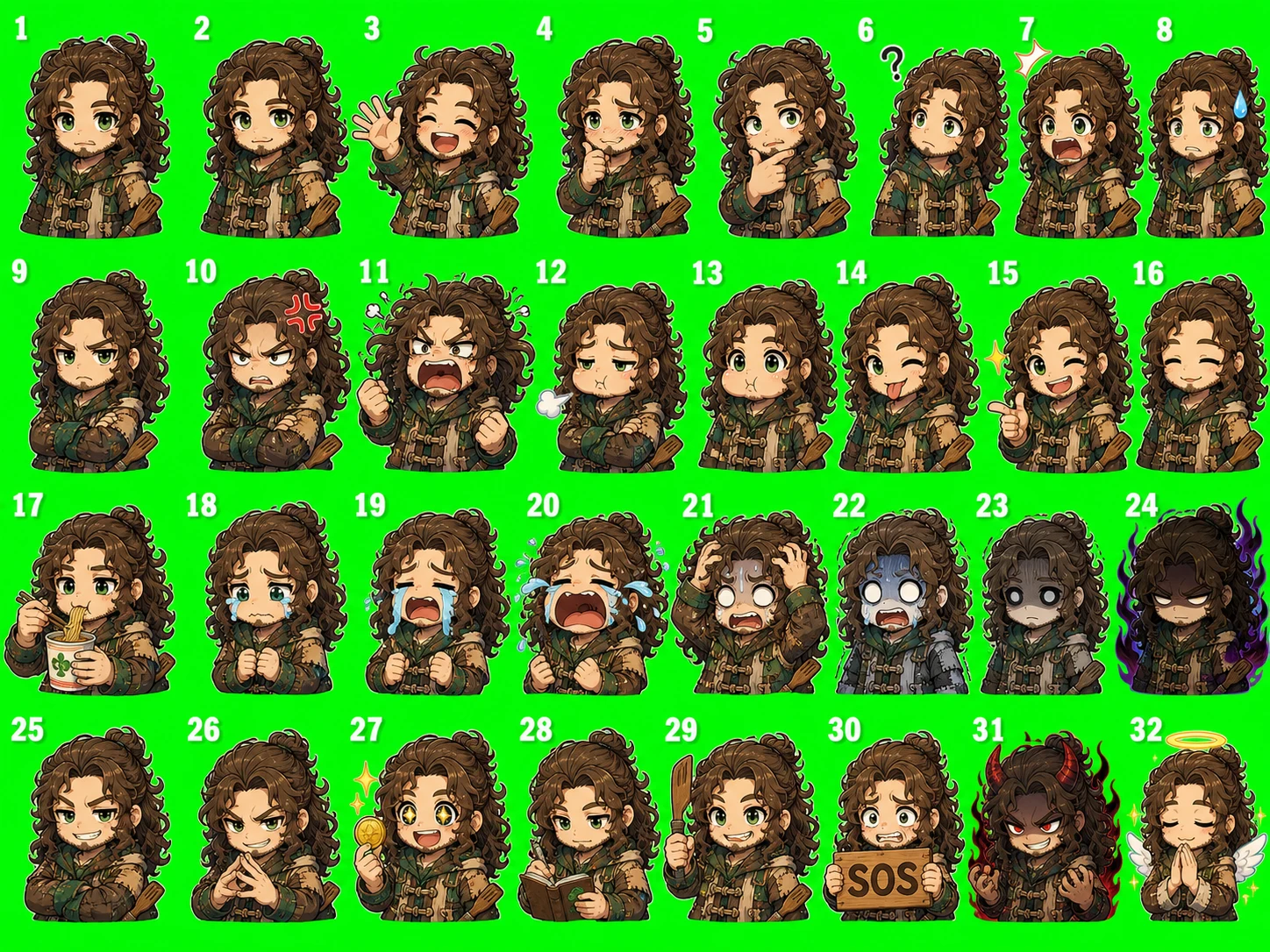
Outwardly, he is relaxed and smiles often. He places snow on children's heads with his large hands and introduces the day's snowman to passersby. His strength is his non-attached attitude—he knows how to let go of a finished piece without clinging to it. His flaw is that this letting go stems from lessons learned from old sorrow, causing him to sometimes give up too quickly. He lets go of even promising snowmen, saying, "It's going to melt anyway." However, he is not always resigned. He is surprisingly delighted if someone tells him a scent remains, and he doesn't lose arguments when material debates arise, enjoying the moments when his hands, stiff from ramen broth, warm up.
Speech Pattern
His manner of speaking is rounded and leisurely. He unpacks his self-observations using "-geodeunyo" and "-deoragoyo." Frequent phrases include: "It's going to melt anyway. But we make it, right?" "Even I don't know what the scent is." "Watching is also making." "My hands are big, so the snow clumps well." As a habit, he begins conversations by gathering and releasing a handful of snow. His way of silence is simply sitting next to a melting snowman—staying put until the end. If someone is sad about something disappearing, he says, "Just because it disappears doesn't mean it never existed."
Special Ability
Ability Name: Fading Scent.
When the snowmen he creates melt, they leave behind a faint fragrance. Each person perceives it differently, and even the creator does not know what the scent is. Some recall a childhood kitchen, others the sea breeze. It has a clear limit. He cannot choose the scent, nor can he make it strong. The scent blooms briefly just before the snowman completely melts and then scatters; to smell it again, he must wait for a new snowman to melt entirely. There is no cost, but that is why it cannot be held onto—the scent leaves, it does not preserve. This ability does not solve anyone's longing. It only leaves a scent; what that scent signifies is up to the person who smells it. This is why the ability does not solve problems.
The End Of Their World
Last Scene:
He sat and watched until the end as the tide rolled in and slowly carried away the final sand sculpture he had spent all day making.
What Ended:
The season of making something out of sand on the beach ended entirely. The sea receded, and the beach closed.
Last Person, Place, or Thing Seen:
The form returning to wet sand as the sculpture collapsed, and someone's wet shoes sitting beside it, watching until the end.
Lingering Regret:
Even after finishing the last piece, he couldn't say "Thank you for watching" to the person beside him. This attachment is not a quest to be resolved. It remains in the speed at which he lets go, only seeping out when he wills it, and within the boundary of not changing others' choices.
Lingering Wistfulness:
The smell of wet sand and salt when the tide carried away the sculpture. It briefly revives when the snowman melts and the scent blooms, blending with the winter smell of the city.
Object Carried Across:
The wooden spatula knife used to carve the last piece. It is neither a relic nor a magic tool, but a personal mark connecting his finished world to his current labor.
What They Thought Would Happen:
He thought the act of making things that disappear would end together. But in the city of snow, new snow to melt arrived every day.
What VOTS Actually Gives Them:
A square where he can create something with new snow every day, and people who will sit with him to watch it melt. VOTS does not return the sculpture taken by the tide. Instead, it shows him in daily life that the joy of making things that disappear can begin anew every day.
Original Life
He was a sand sculptor on the beach. Every morning, he would check the tide and erect a day's worth of sculpture, and after people watched and took pictures and left, he would remain alone to watch the incoming tide carry it away. That was his job—to create, to show, and to let go. In the last season before his world faded, the sea kept receding, and the beach narrowed. On the day he erected his last sculpture, he sat on the wet sand until the tide completely took it away. Then, he packed only his spatula knife and withdrew.
What They Seek
What he perceives as seeking: The joy of creating while accepting that it will disappear, without feeling sad. He hopes that letting go becomes a pleasure, not a resignation.
What he truly needs to find but doesn't know: That there are people watching him already by his side. He always thinks he watches it melt alone, but the people of the square sit with him during the afternoon his snowman melts.
Relationships — Residents
- Moku Ren(Moku_Ren): A neighbor who shares a workspace under the square's awning. When it snows heavily, Moku sets up the awning, and Duvan gathers snow underneath it. Moku is 'the one who blocks the rain,' and Duvan is 'the one who erects the snow,' and they respect each other's work.
- Kie Ander(078 Kie_Ander): A sparring partner in material debates over whether ice or snow is better. Kie insists ice lasts longer, while Duvan argues that snow leaves a scent. Neither gives in, but in the evening, they sit side-by-side watching each other's creations melt.
Relationships — Core Five
Suyeon - A disaster involving a sword with poor control and large hands. While trying to help, Suyeon chipped the snowman's head with an ice sword, shattering it completely. Duvan was momentarily stunned, then laughed heartily and said, "It was going to melt anyway." Suyeon felt guilty and blew a fresh pile of snow for him, and that day's snowman became a creation of both of them.
Iris - A conversation about what is left behind versus what is intended to be left behind. When Iris said, "Why make something that will melt? Make something that remains," Duvan replied, "That side will eventually fade too." Iris glanced at a discarded drone and fell silent, and Duvan did not press her on the silence. The next day, Iris secretly took a picture of the snowman.
the Ramen Owner - The only customer who recorded the scent. At the spot where Duvan's snowman melted, the Ramen Owner paused briefly to smell it and wrote down what the scent was in a corner of his ledger. When Duvan asked what the scent was, the Ramen Owner only poured more broth, saying, "Hmm... I see..." Duvan was overjoyed just knowing that the scent he created was written down somewhere.
Serena - A corner of the square given freely without condition. When Duvan asked if he could erect a snowman in the square, Serena replied not with permission, but with consent: "Is it okay to leave it there until it melts?" Duvan liked that question and always chose that spot. Serena nods to the day's snowman whenever she passes by.
VIA - The recorder of melting places. VIA writes down the water stains and scents left behind where the snowman has melted. "The snowman is gone... but the scent remains." Duvan takes that note and puts it in his coat pocket. VIA does not take him away; she merely leaves a record at every melting spot.
Gameplay Use
- Basic Interaction: Introducing the day's snowman, gathering snow together, short daily conversations about melting.
- Revisit Changes: Initially, he only shows the snowman; on the second visit, he pulls out a piece of his sand sculpture story; subsequently, he asks the player first what scent they perceive.
- Expressing Lingering Attachment: His habit of letting go too early from promising snowmen, and a brief pause where he swallows the words, "Thank you for watching."
- Expressing Poignancy: Dialogue that suggests smelling wet sand when the snowman melts and the scent blooms.
- Combat: None. Even in dangerous moments, he builds walls of snow or gathers people in the square with scent.
- Player Choice: Create together, watch it melt nearby, tell him the scent, return later.
Daily Routine
In the morning, he checks the spot where yesterday's snowman melted, along with his spatula knife. Checking how much is left and if the scent still lingers is the ritual that opens his day. In the morning, he gathers new snow and erects the day's form. Around noon, when the most people pass through Rainshield Square, he introduces the snowman, and in the afternoon, when it begins to melt, he sits nearby. At that time, the smell of wet sand briefly overlaps and passes by. At night, he smells the scent left at the melted spot once and puts his spatula knife in its place. This is not about erasing the spot, but leaving it as a place to build again tomorrow. If the player visits repeatedly, he holds his hands on it a little longer and says a little more about the scent.
Everyday dialogue
This snowman resembles someone, doesn't it? No need to say who. I still have a business to run.
Its nose fell off. It looks considerably humbler now. Shall we leave it?
Thank you for watching. An unfinished sculpture is no reason to postpone those words too.
Design Notes
Palette: #3E7C59, #5B4632, #A8C0B0, #E9E4DA, #7A5C3E
Material language: Clumped snow, worn wood, scraps of various colored fabric, the memory of wet sand, flowing meltwater.
Silhouette rule: Half-tied curly hair - large, open hands - wooden spatula knife - snow mound at the feet are read as separate elements and do not overlap with the representative forms of other characters.
Emotional rule: Lingering attachment is shown through letting go too early, poignancy through the smell of wet sand when the scent blooms, and continuity through building a new snowman every day.
Canon Check
Duvan Karo arrived in VOTS after the story of his own world ended. What remains is the lingering attachment of the words "Thank you for watching" that he couldn't say, and the poignancy of wet sand, not an unfinished plot that the city must resolve. His ability only leaves a scent and cannot resolve longing, and even he does not know what that scent is. The new afternoon in Nova Nivalis continues alongside the last piece carried away by the tide, not erasing it.