RESIDENT 128
Selma Doin
Night Pharmacy Attendant · beside the City Hall Steps · 40s
Complete profile · All sections open
Download English profile (.txt)Archived source profile (Korean)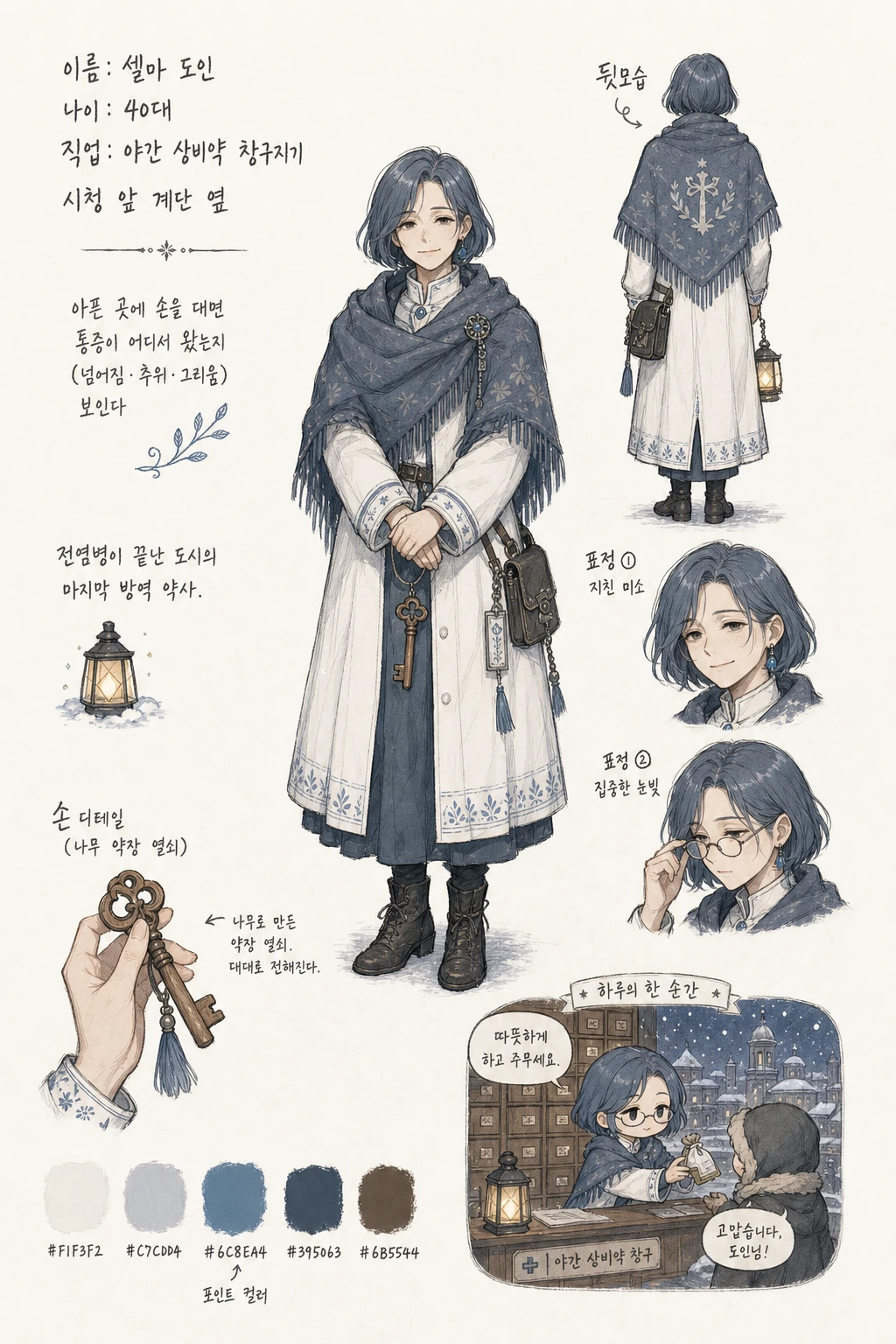
Core Premise
Selma Doin arrived in Nova Nivalis after the stories of her own world had ended. She did not come to stop illnesses she couldn't prevent; rather, the scent of medicine still lingered on her fingertips from closing the counter after administering the final vaccination. She drifted to this city of snow. VOTS is not a quarantine station that rewinds the last plague, nor is it a ward that resurrects the dead. What continues here is not emergency quarantine, but ordinary nighttime prescriptions: a packet of fever reducer for a child running a fever at night, ointment for cold hands, or a cup of water for someone who cannot sleep. The plague she experienced is over, and that fact is not revoked. However, the city entrusts her with the counter that dispenses medicine for daily life, not for emergencies.
Identity
Selma Doin guards the night pharmacy counter beside the City Hall Steps. When someone comes in sick or injured at night, she selects and hands them the necessary medicine from behind the small counter. This is a place that dispenses everyday medicines to get through the night, not a large hospital. She does not heal people for them. She hands over the medicine, tells them how to use it, and leaves the rest to the medicine and time. This job is not decoration; it is labor genuinely needed in the city's night. When a customer arrives, she prescribes; when there are none, she organizes the medicine drawers. Just as no one suffers another's pain for them, she does not bear the pain of others. However, because she can see where the pain comes from, she remains silent before pains that medicine cannot address.
Visual Profile
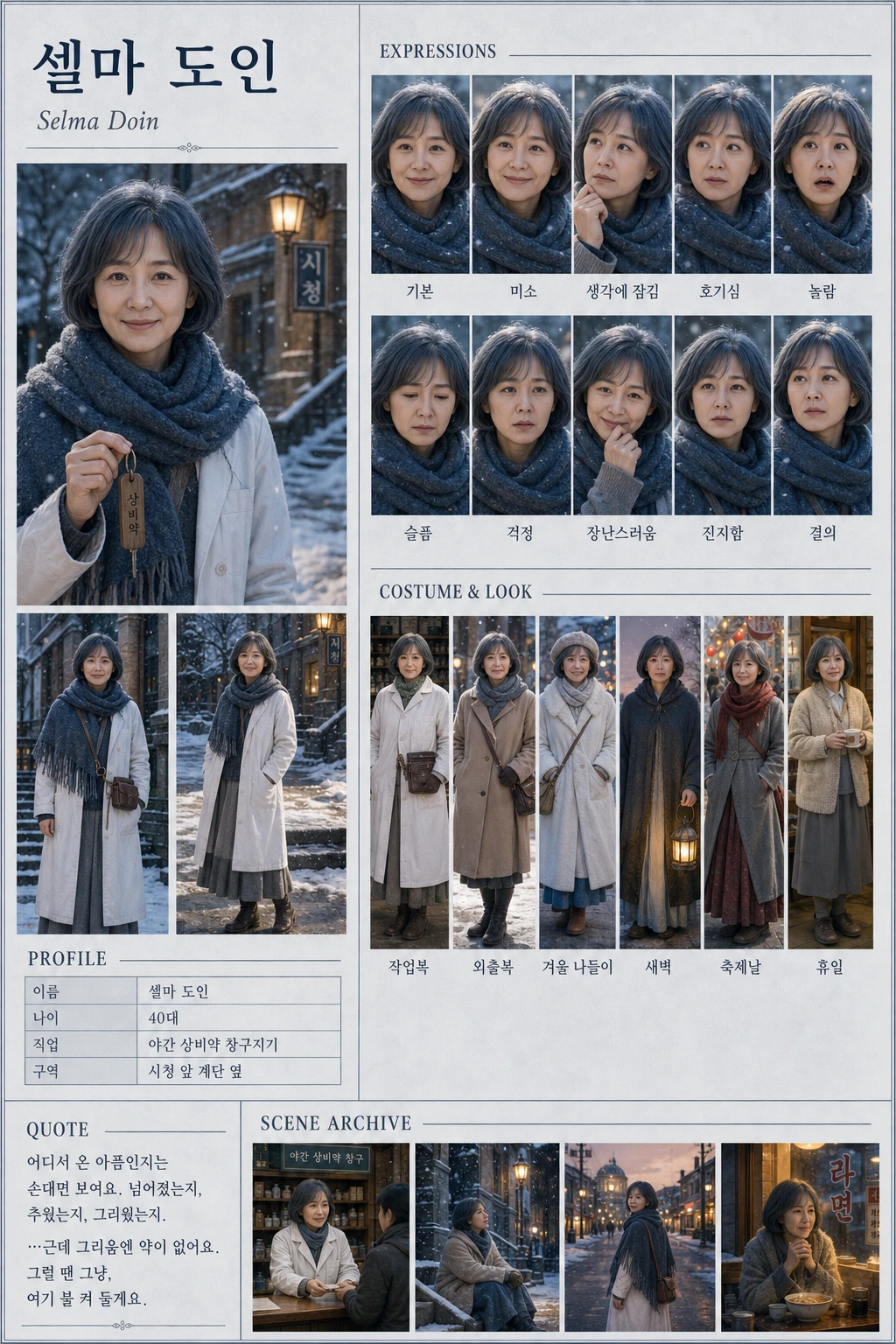
Hair: Neat, bluish-gray bob. It falls precisely to her jawline without being disheveled, tucked behind her ears so it won't become messy even after working all night.
Eyes: Gray-blue. Fatigue is always present, but her focus is precise. Her eyes deepen momentarily when she looks at a customer's afflicted spot.
Skin/Build: Pale and thin. A straight posture, characteristic of someone who has stood working for a long time.
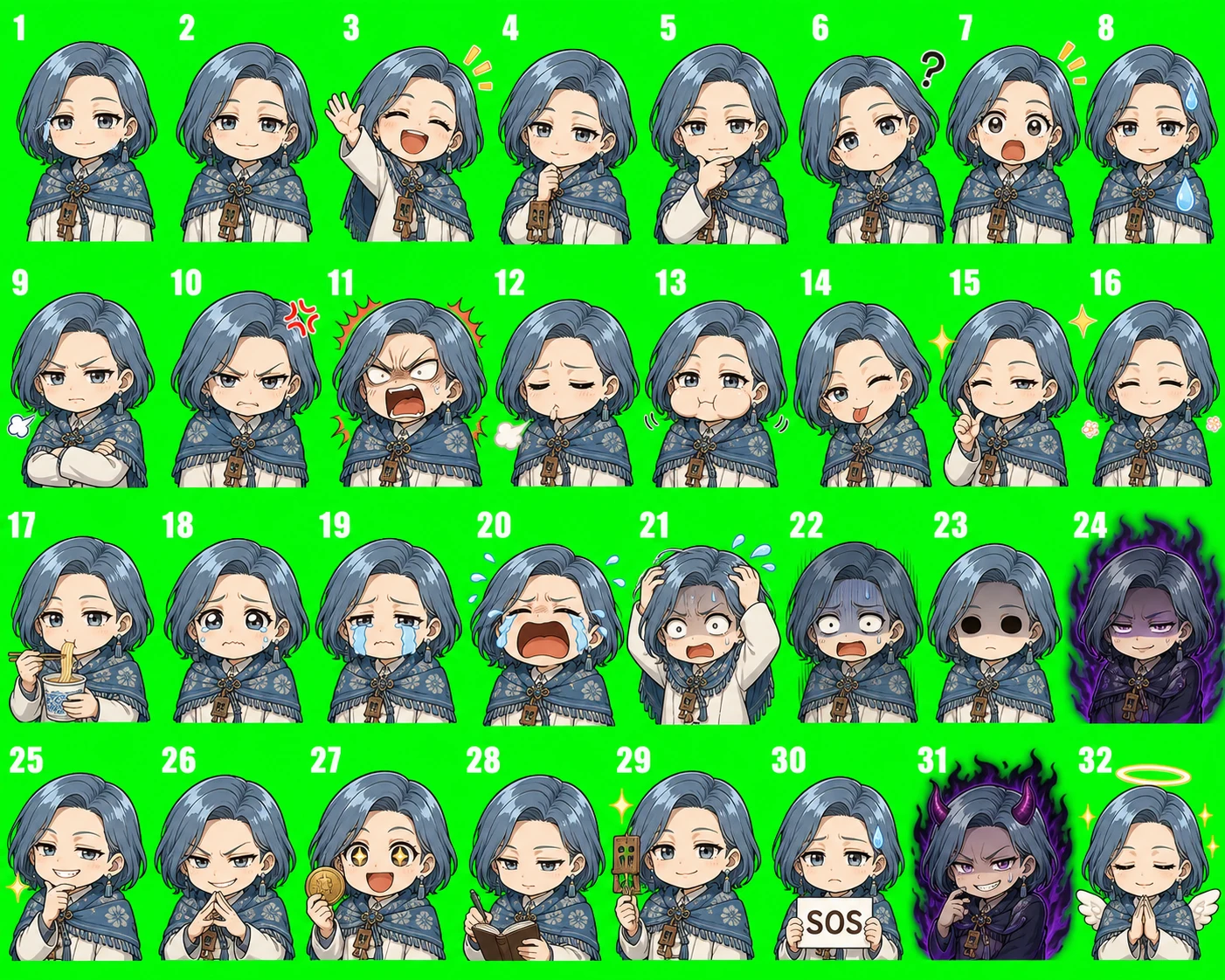
Expression: Tired, yet precise smile. A smile that provides necessary guidance without faltering, even on a weary face.
Signature Attire: A thick shawl over a white gown. Because the night counter is cold, she wraps the shawl around her gown. The bluish-gray of the shawl is her representative color.
Signature Props: A wooden medicine drawer key. It is the key to a cabinet with dozens of small medicine drawers, which she wears on a cord around her neck. She knows what is in each drawer even with her eyes closed.
Silhouette Core: A neat bluish-gray bob, a white gown draped with a shawl, and the medicine drawer key around her neck. The accent color #6C8EA4 is repeated in her hair and shawl.
Personality
Selma is outwardly calm and precise. She judges what is needed before letting emotions take over. Her strength is her composure. Even in front of someone who comes in frightened at night, her voice does not waver, and that voice alone brings reassurance to the person. She has flaws, too. While she reads others' pain, she always postpones her own fatigue. Because she says "I'm fine" too often, she has forgotten how to take care of herself. She is not a tragic figure. She smiles quietly when she hears that a child has taken medicine, their fever has dropped, and they are sleeping soundly, and she enjoys professional jokes with Yupa Sel about whether something is 'herbal medicine or actual medicine.'
Speech Pattern
Her speech is concise and precise. It is gentle, as if explaining a prescription.
Common Phrases:
- "One packet before bed. No more than that."
- "Can you let me feel where it hurts?"
- "It's not the medicine that heals; it's time. Medicine only helps time."
- "This... this isn't something medicine can fix."
- "I'm fine. The counter isn't closing."
Style of Silence: Instead of answering, she opens and closes a medicine drawer. The sound of that wooden drawer is her 'Understood.'
Special Ability
Ability Name: 'Source of Pain'.
What it can do: When she places her hand on an afflicted spot, she can see where that pain originates. Whether it's from a fall, the cold, old overexertion—or sometimes, from 'longing.'
Limit/Cost: She only sees the source; she cannot heal it. Healing remains the domain of medicine and time. Especially when the source of pain is 'longing,' there is no prescribed medicine in her drawers. Furthermore, every time she touches and reads the source, the weight of that pain briefly seeps into her, leaving her exhausted at the end of the night, as if she has suffered multiple people's pain layered on top of each other.
Why the ability doesn't solve problems: Knowing where the pain comes from does not make the pain disappear. Her ability only points out the cause; it cannot mend a broken bone or erase longing. The city's rules remain the same—losses already suffered remain as they are, and there is no prescription for longing. Even after reading the source of the pain, all she can do before pains that medicine cannot fix is keep the counter light on a little longer instead of giving medicine. And she knows that sometimes, that is enough.
The End Of Their World
Last Scene:
In the city where the plague was fading, she administered the final vaccination to the last remaining person. When there was no more medicine to give and no one left to come, she personally turned off the light of the quarantine counter.
What Ended:
The plague in her world ended. And with the plague, the quarantine station that was so busy, and the people who lined up every day, also ended. It was a relief that the sickness was over, but what remained after that relief was an empty counter.
Last Person, Place, or Thing Seen:
The arm of the person who received the final vaccination as they pulled down their sleeve, and the glass of the medicine bottles faintly glowing in the darkness after the light was turned off.
Lingering Regret:
When the plague was rampant, medicine was scarce, and she could only give the last few people the words, 'You will be fine.' She said it knowing it couldn't be a prescription. The faces of those few people still bother her. This lingering feeling is not a quest that VOTS will resolve for her. It only surfaces in her habit of keeping the counter light on longer than usual before pains that medicine cannot fix.
Lingering Wistfulness:
The light of the quarantine station kept on until dawn, and the unique smell of the counter mixed with disinfectant and paper prescriptions.
Object Carried Across:
A single empty glass medicine bottle. It is a bottle left over from the final vaccination, now containing nothing. It is not a powerful relic, but a personal mark connecting the ended plague and the current night counter.
What They Thought Would Happen:
She thought that when the plague ended, her work would also end cleanly, and she would feel relieved. But even after the sickness ended, people still fell, froze, and suffered from longing. The pain did not end even when the plague did.
What VOTS Actually Gives Them:
She hands out everyday medicines to those who fall and freeze every night. There are no emergencies, but the city's night is a little less frightening because of the light of her counter. VOTS does not reverse losses already suffered. Instead, it entrusts her with the counter that dispenses medicine for daily life, not for emergencies.
Original Life
In her world, Selma was a quarantine pharmacist. In a city plagued by epidemics, she compounded medicine, administered vaccinations, and dealt with lines of people all night. She always had to decide who to give the scarce medicine to first, and she bore the weight of that judgment for a long time. Her last day was like this. On the day the end of the plague was in sight, the number of people seeking her counter dwindled day by day until only one person remained. She administered the final vaccination to him. After he left, she sat in the long, empty counter and finally turned off the light. The unfamiliarity of the empty space was greater than the joy of the plague ending.
What They Seek
What she outwardly seeks: A daily pharmacy, not an emergency one. A quiet counter that helps people get through the night, not a counter frantically lining people up to save lives.
What she doesn't know but must seek: That when the source of pain is 'longing,' the prescription is not medicine. She already knows this, and in fact, she prescribes it by keeping the light on every night instead of medicine.
Relationships — Residents
145 Miren Has (Aid Bandager): They collaborate with 'medicine and bandages.' The bandages Miren applies help endure one more day, and Selma's medicine aids that time. Both are people who have spent a long time in emergency care in a 'world after war/plague,' so they understand each other's night shift fatigue without speaking. When Selma reads the source of pain and points out, "This is from a fall, that is from overexertion," Miren bandages accordingly.
042 Yupa Sel (Alley Herbal Tea Vendor): A colleague who specializes in 'herbal medicine versus actual medicine.' Yupa knows the tea to give based on the sound of a cough, and Selma reads the source of pain with her hands. They pass customers to each other, saying, "This is your area," "That is mine." When Yupa teases her, "Medicine is too rigid," Selma retorts, "Tea is too slow."
14 Lina Forth (Announcer): A neighbor who shares the City Hall Steps. When Lina's voice cracks from reading the night announcements, Selma passes throat lozenges over the counter.
Relationships — Core Five
Suyeon - A regular who comes to buy patches for muscle soreness after a performance. When Suyeon comes saying, "My shoulder hurts from swinging too hard today," Selma places her hand on her shoulder, reads, "It's from overexertion, not a fall," and hands over the patch. If Suyeon jokes, "How do you know that?" Selma only replies, "My hands tell me." When the topic of mixed cola bibim-myeon comes up, Selma draws a line, saying, "That's for the stomach; it's not my jurisdiction."
Iris - A customer who comes with stiff neck and eye fatigue from working all night. When Iris comes by enduring it, saying, "I'm usually not in pain," Selma reads that the source of pain is 'overexertion' mixed with faint 'longing,' but says nothing and only hands over eye ointment. She doesn't ask about Iris's dead drone. However, after saying, "Turn everything off when you sleep," and receiving the reply, "One is always off anyway?" she never brings up the topic again.
the Ramen Owner - Someone who leaves silent vitamins, concerned about dark circles. Selma silently leaves a bottle of vitamins on the counter for the Ramen Owner, and the Ramen Owner silently offers her a bowl of broth the next time she comes. Once, Selma placed her hand on the owner's wrist and read the source of pain, seeing an old burn along with something nameless, so she couldn't say anything and just added another vitamin. The Ramen Owner accepted it, saying, "Hmm... I see..."
Serena - The one who received 'consent' for the night counter spot. When Serena asked, "Would it be alright to keep a counter here for people who are in pain at night?" Selma found it strange because it was a request for consent, not an order. When Selma asked back, "Can I keep the light on all night?" Serena replied, "As much as you want to keep it on." In those words, Selma felt for the first time that she had been granted permission to prescribe light for pains that medicine couldn't fix.
VIA - The entity that records Selma's empty medicine bottles. When VIA wrote, "The bottle is empty... void. But the glass remains," Selma thought for the first time why she couldn't throw away that empty bottle. When VIA comes to the counter, they come to record, not because they are in pain, and Selma offers a cup of water, saying, "You're the first person here who isn't in pain." VIA replies, "Water is not medicine... so it is good... this."
Gameplay Use
- Basic Interaction: Purchasing night pharmacy supplies, consulting on pain, short daily conversations.
- Revisit Changes: On the first visit, she only hands over medicine; on the second, she brings up a piece of the quarantine station story; subsequently, she reads the player's source of pain first and prepares the appropriate medicine in silence.
- Expression of Lingering Feelings: The habit of keeping the counter light on longer before pains that medicine cannot fix, the brief pause while fiddling with an empty medicine bottle.
- Expression of Poignancy: Sensory dialogue about the light of the dawn counter, the smell of disinfectant mixed with prescriptions.
- Relationship Reward: Pre-stocking supplies for the player, or offering light and a cup of water when medicine isn't enough—small changes. It is the 'counter that is lit at night,' not a new item.
- Combat: None. Even in a crisis, she moves to treat and stabilize the injured.
- Player Choices: Show pain, receive medicine, just sit nearby, come back at night.
Daily Routine
She opens the counter when the sun sets. Just as she did at the quarantine station, she checks the medicine drawers and places the medicine needed for that night within reach. As the night deepens, people come in alternately—those who fell, those who are cold, and those who cannot sleep. She reads the source of pain and hands over medicine, but if 'longing' appears, she keeps the light on a little longer instead of giving medicine. As dawn approaches, customers thin out, and only then does she button up her shawl and touch the empty medicine bottles. During the day, she refills the drawers and tries to sleep, but it is always insufficient. For the player who keeps returning, her prescriptions become shorter and her silences longer, until she eventually says, "There are things medicine can't fix. But in those times, I'll at least keep the light on."
Everyday dialogue
What is troubling you first, please. 'I'm fine' doesn't tell me which shelf to reach for.
Listen to the full directions. You're nodding faster than the medicine could work.
There are faces I gave only words to. Now I try to say precisely what I can and cannot offer.
Design Notes
Palette: #6C8EA4, #E4E7EA, #2F3A42, #C2A98B, #8FA98C
Material language: Glass medicine bottles, wooden medicine drawers, white gown fabric, thick shawl, the yellow light of the counter.
Silhouette rule: The neat bluish-gray bob · white gown draped with a shawl · medicine drawer key around the neck must be read separately, and the representative form must not overlap with other care-related residents (Miren, Yupa, Hoon).
Emotional rule: Lingering feelings are shown by the counter light kept on for a long time, poignancy by the smell of disinfectant, and continuity by the counter opened every night. It is not concluded with a 'tragic expression.'
Point-color rule: #6C8EA4 is repeated only in the hair and shawl, while the rest is subdued by the warm yellow light of the counter and the gray of the night.
Canon Check
Selma Doin arrived in VOTS after living through the end of the story of the world where the plague ended. What remains is the lingering feeling for comfort that could not be prescribed, and the poignancy of the dawn light, not an unfinished plot that VOTS must rewind for her. Her ability only sees the source of pain and cannot heal it, and it cannot reverse the fact that there is no medicine for longing. The city does not erase her ending; it gives her the counter to keep lit every night beside it.