RESIDENT 147
Ziko Telo
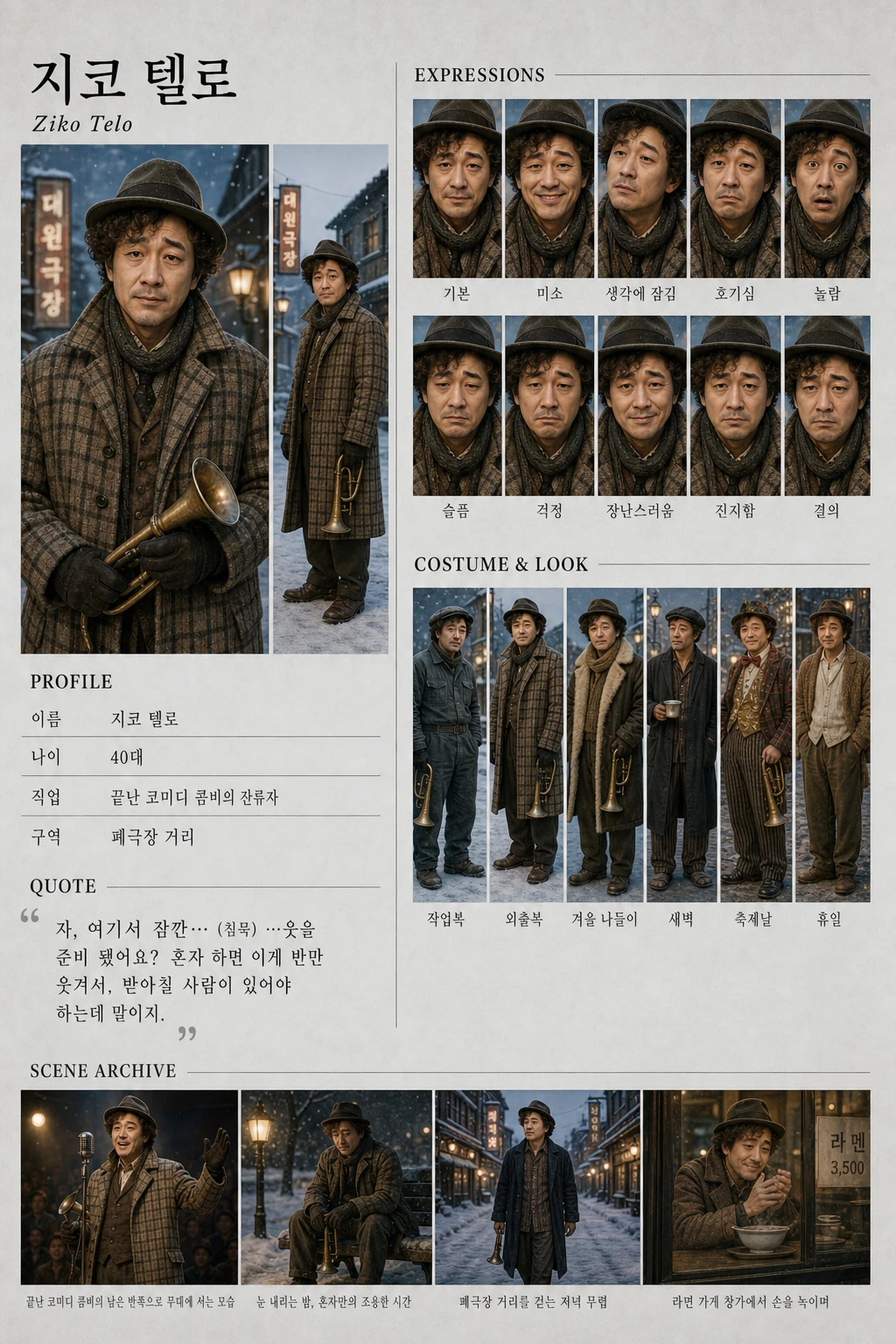
Remnant of a Finished Comedy Duo (Street Comedian) · Closed Theater Street · 40s
Complete profile · All sections open
Download English profile (.txt)Archived source profile (Korean)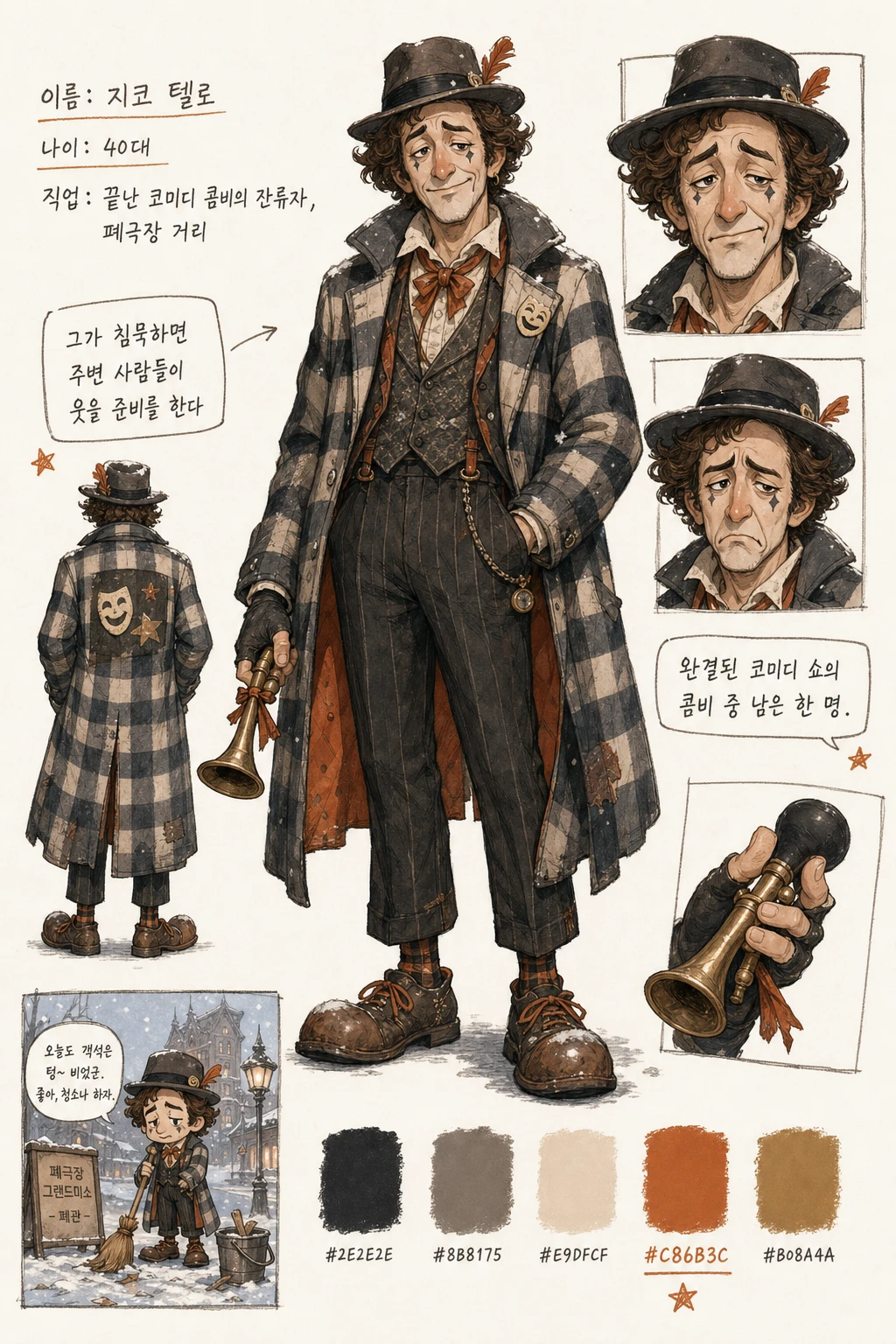
Core Premise
Ziko Telo arrived in Nova Nivalis after living out the final episode of his own story. He was one of the members of a completed comedy show, and after his partner exited in the final episode, he was left alone. He wasn't drawn here to solve an unfinished plot, but rather the timing sense ingrained in him and the habit of wanting to make someone laugh, even after the show ended. VOTS is not a hall of judgment, nor is it an afterlife that distributes awards. What continues here is not a grand destiny, but small daily things—a joke thrown in an alley, the brief silence just before laughter bursts out, the applause of a single audience member. With the body of a half-duo left without his partner, he practices how to make people laugh by himself in this city.
Identity
Ziko Telo is a street performer who tells jokes on Closed Theater Street. Without a stage or a troupe, he stops passersby and throws out short jokes. Originally, he was one pillar of a duo comedy act—when he would pause seriously, his partner would respond. Now that there is no one to respond to, he is trying to find how to fill that gap alone. His function is not decoration, but a form of labor that reintroduces laughter into Closed Theater Street. He makes people laugh, but he doesn't force them to. He believes whether they laugh or not is up to the listener.
Visual Profile
He wears an old fedora atop chestnut-colored curly hair, and his eyebrows are asymmetrical—one side is raised in a smiling expression, the other is drooped in a crying expression. This is a residue of old makeup ingrained in his skin and cannot be erased. Thus, even when still, he appears half-smiling and half-sad. His large checkered coat is bigger than his body, leaving excess sleeves, and he pulls out an old whistle from his pocket that has lost its squeaker—it makes no sound, but it is his signature prop. The core of his silhouette is the fedora, the asymmetrical eyebrows, the large checkered coat, and the silent whistle. The strong accent color is the orange of his coat, #C86B3C, which stood out under stage lights, signaling that he is a 'funny person' even in a small sprite. His attire is the form of flamboyant duo stage wear reduced to faded everyday clothes.
Personality
Outwardly, he is witty and jovial. He throws jokes at everyone and smiles through embarrassment. His strength is knowing the moment laughter will burst by reading people's expressions. His flaw is that he becomes unusually quiet when alone—without a partner to respond to, his jokes are only half-formed, so he keeps his mouth shut in empty alleys. And because he refuses to admit that he is looking for a new partner, he insists, "I'm looking for a solo stage." He is not someone burdened only by tragedy. When a joke lands well, he is as happy as a child, and he readily sacrifices his own dignity to make others laugh; hearing laughter makes the day worthwhile.
Speech Pattern
His sentence endings have a rhythm—a comedic cadence of pausing and then dropping the punchline. Frequent phrases: "Now, just for a moment..." (and silence) "...Are you ready to laugh? Not yet." "When it's just me, it's only half funny." "There should be someone to respond to, you know." As a habit, before a crucial moment, he presses the silent whistle once—instead of a squeak, silence comes. The way he uses silence is a joke in itself. He stops talking, stares intently at people, and waits for laughter to build up. If someone looks depressed, instead of comforting them, he says, "Look at my eyebrows; half of them are already crying." That is the kindest sentence he knows.
Special Ability
Ability Name: The Magic of the Pause.
When Ziko stops talking and falls silent, the people around him unconsciously prepare to laugh. The gap he creates builds anticipation, and people instinctively know that something funny is coming. The timing that used to wait for his partner's response in duo comedy has become his ability. However, there is a critical limit—no one laughs at the jokes he tells to himself. He can create the pause, but without someone to fill that pause, the laughter doesn't burst; it remains an awkward silence. The cost is that the ability feels hollower the lonelier he is. Above all, this ability solves nothing. The fact that people are preparing to laugh doesn't fill his loneliness, and no matter how well he creates the pause, the partner who left doesn't return. This ability only keeps teaching him that 'laughter is not completed alone,' and it cannot bring him someone to respond to.
The End Of Their World
Last Scene:
In the final episode of the completed comedy show, his long-time partner character finished their story and exited, leaving Ziko alone on stage to throw out a joke with no one to respond to.
What Ended:
With the conclusion of the show, the duo comedy, the partner's voice, and the script they exchanged together all ended. Only the half-duo left behind.
Last Person, Place, or Thing Seen:
The partner's back as they looked back at him before exiting, and the final stage light illuminating his half-smiling, half-crying eyebrows.
Lingering Regret:
When his partner exited in the final episode, he only delivered a concluding joke, failing to say a single "Thank you." He believed that ending with laughter was the rule of a duo. This regret is not a quest that VOTS must resolve. It surfaces only when he wills it, and remains in moments when his jokes suddenly stop, without changing others' choices.
Lingering Wistfulness:
That perfect half-beat silence that flowed on stage just before his partner responded. It remains as a rhythm, briefly reviving when he pauses in the streets, only to blend with the noise of the city's alleys.
Object Carried Across:
The old whistle that has lost its squeaker. It was a prop used with his partner. It is neither a relic nor a magical tool, but a personal mark connecting the stage when they were two and the present when he is alone.
What They Thought Would Happen:
He thought that when the show ended, he would quietly disappear backstage. But his body still tried to pause and throw jokes whenever he saw people.
What VOTS Actually Gives Them:
Alleys to throw jokes in every day, and faces that sometimes genuinely laugh. VOTS does not return the departed partner. Instead, it slowly grants him the space to attempt laughter alone, and perhaps encounters where a new response might come, within the repetition of daily life.
Original Life
He was one of the members of a completed comedy show. He and his partner had a long history together—when he would pause seriously, his partner would respond unexpectedly and make them laugh. Their timing matched even things not in the script, and the audience viewed them as one body. In the last season leading up to the show's conclusion, the partner character's story ended, and their exit was set. In the final episode, the partner delivered the last response and left the stage. Ziko remained alone and threw out the next joke, but there was no voice to respond. In that silence, for the first time, he became conscious that his eyebrows were half-smiling and half-crying. And the story after that did not remain in his world.
What They Seek
What he believes he is seeking: His first solo stage. He practices stand-up comedy alone in alleys every day to prove that he can make people laugh by himself without a partner.
What he actually needs but doesn't know: What he is looking for is not a stage, but a new partner. The more he tries to make people laugh alone, the emptier his pauses become, and what he truly wants is someone to respond to his silence. He still hasn't admitted that.
Relationships — Residents
- Komo Rici(036 Komo_Rici): Komo, the street puppeteer, is a potential 'new duo candidate' with whom Ziko exchanges sidelong glances. Even after Komo's puppet is released, it continues to move for three seconds, and those three seconds coincidentally align with Ziko's pause, causing people to burst out laughing. Both felt that this could be the start of a duo, but Ziko insists, "I'm looking for a solo act," and Komo smiles and doesn't push it. Their awkward first collaboration is already creating laughter.
- Bel Hamo(088 Bel_Hamo): Bel, the long-time guide of Closed Theater Street, is the person who reserves Ziko's first audience. When Ziko asks, "If I open a solo stage, will you come?" Bel replies, "I've already reserved a spot for you, the very front row." Ziko subtly relies on that seemingly empty promise to practice every day.
- Mael Hush(17 Mael Hush): With Mael, who used to direct silent film scenes, they research 'how to make people laugh without sound.' Mael creates laughter with silent gestures, and Ziko does it with the silent whistle and silence. They agree that "the biggest laughter comes when it's quiet."
Relationships — Core Five
Suyeon - The only audience member who bursts out laughing. While most people laugh lukewarmly at Ziko's jokes, only Suyeon bursts out loudly every time. When Ziko pauses, Suyeon is already leaning forward saying, "What is it, what is it?" and genuinely bursts out at the critical moment. Thanks to Suyeon, Ziko confirms that his timing is not yet dead. When Suyeon makes a pained face saying, "How about this expression after eating mixed cola ramen?" Ziko genuinely exclaims, "That's funnier than my eyebrows."
Iris - Two people who understand silence. When Iris says, "That pause is just like a stage light fading out," Ziko beams, "Oh, there was someone who understood." Iris once timed the lighting to Ziko's pauses during stage direction, and when the lights slowly dimmed during a moment of silence, the laughter doubled. Ziko never made a joke out of, nor even asked about, the drone that was always turned off—that was the courtesy he knew.
the Ramen Owner - Indifference is the best feedback. When Ziko comes up with a new gag, he tests it first in front of the Ramen Owner. The Ramen Owner doesn't laugh. He just stirs the broth, saying, "Hmm... I see..." But to Ziko, that indifference is the most accurate feedback—if "Hmm... I see..." drags on even a little, he discards the gag; if it's short, he keeps it. The Ramen Owner doesn't judge, but the subtle difference in that calm reaction is more honest to Ziko than any audience member. He decided not to tell the peach joke.
Serena - The one who asked if it was okay to laugh. When Ziko asked, "May I tell jokes in front of the city hall? It might be noisy if people laugh," Serena replied, "Laughter that is loud is a good kind of loud. I agree with that sound." For the first time, Ziko received laughter not as permission, but as agreement. Serena has never asked him to make anyone laugh with anything specific. However, there was a time when Serena slightly lifted her shoulders without making a sound at one of his jokes, and Ziko considers that a lifetime standing ovation.
VIA - A record of pauses. Watching Ziko's comedy, VIA measures the silence before the laughter and writes it on a note: "A three-second pause... They laughed." Fascinated to see his timing recorded in numbers, Ziko kept VIA with him to test several versions. VIA records the silences without laughter in exactly the same way: "A three-second pause... They did not laugh." Ziko dimly senses that this honest record is, in fact, the response he most needed.
Gameplay Use
- Basic Interaction: Short jokes, gap-based comedy pauses, conversations about whether today's joke landed or not.
- Revisit Change: Initially, he only throws jokes; on the second visit, he brings up a piece of his partner story; subsequently, he asks the player, "Want to respond?" and invites them to be a duo.
- Expression of Lingering Feelings: The habit of fiddling with the silent whistle when he suddenly falls silent in an empty alley.
- Expression of Nostalgia: Dialogue where he glances to the side briefly, as if waiting for a partner's response during a pause.
- Combat: None. Even in dangerous moments, he relieves tension with a joke or redirects people's attention to laughter.
- Player Choice: Listen to the joke, respond to it, laugh at it, or visit again.
Daily Routine
He starts his day by adjusting his fedora and putting the silent whistle in his pocket. In the morning, he walks around Closed Theater Street, throwing short jokes at passersby to gauge what lands. Around noon, when the street is crowded and laughter is exchanged, the perfect half-beat silence of a duo performance briefly overlaps and passes. In the afternoon, he tests new gags at the ramen shop and wanders near Komo's puppet show. When left alone in an empty alley, he suddenly grows quiet—because there is no one to respond to. At night, he puts the whistle in its place and takes off his fedora. This is not hiding the whistle, but leaving it so he can hold it again tomorrow. If the player visits repeatedly, he brings up his partner's story a little more and increases his requests for a response.
Everyday dialogue
This is where my partner answers. …Why so quiet? Oh, just me again. Savings on payroll!
Late applause is fine. I forgot to hand out the joke's instruction manual.
Thank you. No punchline afterward today. Turns out those words may stand on their own.
Design Notes
Palette: #C86B3C, #E8D0B0, #3E3630, #8A9BA8, #D9C0A0
Material language: Faded checkered coat, old felt fedora, silent brass whistle, makeup residue ingrained in the skin, hat brim moistened by tears.
Silhouette rule: The fedora-asymmetrical eyebrows-large checkered coat-silent whistle are read as separate elements and do not overlap with the representative forms of other characters.
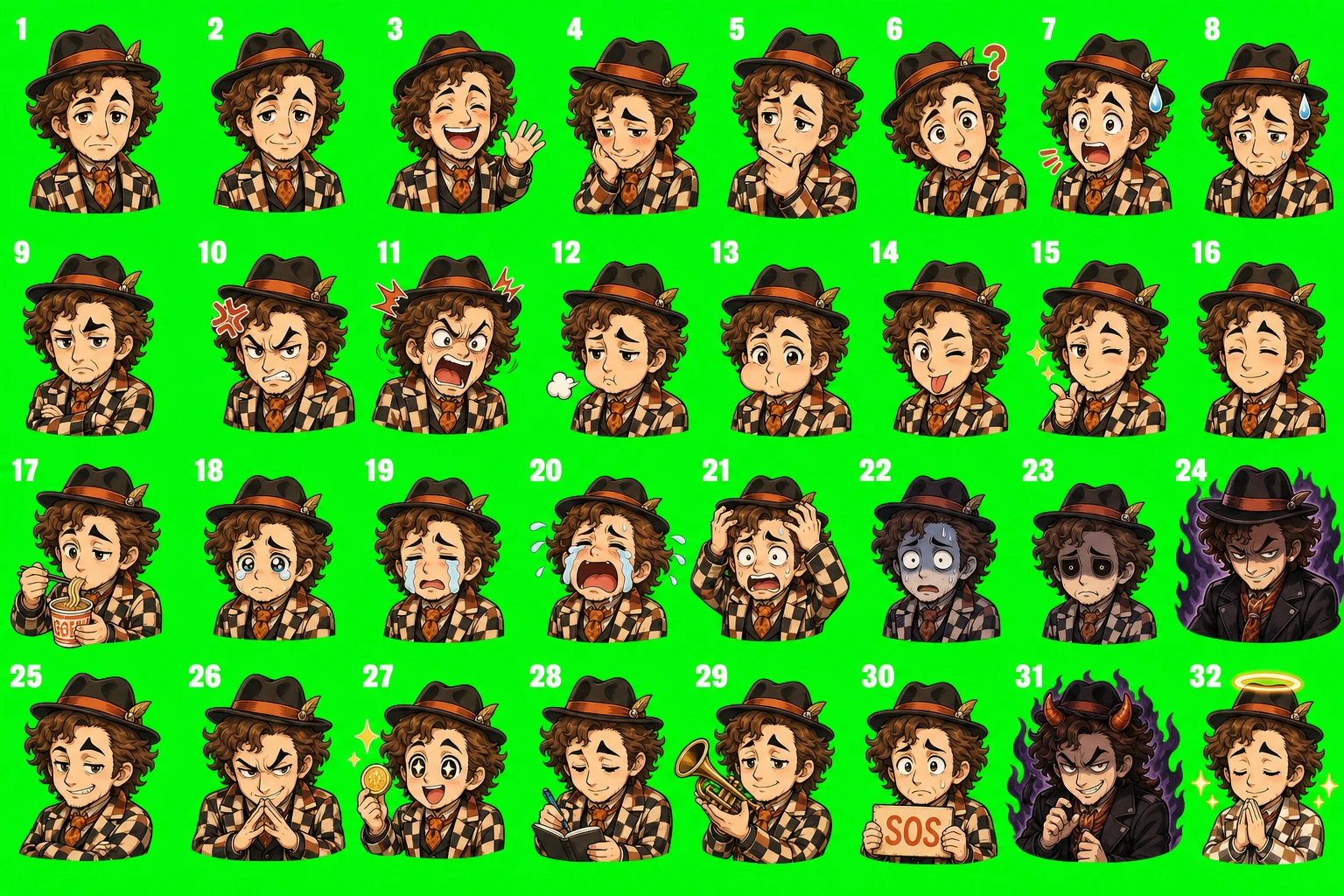
Emotional rule: Lingering feelings are shown through the sudden silence in empty alleys, nostalgia through glancing sideways while waiting for a response, and continuation through the jokes thrown every day. It is not concluded with a 'tragic expression' alone—his face is already half-smiling and half-crying.
Canon Check
Ziko Telo arrived in VOTS after his story concluded in the final episode. What remains is the regret of not being able to say "Thank you" and the wistfulness of the duo's half-beat silence; it is not an unfinished plot that the city must resolve. His ability only creates the space for laughter but cannot complete the laughter alone, and his stage does not bring a partner to him. The new laughter in Nova Nivalis quietly follows the finished duo show, without erasing it.