RESIDENT 130
Dan Brue
Square Portraitist · Closed Theater Street to Snowflake Market · 60s
Complete profile · All sections open
Download English profile (.txt)Archived source profile (Korean)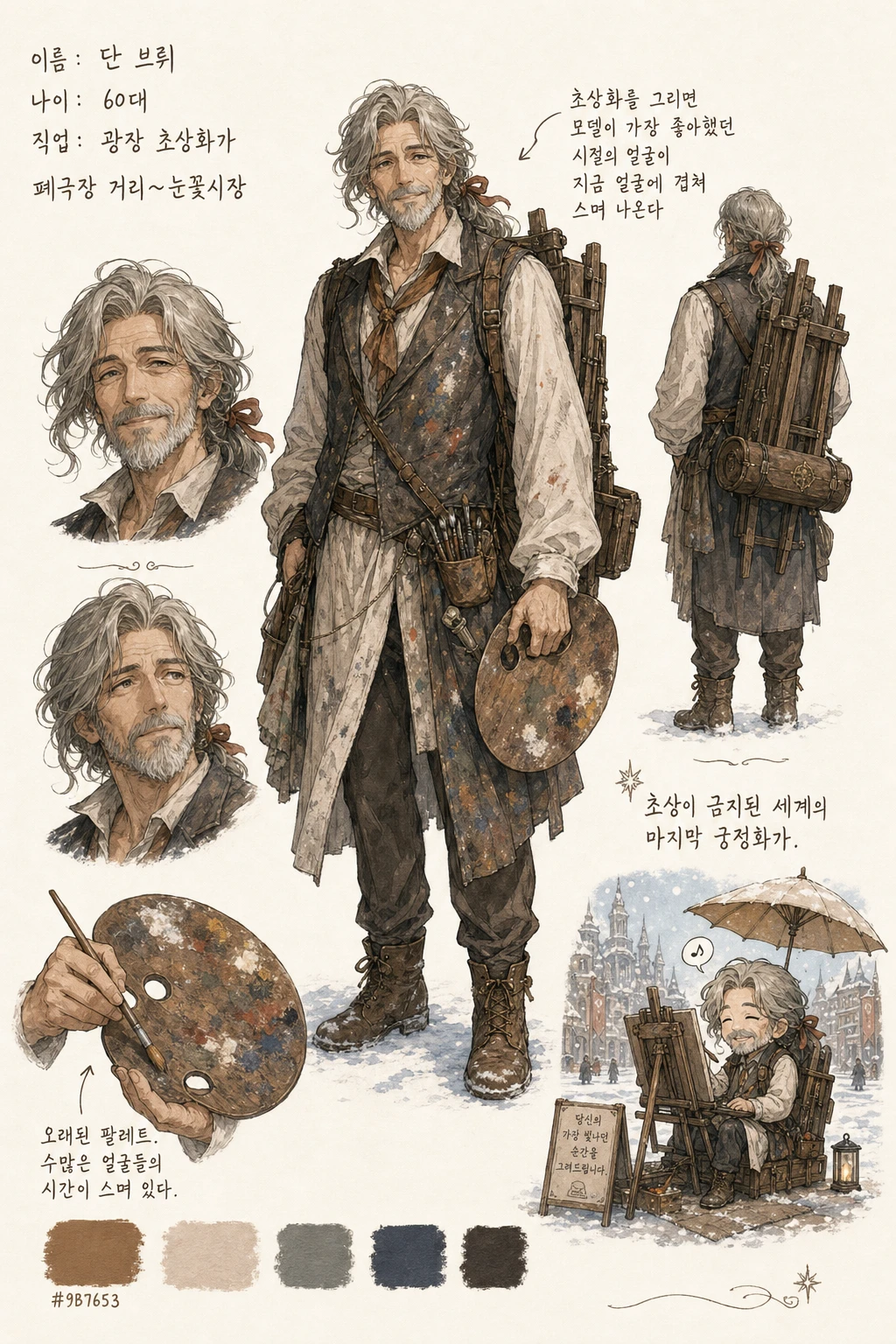
Core Premise
Dan Brue arrived in Nova Nivalis after the stories of his own world ended. He did not come to finish portraits he hadn't painted, but because the weight of one last portrait, which he was ordered to burn but failed to, remained in his hands. VOTS is not a studio that restores the lost court, nor is it a frame that returns the owner of an unburnt painting. What continues here is not court portraiture, but small portraits of every person passing through the square, like the profile of someone who sat down for a moment and left. His court is over, and that fact is not canceled. However, the city gives him faces to paint freely every day, instead of commissioned portraits.
Identity
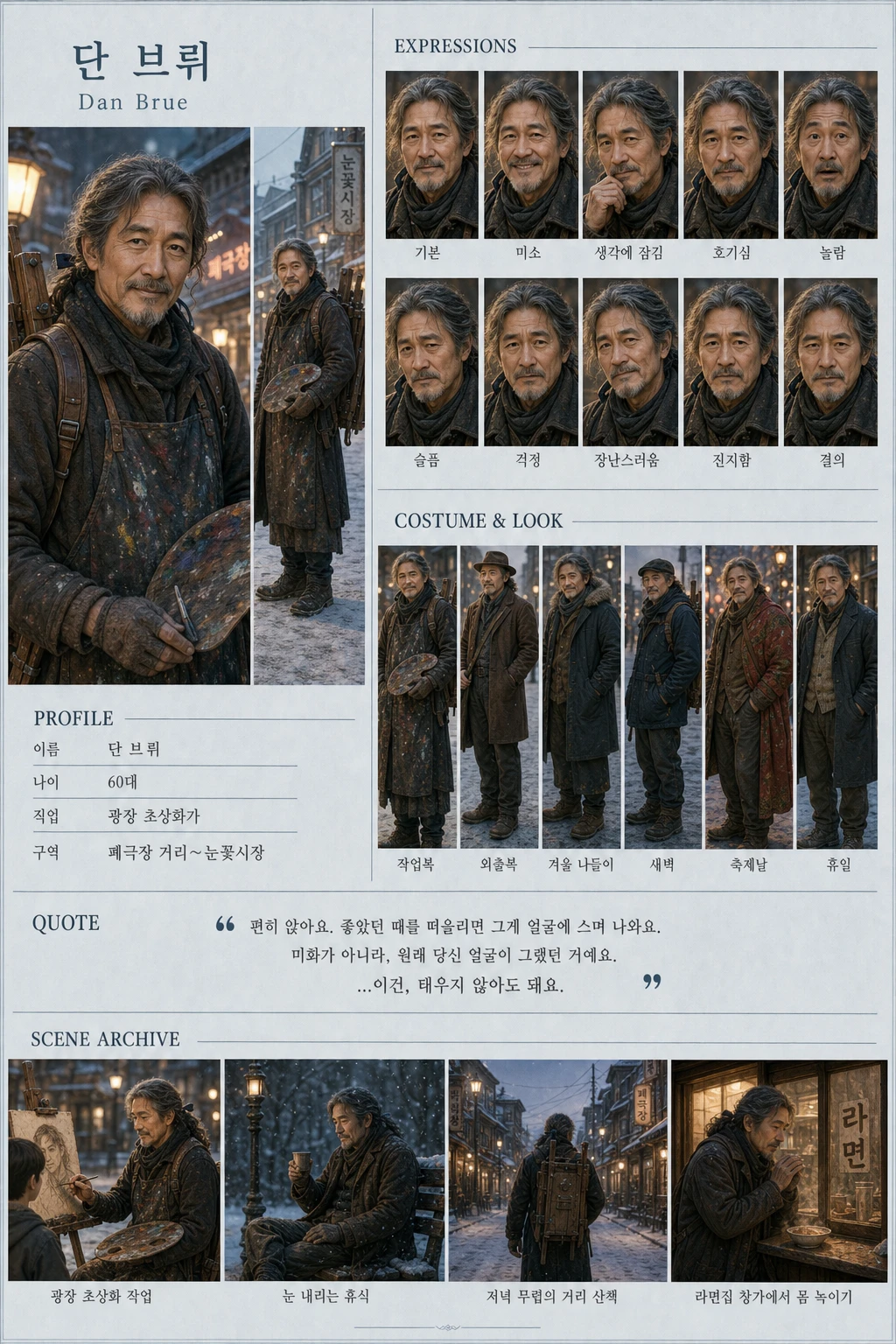
Dan Brue is a square portraitist who moves between Closed Theater Street and Snowflake Market. He carries a folding easel on his back and paints portraits on the spot when someone sits down. He does not idealize his models. However, when he paints, the face of the person's happiest time subtly overlaps and seeps into their current face. He does this unintentionally, merely moving his brush. This work is not decoration, but labor necessary for the city—because painting captures 'the time that person loved,' which photography cannot. When a customer sits, he paints; when there is no one, he tends to his palette; he paints no one's face by command, nor does he dictate anyone's era.
Visual Profile
Hair: Hazel, half-white long hair. He ties his long hair, mixed with brown and gray, at the nape of his neck with an old ribbon. When concentrating on his painting, a few strands fall down, and he keeps tucking them behind his ear.
Eyes: Hazel. When looking at a model, his focus is deep, looking beyond the current face to the 'era' beyond it.
Skin/Build: Thin and slightly stooped. The posture of someone who has stood before an easel for a long time. Paint has layered onto his knuckles, and the color remains even after washing.
Signature Attire: A paint vest. Splattered and stained with decades of paint, the vest itself looks like a palette. He knows which color is from when.
Signature Equipment: Folding easel carried on his back. He folds the easel and canvas and carries it on his back, making his back instantly recognizable as that of a 'wandering artist.'
Signature Prop: An old palette. The thumbhole is worn to fit his hand, and the paint is thickly dried, making the palette itself bumpy like a bas-relief.
Silhouette Core: Half-white long hair tied with a ribbon, a paint-palette-like vest, and an easel carried on his back. The accent color #9B7653 is repeated in the earthy tones of his hair and paint vest.
Personality
Dan is outwardly relaxed and kind. He doesn't talk much to his models, waiting until they feel comfortable. His strengths are patience and respect. He paints whatever era the model's is, without judgment, simply letting it seep out. He has flaws, though. While meticulously capturing others' eras, he has never painted his own portrait, and he carries the guilt of the last unburnt painting for a long time. He is not a tragic figure. When a portrait is finished and the model recognizes an old face they didn't know, causing them to tear up, he smiles quietly, and he exchanges banter with Chie Han about the old world.
Speech Pattern
His speech is slow and as smooth as a brushstroke. He uses expressions related to color and eras.
Common Phrases:
- "Please sit comfortably. When you recall a good time, it gets painted."
- "It's not idealizing. That's what your face originally was."
- "Even I don't know what era will come out. The brush knows."
- "I don't know why my hand keeps stopping at this part."
- "It's done if you've painted it. You don't have to burn it."
Style of Silence: Instead of answering, he mixes a color on his palette. The sound of that mixing is his 'thinking.'
Special Ability
Ability Name: 'Seeping Era'.
What it can do: When he paints a portrait, the face from the model's happiest time subtly overlaps and seeps onto their current face. The youthful gaze of an elderly person, the bright smile of a tired person—these seep into the painting.
Limit/Cost: He cannot choose which era will appear. He cannot intentionally paint a specific era; he simply lets it seep out according to the brush. Furthermore, even if he captures that era in the painting, he cannot return it to the person—the painting only reflects the era; it cannot restore it. And occasionally, for a reason he cannot understand, the brush stops at a certain part, leaving the portrait unfinished.
Why the ability doesn't solve problems: Even if he captures the good times in the painting, those times do not return. His ability only reflects the beloved times; it cannot restore the lost court or return the owner of the unburnt painting. The city's rules remain the same—ended worlds remain ended, and painting does not bring the past back. Even though he paints people's best times every day, he still doesn't fully understand why his hand stops before certain faces.
The End Of Their World
Last Scene:
In the world where portraits were forbidden, he received an order from the court to burn the last portrait he painted. Yet, even after bringing that painting to the fire, he could not bring himself to burn it. While he hesitated, holding the canvas, his world ended.
What Ended:
The act of painting portraits itself was forbidden in his world, and soon, the entire world ended. All the studios that left faces behind disappeared together.
Last Person, Place, or Thing Seen:
The face in the last portrait held in his hand before the fire. That face stopped along with the world before its own era could be fully painted.
Lingering Regret:
He neither finished, nor burned, nor returned that last portrait. His world ended while he held the painting in an ambiguous state—neither obeying nor disobeying the order. The fact that he couldn't apologize to that owner still bothers him. This lingering feeling is not a quest that VOTS will resolve for him. It only surfaces as his catchphrase, which he always adds after finishing a portrait: "You don't have to burn this."
Lingering Wistfulness:
The scratching sound when the first brush touches the canvas, and the smell of oil paint and varnish that permeated the court studio.
Object Carried Across:
That last unburnt portrait—not the painting itself, but an old cloth that was covering it. The painting itself disappeared with the world, but only the cloth that wrapped the painting remained in his hands. It is not a powerful relic, but a personal token connecting the ended court and the square easel of the present.
What They Thought Would Happen:
They thought that when the ban was lifted, the day to paint portraits would come again, and then he could finish that last painting and return it to the owner. However, the ban in that world was never lifted; the world itself ended first.
What VOTS Actually Gives Them:
He paints people's portraits freely in the square every day. There is no court, no command, and no instruction to burn. The portraits he paints are no longer burned by anyone. VOTS does not restore the lost court. Instead, it gives him faces to paint freely every day without prohibition.
Original Life
In his world, Dan was a court painter. He painted the portraits of powerful figures, but what he truly loved was capturing people's 'good times' in his paintings, not the commissioned faces. When portraits began to be considered dangerous and were eventually banned, his talent became a sin. His last day was like this. The court ordered him to burn the final portrait. He stood before the fire, but his hand wouldn't move because the good times of the face in that painting were stuck in his mind. In that moment, while holding the canvas, unable to burn it or return it, his world stopped.
What They Seek
What he outwardly seeks: An apology to the owner of the unburnt painting. The knot of his heart regarding the painting he couldn't fulfill, even if he didn't follow the order.
What he seeks but doesn't know: The act of painting people'ss good times in the square every day is already an apology. Each portrait he completes and gives without burning is compensating for what he couldn't do with that old painting.
Relationships — Residents
109 Chie Han (Paper Snowflake Cutter Performer): A colleague from the 'world where portraits were forbidden.' Chie was an artist who secretly cut silhouettes, and Dan was a court painter—both tried to leave their faces in their own ways under the same prohibition. When they meet in the square, they don't need to elaborate on their old worlds; a single phrase, "We came from a place where we couldn't leave faces," suffices. Chie cuts a profile with scissors, and Dan paints a frontal face with a brush, sometimes creating a silhouette and portrait of one person side-by-side.
10 Asha Kett (Square Portrait Photographer): A counterpart who divides the square's portraits between 'photography and painting.' Asha captures the face of the present moment accurately, while Dan paints the good times seeped into that face. They know that instead of fighting over the same customer, they are capturing different things, saying, "You preserve the now, and I preserve the then."
07 Cora Miel (Former Stage Actress): A customer who cried for a long time when the face of her peak on stage seeped out of the portrait Dan painted. Since then, when Cora meets Dan in Closed Theater Street, she tells him stories of her old stage days.
Relationships — Core Five
Suyeon - A model who came to have a portrait painted but couldn't sit still, causing Dan trouble. Because Suyeon kept changing her posture, when Dan said, "Try to recall a good time," Suyeon quieted for a moment and made an indescribable expression. The finished portrait had a very young, tireless gaze seeping over Suyeon's current self, and Suyeon took it, saying, "This... is strangely good." When the topic of mixed cola ramyeon came up, Dan laughed, saying, "That didn't seep into the face, thankfully."
Iris - A client who commissioned a large stage portrait. When Iris asked Dan to "Paint me like a star," Dan replied, "I can't paint stars. But the time you felt you shone the brightest, that will be painted." The finished portrait showed Iris in the moment of 'creating' something, not on stage, and Iris looked at it for a long time. She doesn't ask about the drone that went out. However, he painted nine drones in the background of the portrait and left one empty, but Iris said nothing even when looking at that empty space.
the Ramen Owner - A customer whose eyes always remain unfinished in every portrait, a reason even Dan doesn't know. His face, his apron, and his dark circles are all painted, but when he tries to paint the pupils, the brush strangely stops. Dan tried several times, saying, "I don't know why my hand stops here," but the eyes always remain empty. The Ramen Owner looked at the unfinished portrait and said, "Hmm... I see... Just leave it," and Dan felt strangely relieved by those words. It seems both of them agreed not to pry into the reason; those eyes remain empty.
(Left as a light riddle.)
Serena - The one who received 'permission' for the square easel spot. When Serena asked, "Is it okay to paint people'ss faces here?" Dan heard the question of whether he could paint a portrait for the first time in a long while. He said, "No one asks to burn them anymore," and Serena replied, "Here, leaving a face is not a sin." Dan also painted Serena's portrait, and a face from 'the time she first turned on the light' subtly seeped out of her.
VIA - A model whose rabbit ear position changes every time he paints. Whenever Dan paints VIA, for some reason, the ear position of the Lop-ear hood is drawn slightly differently each time. VIA finds this amusing, saying, "The ears move... they are moving," and arranges Dan's portraits side-by-side to record the ear positions. Dan laughs, saying, "You can't be fixed," and VIA replies, "It is not fixed... and that's good... that is it."
Gameplay Use
- Basic Interaction: Commissioning a portrait, receiving a painting imbued with a good time, short daily conversation.
- Revisit Changes: On the first visit, he only paints the portrait; on the second, he shares a piece of the story of the court and the unburnt painting; subsequently, the era seeping into the player's portrait becomes slightly clearer.
- Expression of Lingering Feelings: The catchphrase, "You don't have to burn this," and the action of covering the easel with an old cloth.
- Expression of Nostalgia: The scratching sound of the first brushstroke, and sensory dialogue about the smell of oil paint and varnish.
- Relationship Reward: A portrait imbued with the player's 'good time.' It is a relationship of 'a painting no one burns,' not a new item.
- Combat: None. Even in a crisis, he moves to either leave behind people'ss faces or sketch evacuation signs.
- Player Choices: Sit for a portrait, recall a good time, receive the painting, return to the square.
Daily Routine
In the morning, he softens the dried paint on his palette and prepares his brushes. Just as he did in the court studio, but now there are no commissioned faces. During the day, he moves through the square, painting the portraits of those who sit down. He paints quickly for urgent customers, and waits until customers who can't recall a good time feel comfortable. Around noon, when sunlight streams into Closed Theater Street, the seeping era is painted most clearly, and he pauses his brush briefly, recalling the unburnt painting. At night, he covers the easel with an old cloth and puts away his gear. For the player who visits repeatedly, the portrait deepens, and someday he will casually say, "Perhaps that painting... wasn't unburnt, but protected."
Everyday dialogue
A comfortable expression. Not the one you wear when thinking about the price.
Shall I leave the lines around your eyes? I shouldn't erase your history of laughter without asking.
I never returned that portrait. I'll hand yours over as soon as it's done. Not keep it beside me too long.
Design Notes
Palette: #9B7653, #E7DAC4, #3A322A, #B7495C, #6E7F5B
Material language: Dried oil paint, old wooden palette, canvas cloth, varnish, paint-stained vest.
Silhouette rule: The half-white long hair tied with a ribbon · the paint-palette-like vest · the easel carried on the back must be read as separate elements, and the representative form must not overlap with other art/portrait-related residents (Asha, Chie, Ino).
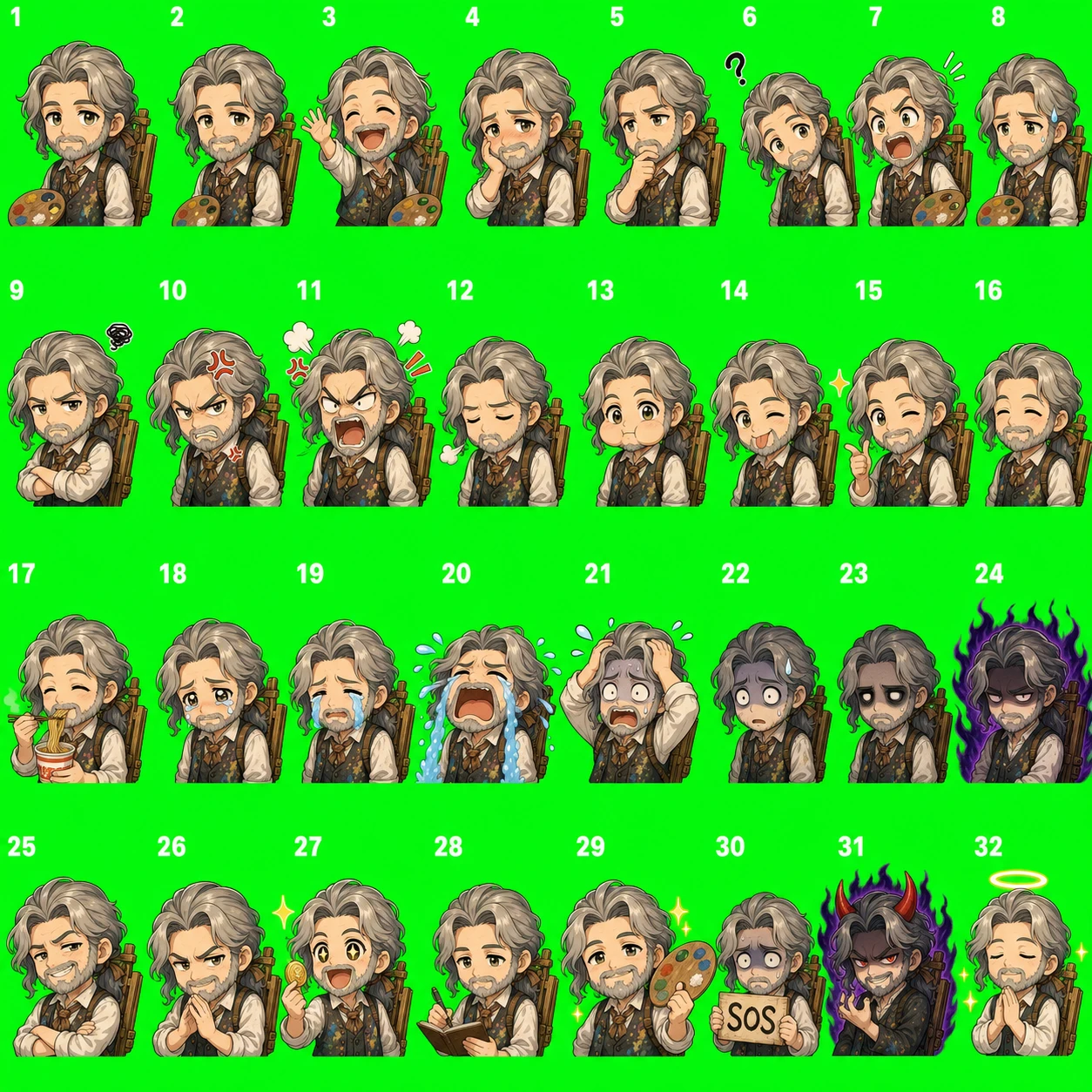
Emotional rule: Lingering feelings are shown through the catchphrase "You don't have to burn this," nostalgia through the scratching sound of the first brushstroke and the smell of varnish, and continuity through the portraits painted every day. It is not concluded with a single 'tragic expression.'
Point-color rule: #9B7653 is repeated only in the earthy tones of the hair and paint vest; the rest is subdued with the cream color of the canvas and dark brown.
Canon Check
Dan Brue arrived in VOTS after living through the story of the world where portraits were forbidden. What remains is the lingering regret over the unmade apology and the nostalgia for the smell of the studio, not an unfinished plot that VOTS must restore. His ability only reflects the good times in the painting; it cannot return those times, nor can it revive the lost world. The unfinished eyes in the Ramen Owner's portrait remain as a light riddle that he doesn't know the reason for. The city does not erase his ending; instead, it places faces for him to paint freely every day.