RESIDENT 131
Olga Sim
Lantern Oil and Wick Shop Owner · Silver Canal · 60s
Complete profile · All sections open
Download English profile (.txt)Archived source profile (Korean)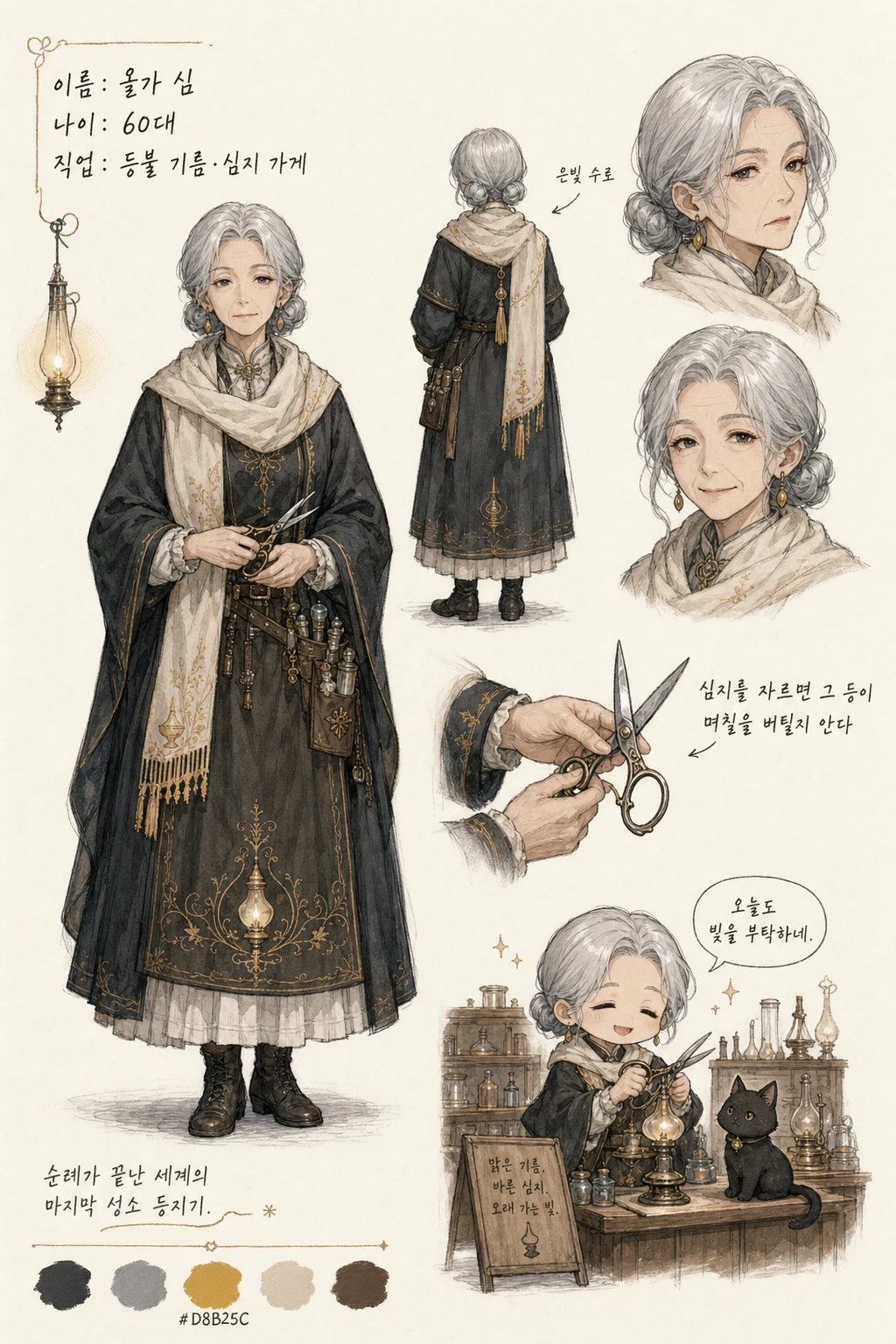
Core Premise
Olga Sim arrived at Nova Nivalis after living out the story of her own world to its end. She did not come to finish an unfinished event. The lamp of the sanctuary, which was said never to go out in her world, finally extinguished, and because the sensation of the wick and the smell of oil remained on her fingertips even after that final scene, she flowed into this city. VOTS is not a hall of judgment, nor is it a paradise to comfort the dead. What continues here is not a grand oracle, but the daily act of lighting and extinguishing a lamp, a single wick to gauge how many days it will last, a life like a small light hanging under an eaves. Olga lives in the city as someone who has already accepted this fact.
Identity
Olga Sim runs a small shop selling lantern oil and wicks at the entrance of Silver Canal. From the city's streetlights, the eaves lights of inns, the wicks by the windows of laundries, to the lanterns in the alleys leading to Dawn Fish Market—the materials for the light that illuminates the night pass through her hands. She does not treat fire as sacred. Rather, she treats it very practically, examining the viscosity of the oil, the thickness of the wick, and the soot on the lamp glass. When a customer comes, she checks the wicks; when there are no customers, she tightens the cap on the oil barrel. She never says she will illuminate anyone's sorrow, but without her materials, the night in this city grows a little darker.
Visual Profile
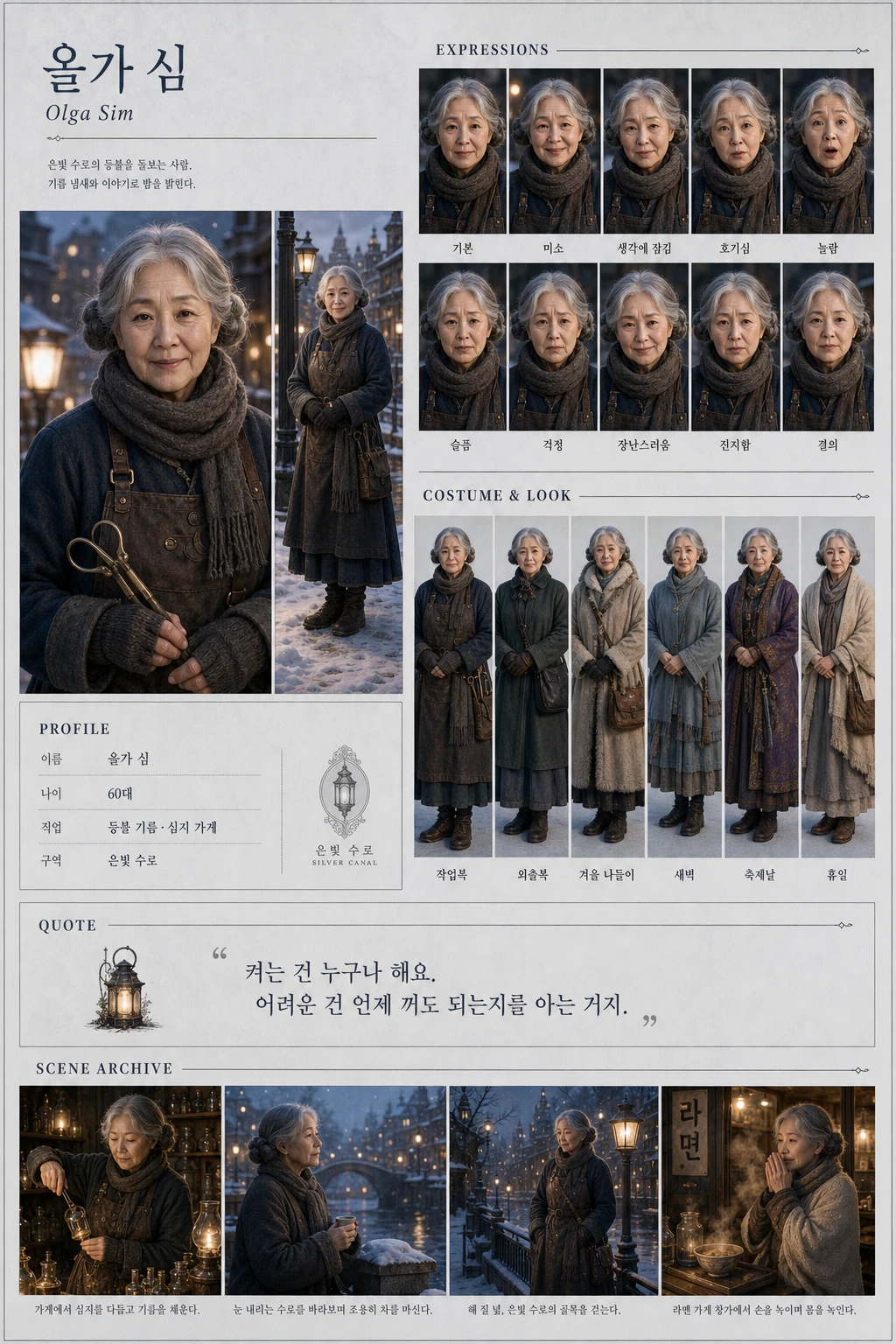
Her hair is silver-gray, styled in low twin buns on both sides. Though silvered by time, it is tied neatly without disarray, and stray hairs are pressed down with a scarf scented with oil. Her eyes are a dull brown, slightly narrowed, characteristic of someone who has looked at fire for a long time. She is short, but her waist is straight, giving her a rigid silhouette. Her skin is that of a woman in her 60s, with age spots on the back of her hands, and there are always faint oil stains on her fingertips and under her nails. Her signature attire is a dark brown apron with several small pockets where she can tuck in wick pieces, and an oil-scented scarf covering her neck and shoulders. Her signature prop is wick scissors with a polished handle—the blades are minutely misaligned, allowing only her to cut them to the exact length. The core of her silhouette is her small stature, straight waist, the rounded line of her scarf, and the wick scissors always held in her hand. The accent color is a warm gold, resembling the light of lantern oil, which signals her profession as 'one who handles the materials of fire' even in small sprites.
Personality
Olga is brief in speech and slow to judge. She has a habit of touching things with her hands before making a decision, so even during conversation, she fiddles with wicks or rags. Although she appears gruff on the surface, when a customer buys a lamp, she is the one to say something like, "It won't last many days." Her strength is her ability to observe objects and people for a long time, and her flaw is that she doesn't apply that gaze to herself. She knows exactly how many days someone else's lamp will last, yet she burns oil unnecessarily long in her own shop. She is not a tragic person. She exchanges trivial jokes with her regulars, and when children play with soot in front of the shop, she reluctantly hands them a piece of wick. However, once the night deepens and the last customer leaves, she habitually lights one more lamp inside the shop. She doesn't explain why to herself.
Speech Pattern
She ends her sentences abruptly and briefly. She uses polite language, but her tone leans toward practicality rather than courtesy. Frequent phrases: "It won't last many days.", "The wick is the problem; the oil is innocent.", "It's easy to light, but hard to put out.", "You have to touch it to know.". When her emotions intensify, she speaks less and her hands become busier. When silent, she answers in place of words by slowly opening and closing her wick scissors.
Special Ability
The name of her ability is 'Measuring the Remaining Flame'. When Olga picks up and cuts a wick with her fingertips, she senses how many more nights the lamp attached to that wick will last. The margin of error is about half a day. Her limit is clear. She can know the lifespan of the lamp, but she cannot extend it. No matter how carefully she cuts the wick, the fire goes out when the oil runs dry. And this sense only works on other people's lamps. Her sense of how long her own shop's lamp will last is wrong every time. The reason this ability doesn't solve her problems is clear. Within the rules of Nova Nivalis, a fire that goes out does not reignite, and what is finished is not canceled. Olga's ability only tells her 'when it will go out,' not 'how to keep it from going out.' So, her knowledge is less a comfort and more like rehearsing every farewell. She considers that the price.
The End Of Their World
Last Scene:
The night the great lamp of the sanctuary, which was said never to go out, finally dimmed on its own after several years of pilgrimage ceasing.
What Ended:
Faith and pilgrimage ended in her world, and all the fires sustaining the sanctuary went out one season after another.
Last Person, Place, or Thing Seen:
The moment the wick shriveled to red for the last time, and the empty corridor of the sanctuary with no one in it.
Lingering Regret:
The thought that if she had left the wick just a little longer before the lamp went out, perhaps it would have lasted another night. She gathered the wick that night and held it in her arms, but brought it without burning it.
Lingering Wistfulness:
That final tremor, a brief brightening at the tip of the wick just before the fire went out. The smell of the air warming inside the lamp glass.
Object Carried Across:
A piece of wick gathered from the sanctuary's last lamp, which didn't burn completely. It is now kept in a small drawer under the shop counter and is not sold.
What They Thought Would Happen:
She believed that if the fire went out, morning would not come.
What VOTS Actually Gives Them:
It lets her see for herself that even when the city's lamps go out every night, morning comes without fail. VOTS does not return the fire she protected. Instead, it gives her a place where she can live even with going out, the hands to cut wicks for the next night, and a life selling small lights to someone's eaves.
Original Life
In her world of pilgrimage, Olga was the keeper of the sanctuary's lamps. She guarded a great lamp, which was said to never go out through generations, grinding wicks and filling oil, and wiping away the soot of wishes left by pilgrims every night. Her job was not to create miracles, but to provide the materials for miracles to continue. As the pilgrimages gradually ceased, the footsteps passing through the corridor faded, and finally, after the last pilgrim had passed, the sanctuary was empty. Yet, the lamp remained lit. She ground wicks every day even when there were no customers. Then, one winter night, no matter how much she tended the wick, the fire kept flickering out. Even though oil remained. On the last day, she sat before the lamp glass and watched the wick shrivel to red until the very end. And after it went out completely, she used her scissors to gather the still-warm wick and held it in her arms as she left the corridor.
What They Seek
What Olga considers herself to be seeking is 'the peace of a lamp that is allowed to go out.' As someone who spent her life trying not to extinguish a flame, she wants to accept going out not as a sin, but as a natural occurrence. What she doesn't know, but must find, is the fact that she is already making that testimony every night. The countless lamps in the city go out every night, yet morning comes, and she cuts wicks again for the next night. That rhythm of going out and coming on again is the repetition of the 'morning that comes after going out,' which she feared so much.
Relationships — Residents
Haro Bendik (021, Glass Lamp Repairman) — The relationship between glass lamps and wicks. While Haro fixes a cracked lamp glass by hand, Olga selects the appropriate wick thickness for that lamp. The two bicker often over whether "the lamp glass comes first or the wick comes first," but in reality, they trust each other's hands the most. They work in silent coordination: when Haro finds the crack with his breath, Olga calculates how many days that lamp will last.
Lia Sero (091, Charcoal and Oil Specialist) — A neighbor whose materials overlap with charcoal and oil. Although they grumble about stealing each other's customers, they silently share barrels when their stock runs low.
Solenne Vey (004, Night Laundry) — They are those who illuminate the night of Silver Canal together. Olga notices when Solenne's window lamp frequently gets soot-covered and changes the wick to a slightly thinner one without being asked.
Relationships — Core Five
Suyeon - A regular who comes to buy wicks late at night. One day, when Suyeon asked, "Can this wick be used for firecrackers?" Olga cut her off, "No. That burns all at once; this one needs to burn for a long time." Suyeon looked dejected, but a few days later, she ordered separate wicks for performance props, repeating Olga's words exactly. Even while listening to Olga's side story about trying cola mixed noodles, Olga only opened and closed her wick scissors without interfering.
Iris - Iris once jokingly asked if there were wicks to fix a drone that had gone out. Olga replied seriously, "It's not a fire that can be made with a wick," and that answer seemed to comfort Iris in a strange way; since then, when passing in front of the shop, Iris occasionally lowers the trajectory of her nine drones to greet her. Olga does not ask about the one that went out.
the Ramen Owner - Regularly supplies wicks for the eaves lamp of the ramen shop. When Olga says, "This wick lasts three days," the Ramen Owner replies, "Hmm... I see..." and just writes 'three days' in his ledger. Olga finds it convenient that he records her words without judgment, so she cuts the eaves lamp wicks a little more carefully than for others.
Serena - Olga's shop was the first place Serena ordered oil for the city's streetlights. Serena asked, "May I light the lamp?" rather than commanding her to light it. Olga was taken aback by the question and replied after a long pause, "...It must be lit; it's night." Since then, on snowy days, Serena passes by the shop and leaves a word, "It's bright today too."
VIA - VIA passes by the shop every evening and records the number of wicks sold that day. "Today is twelve wicks... sold." At first, Olga asked what such a thing was for, but now, if VIA doesn't come near closing, she glances out the door. Olga is grateful that VIA records the existence of the unused wick pieces in the drawer under the counter but leaves them untouched.
Gameplay Use
- Basic Interaction: Buying wicks/oil, sensing lamp lifespan, short life conversations.
- Revisit Changes: On the first visit, she only sells items. From the second visit, she offers an observation like, "You keep this lamp lit for a long time.". If they become close enough, she mentions the existence of the drawer under the counter but does not open it to show it.
- Expression of Lingering Attachment: The habit of lighting one more lamp after the last customer leaves, and always stating the lifespan of her own shop's lamp incorrectly.
- Expression of Poignancy: A brief pause when watching the moment the wick shrivels to red, and sensory dialogue about the smell of the warmed lamp glass.
- Relationship Reward: Not a new quest item, but a small change that connects Olga and Haro to another resident's lamp problem.
- Combat: None. Even in danger, her priority is to protect the light or illuminate the path.
Daily Routine
In the morning, she extinguishes the shop lamp that was lit all night and wipes the soot from the lamp glass. This wiping is not a solemn ritual, but merely preparation for the next night. During the day, she checks the oil barrels, organizes inventory by wick thickness, and serves customers. When Haro brings in a lamp glass, they match the wicks together, and she exchanges materials with Lia. In the evening, she watches the city's lamps light up one by one from the doorway—she roughly knows which window her sold wicks are burning in. When the last customer leaves late at night, she habitually lights one more lamp inside the shop, touches the drawer under the counter once, and closes the door. If someone visits repeatedly, the 'one more' lamp she keeps lit burns out a little earlier. This is a sign that she is slowly accepting the going out.
Everyday dialogue
Refill the oil first. Demand willpower alone from a flame and it complains with smoke.
This much wick. Thrift is fine. No need to make the flame miserly too.
I brought that night's wick with me. Picked it up intending to burn it… and it's still in my hands.
Design Notes
Palette: #D8B25C, #6B5A3E, #2E2A24, #C9BCA0, #8A5A3C
Material language: Sooted brass, oil-stained cloth, dry wicks, glass lamp glass, worn wooden counter.
Silhouette rule: Small stature, straight waist, the rounded shoulder line of the scarf, and the wick scissors in her hand must be read separately and not overlap with other characters.
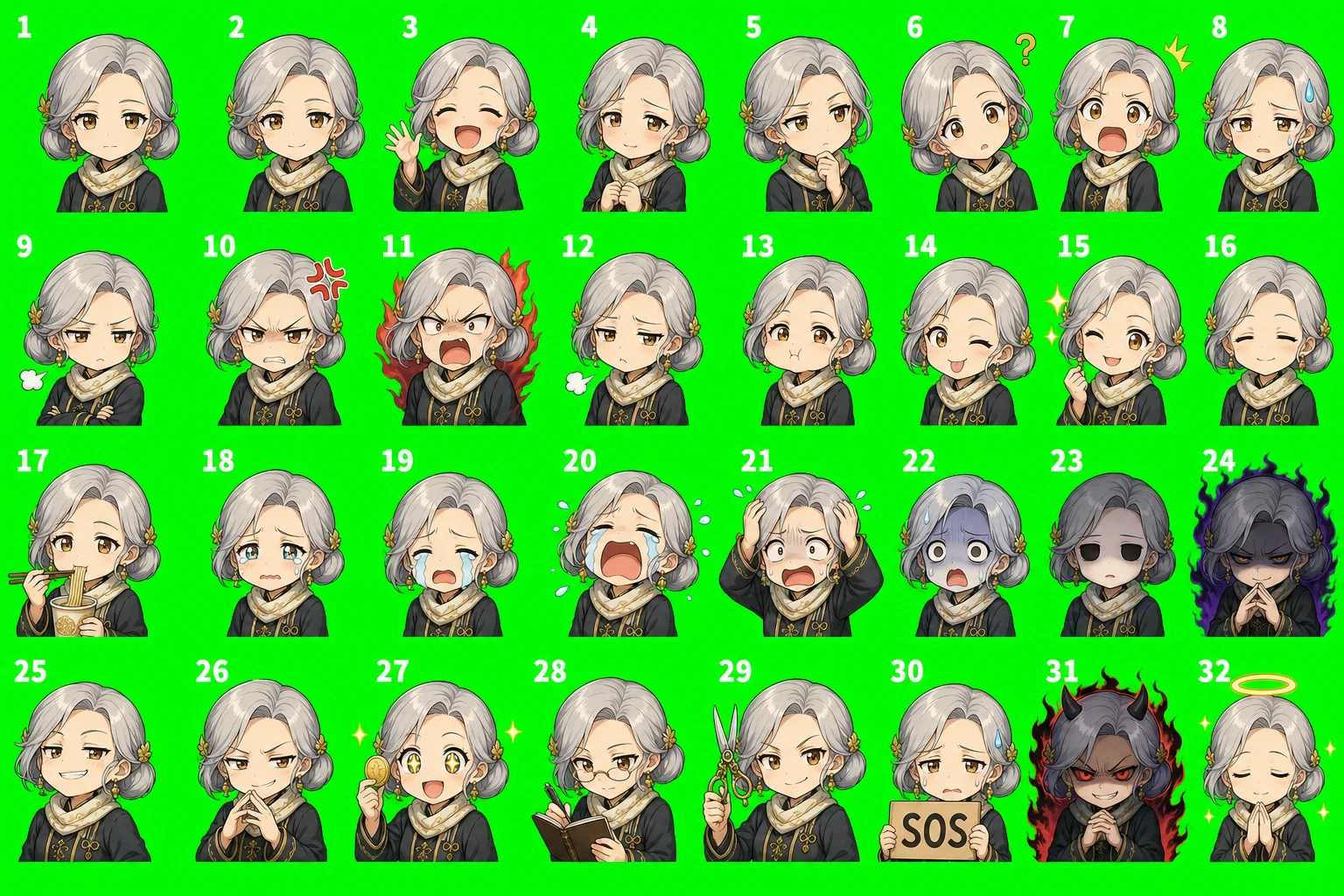
Emotional rule: Lingering attachment is shown by 'lighting one more lamp,' poignancy by the wick's final tremor and the warmed smell, and continuation by the daily repetitive action of cutting and selling.
Canon Check
Olga Sim's world has already ended. The extinguished sanctuary lamp does not come back to life in VOTS, nor can her ability reverse it. What remains is the sensation of rehearsing the going out, and a piece of wick that didn't burn completely, and Nova Nivalis attaches a new daily flame next to it. The city promises no salvation; it opens its doors but does not pull her in, and it keeps her by its side without owning her night.