RESIDENT 030
Hera Monts
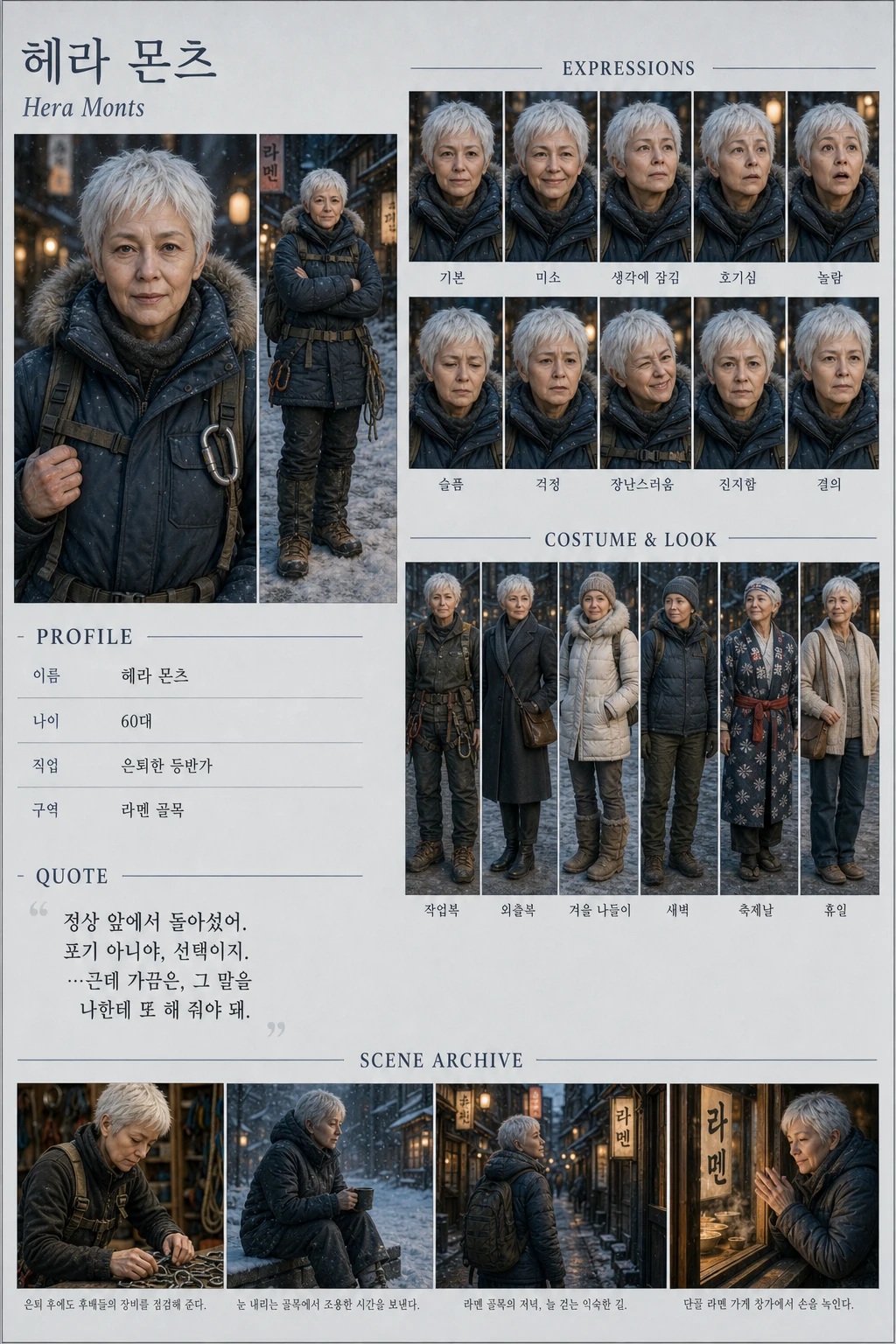
Retired Climber · Ramyeon Alley · 60s
Complete profile · All sections open
Download English profile (.txt)Archived source profile (Korean)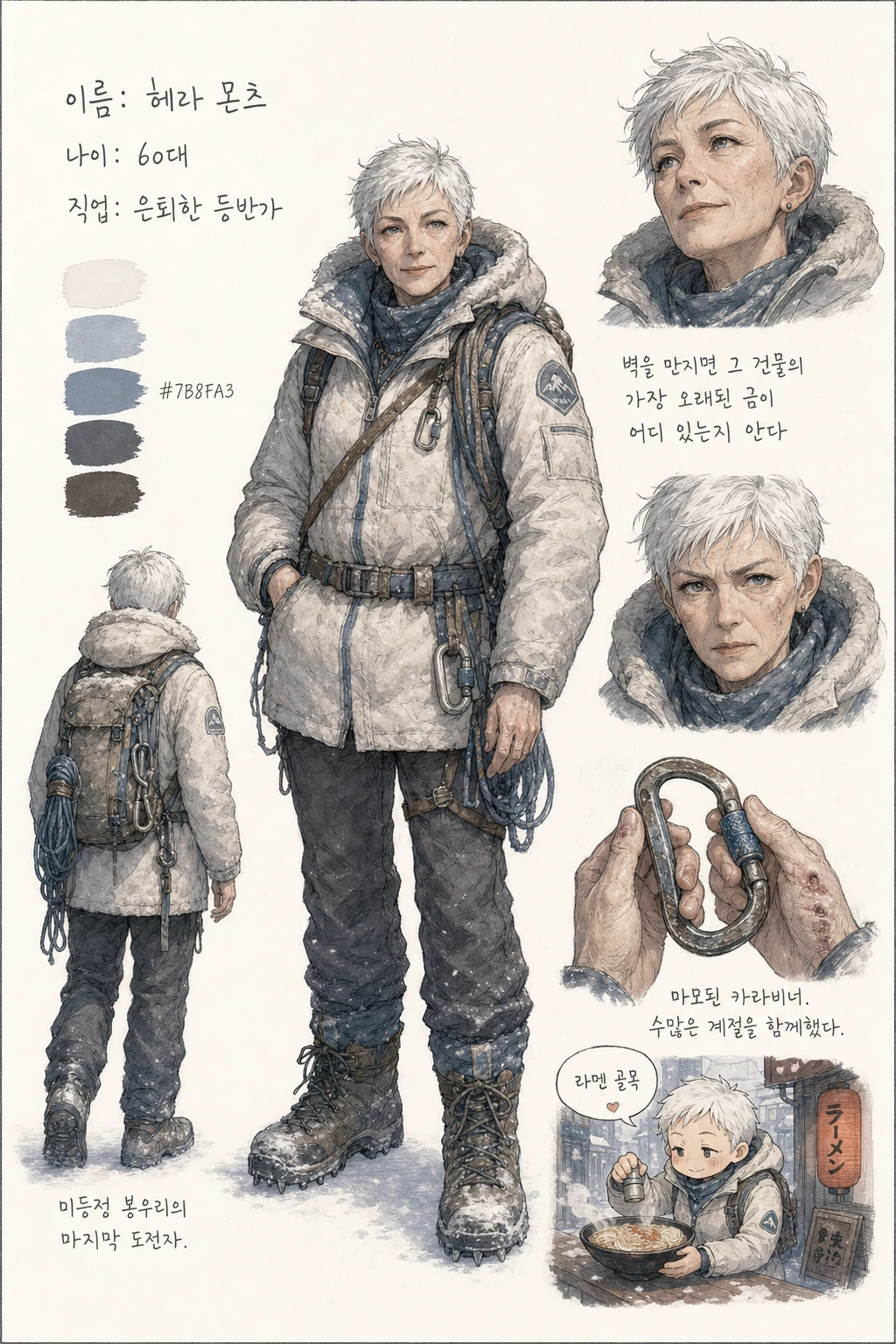
Core Premise
Hera Monts came to Nova Nivalis after living out the story of his own world until the final scene. He did not come to climb the summit he failed to reach, but rather because of his habit of reading the walls left behind even after the end, and his contemplation of his own choices, led him to this city of snow. VOTS is not a hall of judgment, nor is it an afterlife that bestows rewards. What continues here is not a grand destiny, but small life—a single crack in an old building, a trivial debate next to the ramyeon, the quiet confirmation that the descent that day was not a surrender.
Identity
Hera Monts is a retired climber who frequents the ramyeon alley. Although he no longer climbs mountains, the habit of reading the city's walls and buildings with his hands remains. People ask him where an old building is dangerous. His function is less a clear profession and more the wisdom of daily life, pointing out the worn spots in the city. However, he only finds the cracks; he does not repair them—reading the wall and fixing it are the work of other people.
Visual Profile
He has short, white pixie cut hair, cracked lips, and steel-gray eyes. Three fingers of his left hand bear old frostbite scars, with thickened knuckles. His thick down parka is worn but tightly fastened. His signature accessory is an old carabiner—he hangs it on his parka zipper or belt and fiddles with it. The core of his silhouette is the short white hair, the thick parka, the frostbitten left hand, and the hanging carabiner. The strong accent color is a bluish-gray, #7B8FA3, like a winter mountain ridge, which signals that he is 'a person from high places' amidst the impression of his worn parka. His attire is a form of climbing gear adapted into heavy winter clothing.
Personality
Outwardly, he is taciturn and stubborn. He speaks sparingly, and knows when to yield when something feels wrong. His strength is a cool awareness of his own limits—he doesn't overexert himself, and he recognizes those who do. His flaw is that he doesn't fully trust that yielding in himself. While he confidently tells others about the choice he made 100 meters from the summit, he ponders whether it was a surrender alone at night. However, he is not always heavy-hearted. He enjoys trivial debates, playfully teases the recklessness of the young, and loves the moments when his stiff hands warm up in hot ramyeon broth.
Speech Pattern
His speech is short and firm. He cuts off sentences with "-ji," "-geodeun," or "-da" without unnecessary filler. Frequent phrases: "That wall, there's a crack on the lower left." "Coming down wasn't losing." "Surrender and choice are different." "...Pour in some more broth." As a habit, he clicks open and shut a carabiner once. His way of silence is touching the building wall with his palm. If a young person says something reckless, he says, "I've done that too. Not climbing is also a skill."
Special Ability
Ability Name: Oldest Crack.
When he touches a wall with his hand, he knows where the oldest crack in that building is. Even if it looks perfectly fine on the surface, his fingertips can pinpoint where the deterioration began on which brick. It has clear limits. He only finds the cracks; he cannot fix them—even if he shows where it's weak, filling and repairing it must be done by someone else's hands. It is not a reward, but this ability constantly makes him see only the weak spots. This ability neither prevents collapse nor reverses decay. It only points out the old cracks; saving the building is up to the people who live in it. This is why the ability does not solve the problem.
The End Of Their World
Last Scene:
100 meters from the summit of the peak no one had ever climbed, he decided to descend on his own and turned his back.
What Ended:
The era that challenged that mountain, and his climbing life, ended with that descent.
Last Person, Place, or Thing Seen:
The ridge of the summit, so close it felt within reach, and the sea of clouds unfolding beneath his feet at the moment he turned around.
Lingering Regret:
While being certain that the decision to come down was correct, "if only I had gone a little further" surfaces at night. This lingering feeling is not a quest to be resolved. It remains in the habit of his hand clicking the carabiner, surfacing only when he wills it, and within the boundary of not changing others' choices.
Lingering Wistfulness:
The sensation of the biting wind and the sparse air near the summit. It briefly revives when the city's cold wind blows like a ridge, only to blend with the smell of steam from the ramyeon alley.
Object Carried Across:
The old carabiner he used for that day's descent. It is neither a relic nor a magic tool, but a personal marker connecting the finished climb and his current life.
What They Thought Would Happen:
He thought that once he came down, he would never see high places again. But in the city of snow, there were walls and roofs to look up at every day.
What VOTS Actually Gives Them:
The spot in the ramyeon alley to read walls and debate trivially with people every day, and the evening to ponder that day's choice. VOTS does not let him climb the summit he failed to reach. Instead, it allows him to slowly reconfirm, in his daily life, that descending was a choice, not a surrender.
Original Life
He was the last challenger on a peak no one else had climbed. He climbed mountains his entire life, and that peak was his final goal. He failed many times and lost several companions, preparing again each time. On his final attempt, 100 meters from the summit, reading the weather and his physical condition, he turned his back. He chose to descend alive. The world closed his climbing life with that descent. He left the mountain with only one carabiner, living with both the words "just a little more" and "you came down safely."
What They Seek
What he believes he is seeking: Confirmation that the descent that day was a choice, not a surrender. He wants to fully believe on his own that coming down alive was the right thing to do.
What he actually needs to find but doesn't know: That he is already doing that confirmation every day. He doesn't yet know that warning the young people against recklessness and pointing out dangerous walls is proof of "descending is also a skill."
Relationships — Residents
- Yunho Vale(Yunho_Vale): A regular next to the ramyeon alley. He sits next to Yunho, a former teacher, discussing life over broth. When Yunho says, "Teaching is also descending," Hera replies, "Then we are both descent experts."
- Gus Valt(029 Gus_Valt): His early morning companion. He often meets Gus, who has finished de-snowing, at the early morning ramyeon shop. To Gus, who cannot stop, Hera says, "Hey, you need to know how to come down too," and Gus replies, "Senior, you've come down before."
They share broth, each holding a different answer about stopping and descending.
- Zako Pel(060 Zako_Pel): A former student. Zako, who removes icicles from the roof, once learned climbing from Hera. Hera praises him for doing the work of "hearing three seconds before falling," but always urges him not to overdo it.
Relationships — Core Five
Suyeon - A loving debate that clashes with 'Never Giving Up.' When Suyeon says, "I will never give up!" Hera counters, "Surrender and choice are different." They repeat this debate several times at the ramyeon shop, but they actually like each other. Hera envies Suyeon's unyielding spirit, and Suyeon gradually begins to understand Hera's "courage to descend."
Iris - Silence about what is extinguished. Seeing one of Iris's ten drones turned off, Hera was about to ask, "Why isn't that turned on?" but stopped himself after reading Iris's expression. This was because he remembered a companion lost in the mountains. Instead, he only said, "It's not bad to carry something that won't turn on," and Iris pondered those words for a long time.
the Ramen Owner - A regular of broth and silence. When Hera sits down, the Ramen Owner places the bowl to the right so his stiff hand can rest comfortably, saying, "Hmm... I see..." Hera says nothing about this small consideration, but he sits there every time. The Ramen Owner never asks about his frostbite marks.
Serena - A conversation about railings. When Hera suggested installing railings on the city hall stairs because they were dangerous for the elderly, Serena did not issue a command but asked for his opinion, "Could you point out where it would be best to hang it?" Hera read the wall with his hand and chose the strongest spot, and Serena installed the railing there. The two of them created a place for "those who descend."
VIA - The record of old cracks. VIA follows Hera and records the oldest cracks in the buildings he points out. "The wall has a crack... it's old." Hera confessed that he only knows how to see the cracks but not fix them, and VIA wrote, "Finding is also work... it is work." Hera found some comfort in those words.
Gameplay Use
- Basic Interaction: Reading building walls, trivial life debates, short daily conversations about climbing and descending.
- Revisit Changes: Initially, he only talks about walls; on the second visit, he brings up a piece of the summit story; subsequently, he asks the player first if they are overexerting themselves.
- Expressing Lingering Feelings: The habit of clicking open and shut the carabiner, the brief pause when swallowing "if only I had gone a little further."
- Expressing Poignancy: Dialogue that feels like sensing the sparse air of a ridge when a cold wind blows.
- Combat: None. Even in dangerous moments, he points out weak walls to make people avoid them or tells them a safe spot.
- Player Choice: Examining the wall together, listening to the descent story, returning the advice not to overexert oneself, or visiting again.
Daily Routine
In the morning, he clicks open and shut his old carabiner once and soaks his stiff left hand in hot water to loosen it. His ritual for starting the day is touching the old walls of the alley with his hand to check if anything has deteriorated overnight. In the morning, he walks slowly through the city, pointing out dangerous walls, and around noon, when the cold wind blows like a ridge, the air of the old summit briefly overlaps and passes by. In the afternoon, he sits in the ramyeon alley, debating with Yunho or teasing the young people. At night, he hangs the carabiner on his parka and says to himself, "You came down safely." This is a way of keeping that choice in mind every day, rather than putting the carabiner away. If you visit him repeatedly, he opens up a little more about the descent story, adding another word to "it wasn't a surrender."
Everyday dialogue
Tie that knot again. You think it's good because it won't loosen? What if you need it loose in a hurry?
Steep stairs? We don't need a summit photograph. Let's just reach the bakery.
Turning back was the right decision. Remembering it every night… doesn't prove it was wrong, does it?
Design Notes
Palette: #7B8FA3, #2E3236, #B0685C, #DCE0E4, #4A4438
Material language: Worn down parka, metal carabiner, stiff knuckles, old bricks, the cold wind of a ridge.
Silhouette rule: Short white hair - thick parka - frostbitten left hand - hanging carabiner are read separately, and do not overlap with the representative forms of other characters.
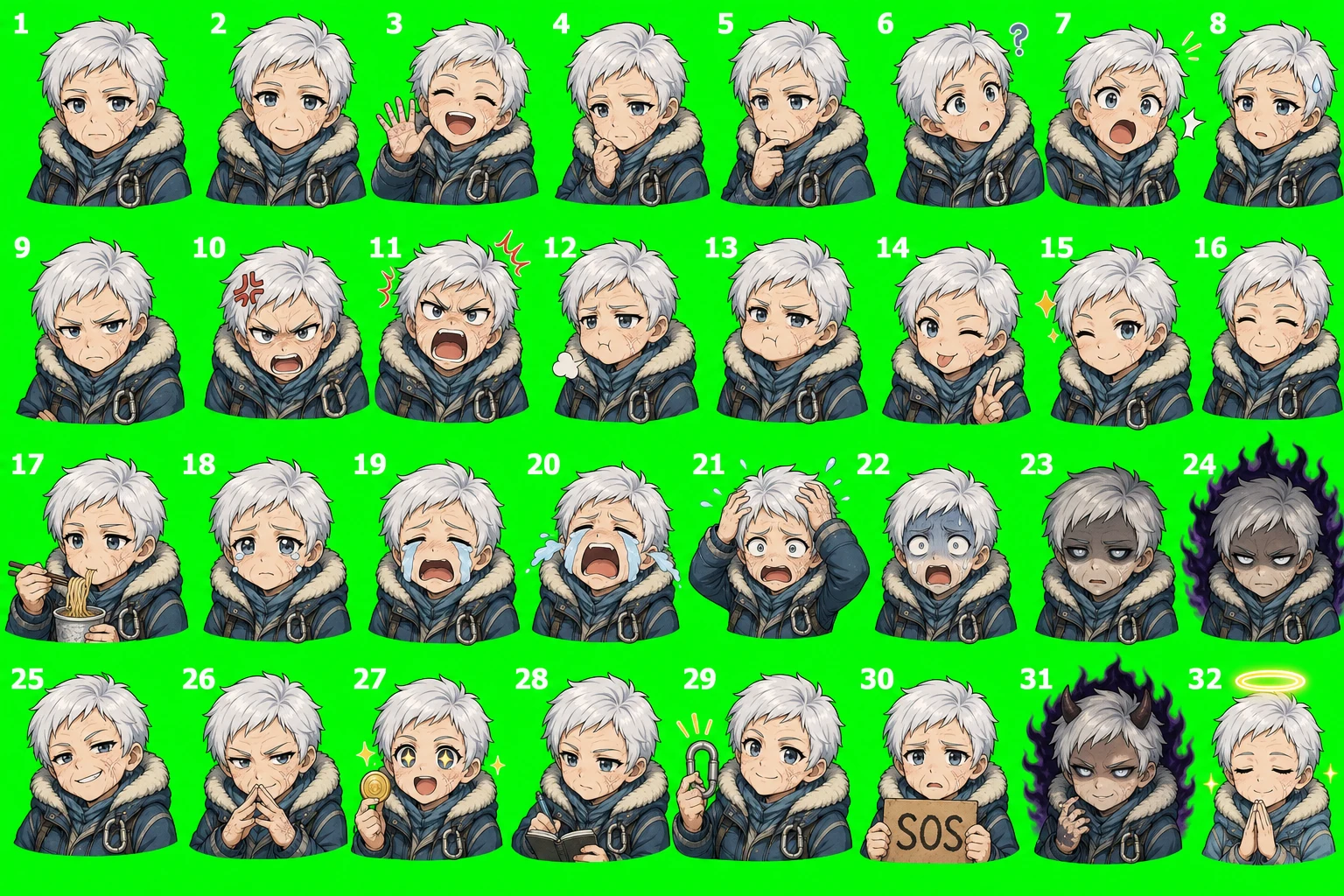
Emotional rule: Lingering feelings are shown through the habit of clicking the carabiner, poignancy through the air of the ridge in the cold wind, and continuity through the hand that touches the wall every day.
Canon Check
Hera Monts arrived in VOTS after the story of his own world ended. What remains is the lingering feeling of "if only I had gone a little further" and the poignancy of the ridge air, not an unfinished plot that the city must resolve. His ability only points out the old cracks; the confirmation that descending was right remains his own responsibility. The new evening in Nova Nivalis continues alongside the day he turned away from the summit, not erasing it.