RESIDENT 089
Muna Feb
Late-Night Radio Story Writer · ramyeon Alley · 20s
Complete profile · All sections open
Download English profile (.txt)Archived source profile (Korean)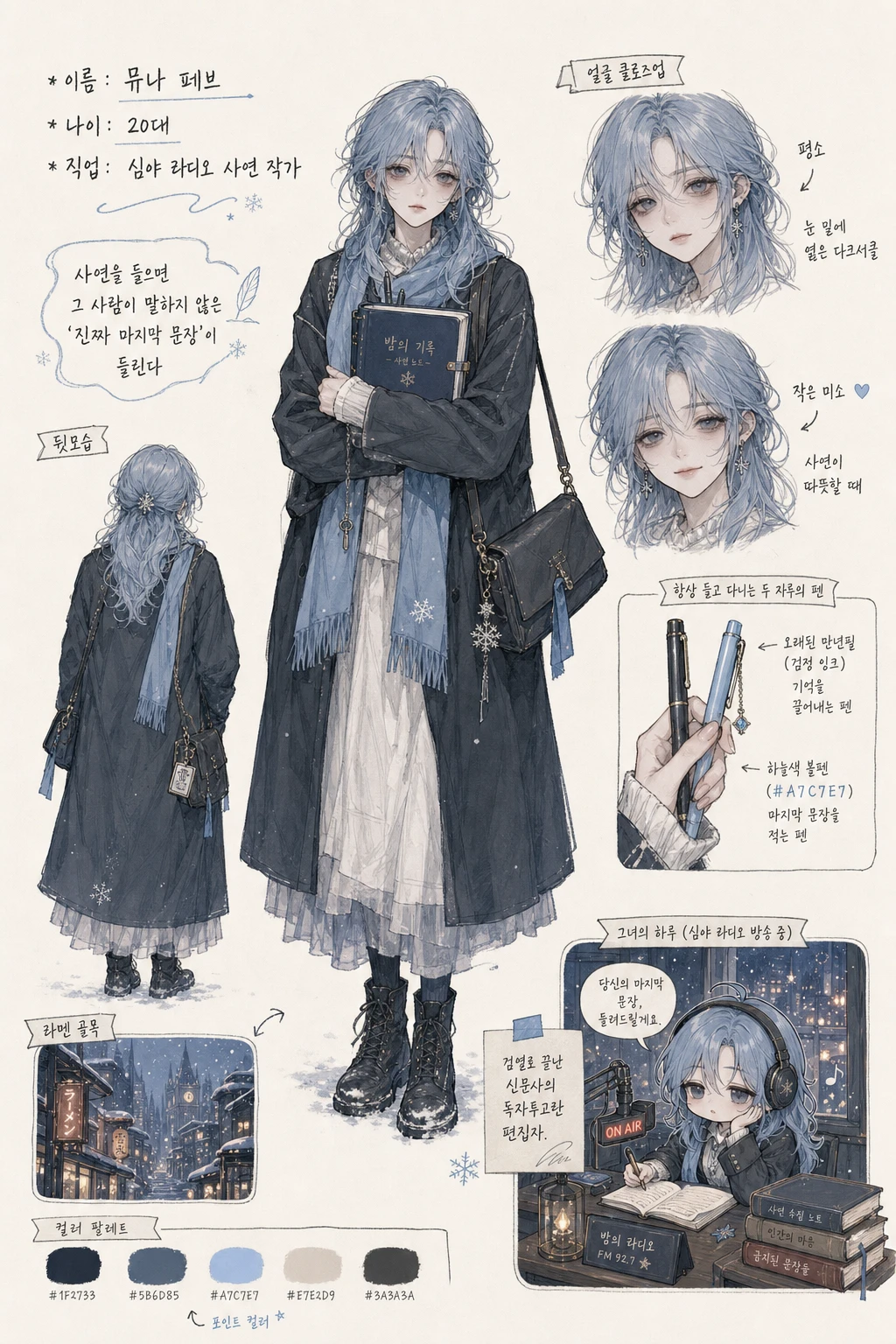
Core Premise
Muna Feb is someone who came to Nova Nivalis after the stories of her own world were closed by censorship. She didn't come to publish the stories she couldn't fit, but rather, the habit of listening to people's stories even after the last broadcast, and her affection for people, drew her to this city. This is not an afterlife, nor is it a place that restores erased writings. What continues here is not a massive scoop, but a life of sitting in a corner of a ramyeon shop, listening to people's stories, transcribing them into short pieces for the late-night radio, and choosing not to write certain sentences. Muna does not try to erase the fact that her newspaper ended. It is just that her ears, which used to be for the censorship drawer, can now be used in the night alleys.
Identity
Muna's workspace is a designated seat in the corner of a ramyeon shop in ramyeon Alley. She writes stories for the late-night radio—transcribing the stories people tell into short, subdued pieces, and passing them on to a late-night DJ like Roko Banz. Her job is a necessary labor for the city's nights. Because sleepless people listen to similar stories on the radio and feel a little less lonely. When she listens to a story, she hears the 'true last sentence' that the person couldn't bring themselves to say, but she never writes it down. It is her professional ethic not to conclude someone else's story.
Visual Profile
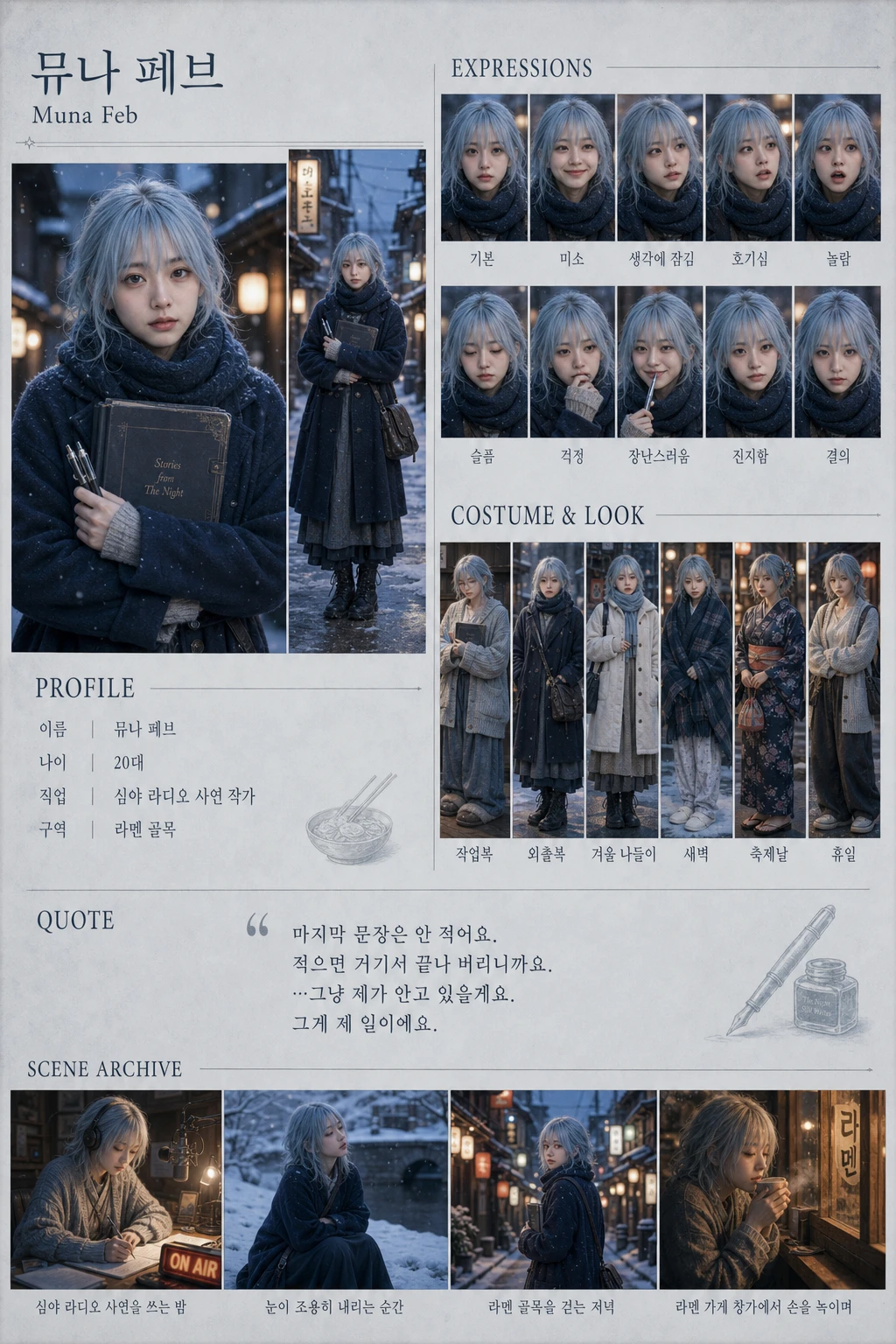
Hair: Dawn-light pale blue layered cut. One side is slightly pressed down as if she has stayed up all night.
Eyes: Pale grayish-blue, with faint dark circles underneath. Her gaze drops when she listens to a story.
Skin/Build: Pale and thin, with ink and pen stains on her fingers. She always holds a large notebook to her chest.
Signature Outfit: A knit sweater with extended sleeves, a large cardigan, two pens tucked behind her ear and in her pocket. An old cord, like a radio station access badge, around her neck.
Signature Props: A large notebook for writing stories, two pens she always carries (one for writing, one for not writing).
Silhouette Core: Pale blue layered cut, the notebook held to her chest, the pen behind her ear. The accent color #A7C7E7 (dawn blue) is repeated on her cardigan and notebook cover.
Personality
Quiet, a good listener, and accustomed to being awake at night. She speaks little and listens to others for a long time. When listening to a story, she neither offers casual comfort nor judgment. Although she appears composed on the outside, there is a heaviness within her regarding the unwritten words. Her flaw is that she never talks about her own story—she listens to others' stories all day but tells no one her own last sentence. That is why the dark circles remain faintly, from carrying the memorized words all night. Still, on nights when her written story is read on the radio, she smiles just a little.
Speech Pattern
Soft and slow, she completes sentences. Formal language is standard, and she often asks follow-up questions.
Common Phrases:
- "And after that? ...No, you don't have to say it."
- "I'll put this on the radio. This... I won't write it down."
- "I don't write the last sentence. That belongs to you."
- "Everyone talks about similar things at night. That's why it's less lonely."
Habit: Fiddling with one of the two pens—when deciding whether to write or not. After a story ends, she briefly closes her notebook.
Silence Style: If asked about herself, she pulls her notebook closer to her chest and changes the subject. That silence means, "My last sentence is not for you."
Special Ability
Ability Name: The Unwritten Last Line
What it does: When Muna listens to someone's story, she hears the 'true last sentence' that the person never voiced aloud. That single sentence, swallowed while trailing off, is clearly audible only to her.
Limit/Cost: She can only hear it; she cannot change it, and most importantly, she never writes it down—because writing it down solidifies that person's story as having ended there. Instead, that sentence remains entirely in her memory. The accumulation of unreleased last sentences makes her nights perpetually a little heavy.
Reason for Not Solving Problems: Hearing the last sentence doesn't resolve the person's lingering feelings. And even if she were to write it down, she has no right to conclude someone else's story. All she can do is listen, choose not to write, and hold that sentence to herself.
The End Of Their World
Last Scene:
On the day the newspaper closed due to censorship, Muna read each of the reader submissions that couldn't be published in the final issue. She read them aloud and memorized all the words that couldn't be printed. After memorizing the last submission, she traced the typesetting frame, devoid of type, with her fingertips and left the editorial office.
What Ended:
The reader submissions section of the newspaper and all the stories piled up there, along with her work of transcribing strangers' writings into type, all ended together.
Last Person, Place, or Thing Seen:
The final typesetting frame, empty save for the missing type, and the dust from the printing room settling upon it.
Lingering Regret:
She still cannot forget a single word of the submissions she memorized that day. Although she memorized the unprinted words for others, the fact that she couldn't put them anywhere weighs on her heart. This lingering feeling is not a quest to be resolved, but remains only as her habit of not writing down the last sentences she hears from people.
Lingering Wistfulness:
The smell of ink being heated just before the printing press ran, and the sound of type being pressed onto paper. The smell of ink, the weight of the pen, briefly revives when they appear.
Object Carried Across:
An old piece of typesetting type missing one character. She knows what the character was. She never knows what sentence it belonged to.
What They Thought Would Happen:
She believed that someday, when censorship was lifted, she would be able to publish all the words she had memorized. But the newspaper never reopened, and the memorized words had nowhere to go.
What VOTS Actually Gives Them:
The people who tell her stories every night, and the radio that transcribes them into short pieces for broadcast. The city does not give her back her newspaper. Instead, it gives her a place where she can live with the unprinted words, a relationship where she only listens without owning the last sentence, and a way of deciding for herself whether or not to write.
Original Life
An editor for the reader submissions section of a newspaper that ended due to censorship. She was responsible for selecting stories sent by strangers and putting them into print. As censorship tightened, the number of articles that could be published decreased, and unprinted submissions piled up in the drawers. On the last day the newspaper closed, Muna took out all the submissions from the drawer and read them aloud, memorizing them. If they couldn't be printed, she would keep them alive as people. After memorizing the last submission, she traced the typesetting frame, devoid of type, with her fingertips and left the editorial office, placing a single empty piece of type in her pocket.
What They Seek
What she seeks on the surface: A place to put down the unwritten words. She wants to offload the stories she has memorized and feel lighter.
What she doesn't know she needs to find: That memorized words are not meant to be put down, but passed on. She doesn't yet know that stories become hers and theirs only when they continue into someone else's night, rather than being discarded.
Relationships — Residents
Rina Parable (Story Runner, behind Threshold Market) — Story collection partnership. When Rina gathers stories while walking through the alleys, Muna refines them into radio stories. They often consult about "how much to write," and Rina agrees when Muna says, "It might be better not to write this one."
Roko Banz (Late-Night Broadcast DJ, Lantern Inn Alley) — Exclusive writer relationship. Roko reads the stories Muna writes on the late-night broadcast. On nights when her words are clearly heard to the end of the alley through Roko's deep voice, Muna smiles quietly from her corner seat.
Boldo Kane (119) — Fellow writer. Another person who writes at night. Muna and Boldo exchange and read each other's work, maintaining the promise, "Let's not correct each other's work."
Horo Mimi (Kim Seorim Window Painter, 82) — Companion of the unrecorded. Horo paints pictures that fade away when dry, and Muna hears the unwritten sentences. They often talk late at night about whether "what is not left behind is also a record," and they understand each other best.
Relationships — Core Five
Suyeon - The only guest without a last sentence. When Suyeon pours out her frustration directly while talking about mixed cola ramyeon at the ramyeon shop, Muna is surprised—Suyeon has almost no swallowed last sentences. Because she is someone whose emotions leak out directly, there is no last sentence for her to hear. Muna is a little envious of that, and happily records Suyeon's stories.
Iris - The one whose last sentence she didn't write down. When Iris speaks quickly about production matters, Muna hears the sentence swallowed beneath it—what lies behind the words that making is not dark. Muna didn't write it down, and she left what Iris didn't say about the turned-off drone as it was. They respect each other's unspoken words.
the Ramen Owner - The one who tolerates the designated seat. Muna writes stories all night in the designated seat in the ramyeon shop. the Ramen Owner always leaves that spot open and only writes in the ledger, "A customer was in the corner." He records only what he sees, and she records what she hears—the two of them uphold the same restraint in different ways.
Serena - The founder whose last sentence was heard. Even Serena, who imagines what doesn't exist as reality, has a swallowed last sentence, and Muna was surprised when she heard it. Serena never asked Muna to read the words she memorized; she simply agreed, "You may keep them."
Without command or viewing, she acknowledged Muna's heavy notebook as it was.
VIA - The rabbit who decided to divide the record-keeping. Muna and VIA agreed not to compete over the subjects of record, but to share them. VIA records the remaining trivial traces—ramyeon bag, receipts, names—and Muna takes on the side of not writing the swallowed last sentences. VIA said, "You take what is not written... I write what remains."
Gameplay Use
- Basic Interaction: Listening to stories, transcribing short pieces for the radio, conversations in the night alley.
- Revisit Change: Remembers the stories the player told, but neither writes nor asks about the swallowed last sentences. On repeated visits, she gradually shows that the memorized words are heavy.
- Expression of Lingering Feelings: The habit of fiddling with the two pens, the pause when closing the notebook at the end of a story, silence when discussing her own story.
- Expression of Poignancy: Sensory dialogue about the smell of ink, the weight of the pen, the sound of type being pressed.
- Relationship Reward: Instead of items, a change where one resident's story is passed on to another resident's night.
- Combat: None. Even in dangerous situations, she chooses to listen to people's stories to reassure them or guide them to evacuate.
Daily Routine
During the day, she sleeps or organizes the stories gathered from Rina. From the evening, she sits in the designated seat in the ramyeon shop to listen to stories and transcribe them. As the night deepens, she finishes the manuscript to pass on to Roko's broadcast. At dawn, she takes out the empty piece of type she brought, rolls it in her palm—confirming that she still doesn't know which sentence it belongs to—and tucks it between her notebooks. When the player revisits, initially she only takes the story, then she shows that the memorized words are heavy, and eventually, she brings up her own story for the first time, saying, "Can my last sentence also be passed on someday?"
Everyday dialogue
A long letter is fine. We'll rest when the paper says it's tired.
May I cross out 'It's nothing important'? The story after it keeps apologizing for being here.
I still remember the submissions we couldn't publish that day. Today I'll put them in my notebook. They have nowhere to rest inside my head.
Design Notes
Palette: #A7C7E7, #E5EEF6, #2B2E36, #6E7684, #C7A0A8
Material language: Ink and pen, large notebook, extended knit, old type, ramyeon shop steam.
Silhouette rule: The pale blue layered cut - the notebook held to the chest - the pen behind the ear must be read separately, and must not overlap with the representative forms of other regulars in ramyeon Alley. The notebook and the two pens are her fixed silhouette.
Emotional rule: Lingering feelings are shown through the hand choosing the two pens, poignancy through the smell of ink and the sound of type, and continuation through writing stories every night. The dark circles do not substitute for her personality.
Canon Check
Muna Feb arrived in Nova Nivalis after the stories of her own world were closed by censorship. What remains is lingering feelings and poignancy, not manuscripts that the city must publish for her. The ability of the Unwritten Last Line cannot resolve others' lingering feelings, memories do not disappear, and endings are not canceled. The Core Five do not solve her problems for her—the Ramen Owner pairs with her restraint by only recording what he sees, Serena agrees that she may keep the notebook without asking her to read it, and VIA only shares the record-keeping, not writing her sentences for her.