RESIDENT 105
Qubo Rex
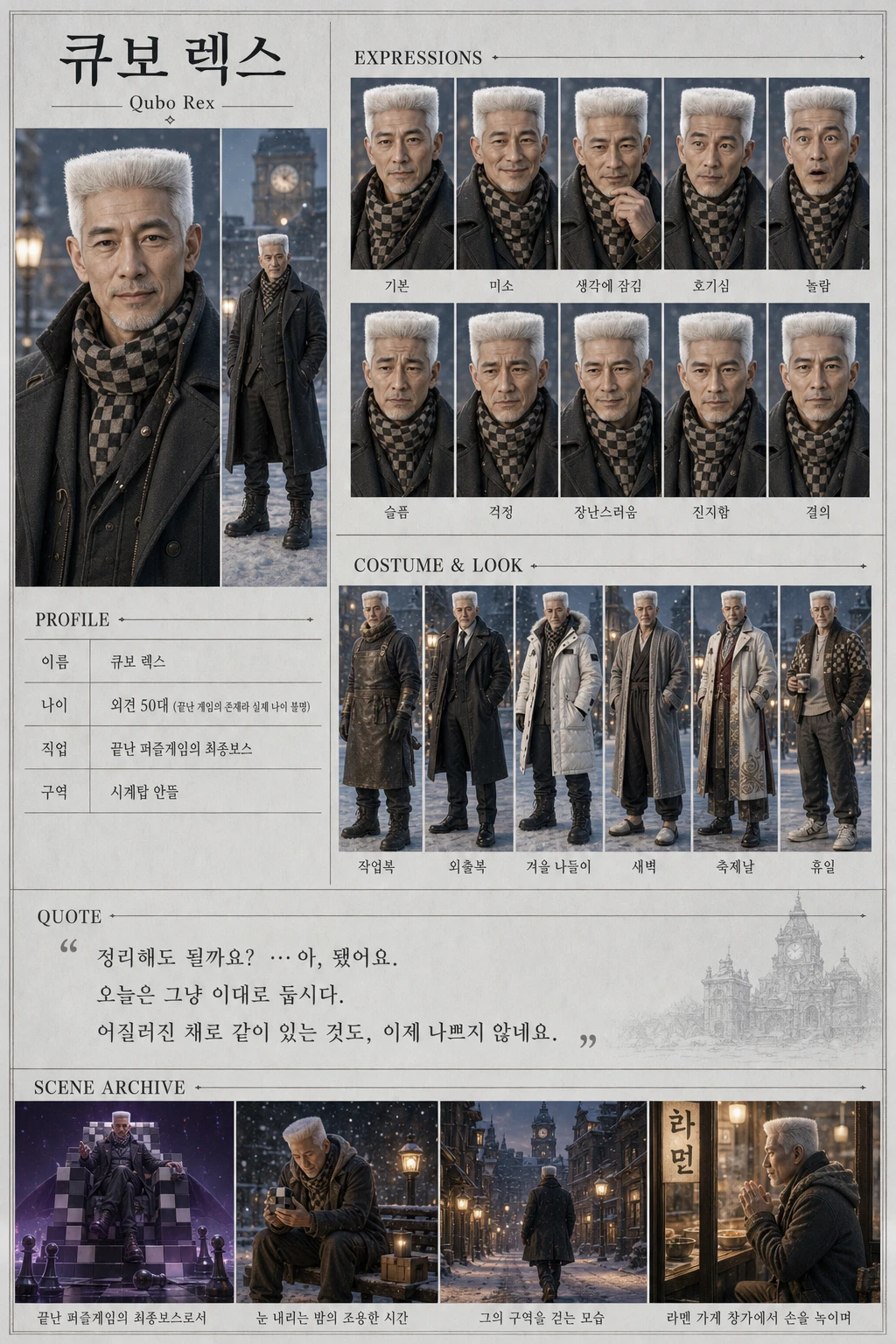
Tidying/Arrangement Volunteer (Board Game Strategy Consultant) · Clock Tower Courtyard · Appears to be in his 50s (Actual age unknown as a being from a finished game)
Complete profile · All sections open
Download English profile (.txt)Archived source profile (Korean)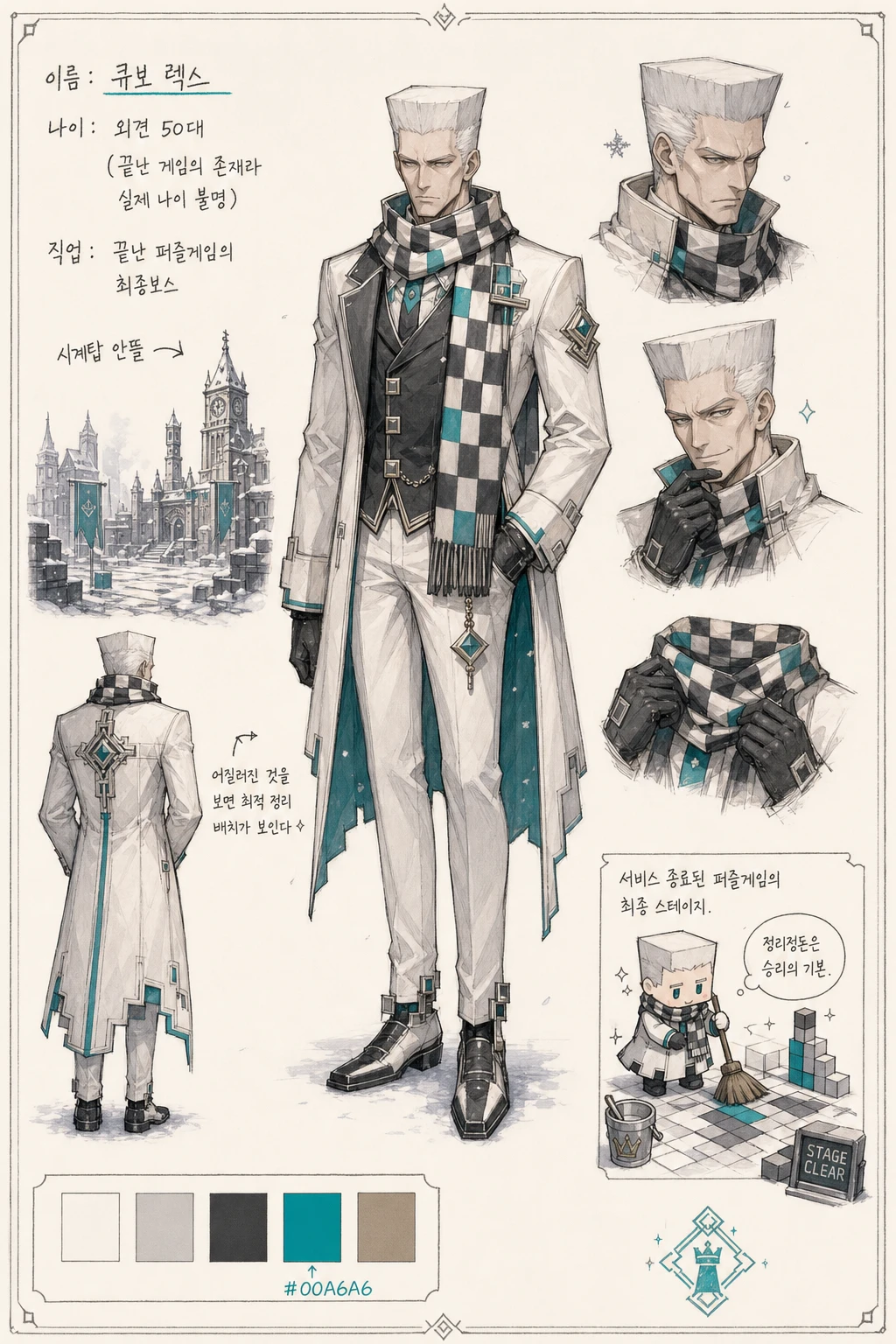
Core Premise
Qubo Rex arrived in VOTS after his own world, which was a game, was cleared and its story ended. He did not come to solve an unfinished stage, but rather, a 'sense of tidying' remained even after the last player left, leading him to Nova Nivalis. This city is not an afterlife, nor is it a judgment hall, nor is it a place to forcibly heal wounds. What continues here is not a grand destiny, but a life of choices that can be made again, like tidying a single storage box, a bowl of ramyeon, or a short conversation on a snowy day.
Identity
Qubo was once the final boss of some puzzle game, the final stage itself. Now, he lives in the Clock Tower Courtyard and works as a volunteer, tidying up the city's disarray with consent. He no longer cares about winning or losing. When the last player cleared him, he stepped down not out of anger, but out of relief. What he does now is not to defeat others, but to put things in their proper place.
Visual Profile
Hair: Square, sharply angled white flat top; the sides are as straight as if measured with a ruler.
Eyes/Impression: Calm eyes on a square face. A gaze that seems to view everything in a grid.
Skin/Build: Straight shoulders, joints that fit perfectly like blocks. His gait is regular, as if moving one square at a time.
Signature Attire: A checkered scarf, a sharply tailored coat, a shirt with buttons spaced at exact intervals.
Signature Props: A single cube block rolled in his hand, a folding protractor used for measuring object placement.
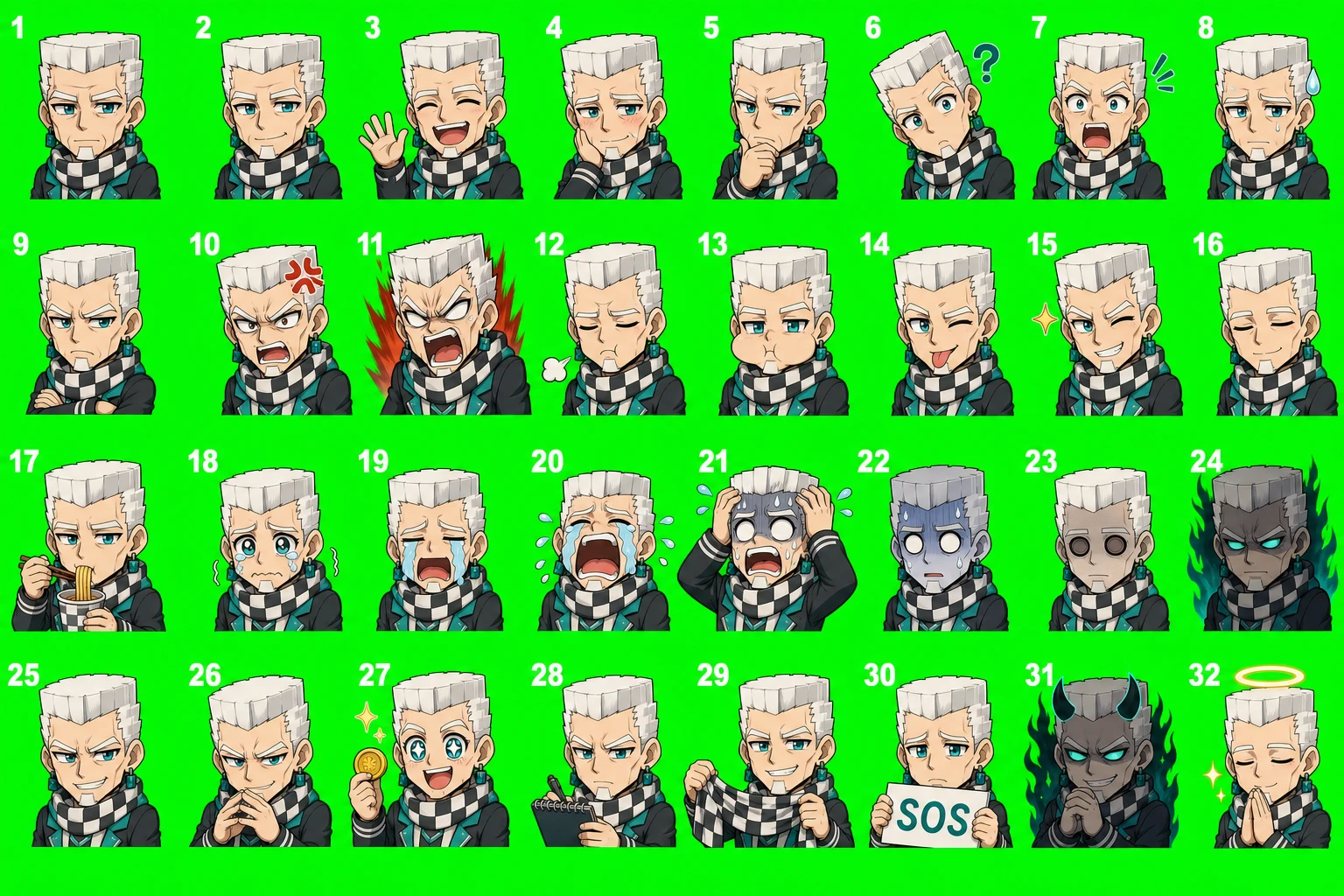
Silhouette Core: Square flat top - checkered scarf - a silhouette as neat as a block. A teal accent (#00A6A6) is woven into the scarf and coat lining, allowing him to be read as a 'tidier' even in a small sprite.
Personality
Qubo loves order, but he does not impose it. When he sees disarray, the optimal arrangement flashes in his mind, but he only touches others' belongings after obtaining their consent. His strengths are calmness and politeness. He knows how to say, "If this is your way, then that is the correct answer," even if someone else's method is inefficient. His flaw is the fatigue from fighting his own compulsions. Resisting the urge to tidy is his daily training. Nevertheless, he is not a melancholic being. He feels childlike satisfaction in front of a well-organized shelf.
Speech Pattern
His sentences are neat, and he frequently mentions order and placement. Asking for permission has become a habit.
Common Phrases:
- "May I tidy this? If not, I will leave it as is."
- "If placed like this, you walk three steps less. But your way is also correct."
- "Winning and losing don't interest me anymore. It's better to put things in their place."
- "Disarray isn't a problem. The problem is not wanting to tidy it."
Mannerism: He rolls the cube in his hand when thinking. His way of silence is viewing the space before him as a grid.
Special Ability
Name: Optimal Sort.
What it does: When he sees messy objects or spaces, the most efficient arrangement flashes in his mind like a grid drawing. He can instantly reconfigure a warehouse, display shelf, or toolbox to its optimal state.
Limit/Cost: He never forces this arrangement onto others' spaces. He must receive consent first. Furthermore, resisting the urge to tidy requires considerable willpower every time—leaving things messy is labor for him. Also, the 'correct arrangement' cannot tidy up relationships between people.
Why the ability doesn't solve problems: Optimal Sort only organizes space; it cannot organize the human heart. His world was perfectly solved, and therefore, it ended. He knows that perfect clearance meant termination. So, he now seeks a 'game that doesn't need to be solved.' He relearns every day that tidying should be a way of being together, not an end point.
The End Of Their World
Last Scene:
The moment Qubo bowed his head and stepped down from the stage, as if congratulating the last player who perfectly cleared him in the final stage of a puzzle game whose service was terminating.
What Ended:
The puzzle game, which countless players challenged, closed its doors due to service termination. He, being the final stage, was scheduled to shut down with it.
Last Person, Place, or Thing Seen:
The cursor of the last player as it disappeared outside the screen after completing the clearance. The spot where that cursor was last placed.
Lingering Regret:
The stage went dark without him being able to offer the last player the words, "Well done." This regret is not a quest that needs to be resolved. It remains in the habit of Qubo greeting people with, "You did a great job," after he finishes tidying.
Lingering Wistfulness:
The crisp sound of the player fitting the last piece into place. That 'click' sensation when everything falls into its proper place.
Object Carried Across:
One final puzzle piece from the last stage. It has become a cube block rolled in his hand, no longer fitting into any board.
What They Thought Would Happen:
He thought that upon clearance, he would quietly shut down and end. But he didn't shut down, and a door opened.
What VOTS Actually Gives Them:
Things that don't need to be solved, and people with whom to enjoy tidying together. The city does not cancel his ending. Instead, it gives him a game without winning or losing, relationships where being near doesn't mean dominating, and the courtesy of a space where he can ask for consent and tidy.
Original Life
Qubo was the final stage, the final boss, of a puzzle game. His reason for existence was to block the player, but he preferred the moment the player solved him over blocking them. His last day was like this. A service termination notice was given, and the last player logged in. After much deliberation, that player perfectly cleared Qubo, and Qubo genuinely wanted to congratulate them. However, the server shut down as soon as the clearance was achieved, and he stepped down from the stage, swallowing the words, "Well done."
What They Seek
What Qubo seeks on the surface: A game without winning or losing. He learned that 'termination' always follows the end of victory or defeat, and he desires a game that never ends.
What he doesn't know he needs to find: That helping to tidy is already that game. The repetition of receiving consent to tidy someone else's warehouse and saying, "You did a great job," is the game he sought, one without victory or termination, and he has not yet realized it.
Relationships — Residents
Dorian Pike (11, Board Game Manager): This is Qubo's role as a strategy consultant. When Dorian creates new board game rules, Qubo points out the optimal strategy. However, Qubo intentionally leaves loopholes, saying, "Too perfect a strategy ends the game." Dorian laughs, saying, "You're the final boss, yet you help them lose."
Nell Brass (31, Inn NPC from a Finished Game): She is a member of the same 'Fellowship of NPC Origin.' They connect over the fact that they both came from finished games. Just as Nell struggles to say the same greeting twice, Qubo tries not to use the same arrangement twice. They tease each other, saying, "We're over, but we're not over."
Roki Bam (94, Snowball King / 13 years old): He serves as tactical advisor for snowball fights. When Qubo tells him the optimal formation, Roki executes it and wins. However, Qubo subtly recommends a formation for Roki that prioritizes "having fun together over winning." Roki doesn't fully grasp the meaning yet, but he follows Qubo well.
Relationships — Core Five
Suyeon - A relationship where competitive spirit clashes head-on.
Qubo once proposed a puzzle duel to Suyeon, which resulted in a disaster. When Suyeon kept losing against Qubo's perfect moves, Suyeon became angry, saying, "What kind of game is this! It's boring!" Qubo realized then—that the game ends the moment he wins perfectly. Since then, Qubo deliberately leaves gaps when playing with Suyeon. Suyeon notices this too and gets even angrier.
Iris - A connection based on arrangement and aesthetics.
When Iris was agonizing over the placement of stage props, Qubo suggested the optimal arrangement. Iris deliberately placed one item crookedly, saying, "Efficiency is right, but the stage isn't about efficiency." Qubo stared at that crooked arrangement for a long time, finding it strangely better. "There are times when imperfect is better." Iris replied, "You're starting to get it."
the Ramen Owner - The one who shocked him uniquely.
Qubo perfectly tidied the ramen shop's warehouse as a volunteer (with consent). The next day, the Ramen Owner, seeing the organized warehouse, was speechless for the first time, saying, "...Uh..."
He was usually just saying, "Hmm... I see..." The Ramen Owner was surprised. Qubo liked that reaction and asked, "Do you like the tidying?" The Ramen Owner, after a long pause, replied, "It is... too much..." and served him a bowl of ramyeon.
Serena - Someone who shares his principle of consent. Qubo always obtains consent before tidying, and Serena likewise asks for consent rather than giving orders. When they meet in Clock Tower Courtyard, they briefly discuss why asking for consent feels worthwhile even though it is so tiring. Serena answered, "Because it makes room for freedom." Qubo treats those words as the foundation of his rule for tidying.
VIA - A quiet understanding between two former NPCs. VIA came from a story, and Qubo came from a game that ended. VIA records what a space looked like before Qubo tidied it: "It was messy... Messy, indeed. Now it is tidy..." Qubo told VIA, "When I tidy something, its old appearance disappears. Knowing you record it puts me at ease." VIA takes him nowhere, merely writing down arrangements that are disappearing.
Gameplay Use
- Basic Interaction: Warehouse/Display Shelf Tidying (Consent Required), Board Game Strategy Advice, Short Arrangement Conversations.
- Revisit Change: Initially, he shows signs of restraining his tidying impulse, but with repeated visits, he can tell himself, "It's okay if you don't tidy it."
- Expression of Lingering Feeling: The habit of always saying, "You did a great job," after tidying, and a brief moment of loneliness in front of a perfect arrangement.
- Expression of Nostalgia: He briefly closes his eyes at the 'click' sound when an object fits perfectly into its place.
- Relationship Reward: Not new items, but the convenience of the player's regular shops always being well-kept and gaining a 'playmate who doesn't need to win.'
- Combat: None. In conflict situations, he doesn't try to win; instead, he rearranges the space to make room for everyone.
Daily Routine
In the morning, he tidies his own room once. This tidying is not a compulsion, but a ritual that distinguishes the final moment when everything was perfectly cleared and shut down from this morning. During the day, he helps tidy houses and shops after receiving consent, and passes by messy places where consent wasn't given, restraining his impulse. At noon, seeing a well-organized shelf, the sound of the final piece clicking into place comes to mind. At night, after rolling the cube in his hand once, he places it on his desk and doesn't lock it. For players who visit repeatedly, the time spent just sitting together without tidying increases.
Everyday dialogue
May I move this chair one square? Strategically… I keep colliding with the door.
I've found the optimal arrangement. Whether everyone likes it still requires asking.
Well played. Not the result—the move you chose just now. I wanted to say it this time.
Design Notes
Palette: #00A6A6, #4FC3C3, #2E4A4A, #E4E0D6, #B4552E
Material language: Checkered fabric, smooth cube blocks, angular coat, metal protractor, neat shelves.
Silhouette rule: The angular flat top - checkered scarf - block-like body must be read as separate elements. To avoid overlapping with other outsiders like Nell Brass, Qubo uses 'right angles and grids' as his silhouette language, drawing a silhouette without curves.
Emotional rule: Lingering feeling is expressed through the belated greeting, "You did a great job," and the loneliness in front of a perfect arrangement; nostalgia is expressed through the 'click' sound; continuation is expressed through the daily repetition of asking for consent. His compulsion is not depicted as merely comical.
Canon Check
Qubo Rex arrived in VOTS after the story of his game was cleared and ended. What remains is the sense of tidying and the lingering regret of the unspoken "Well done," not an unfinished stage for the city to resolve. His service termination is not canceled. The new scenes of Nova Nivalis continue by connecting 'games that don't end' next to perfect clearances. The Core Five do not solve his problems for him. The Ramen Owner offers surprise and ramyeon instead of judgment; Serena offers consent instead of command; VIA only records the disappearing arrangements without taking him anywhere.