RESIDENT 041
Tum Balo
Shoe Sole Repairman · Snowfield Alley · 50s
Complete profile · All sections open
Download English profile (.txt)Archived source profile (Korean)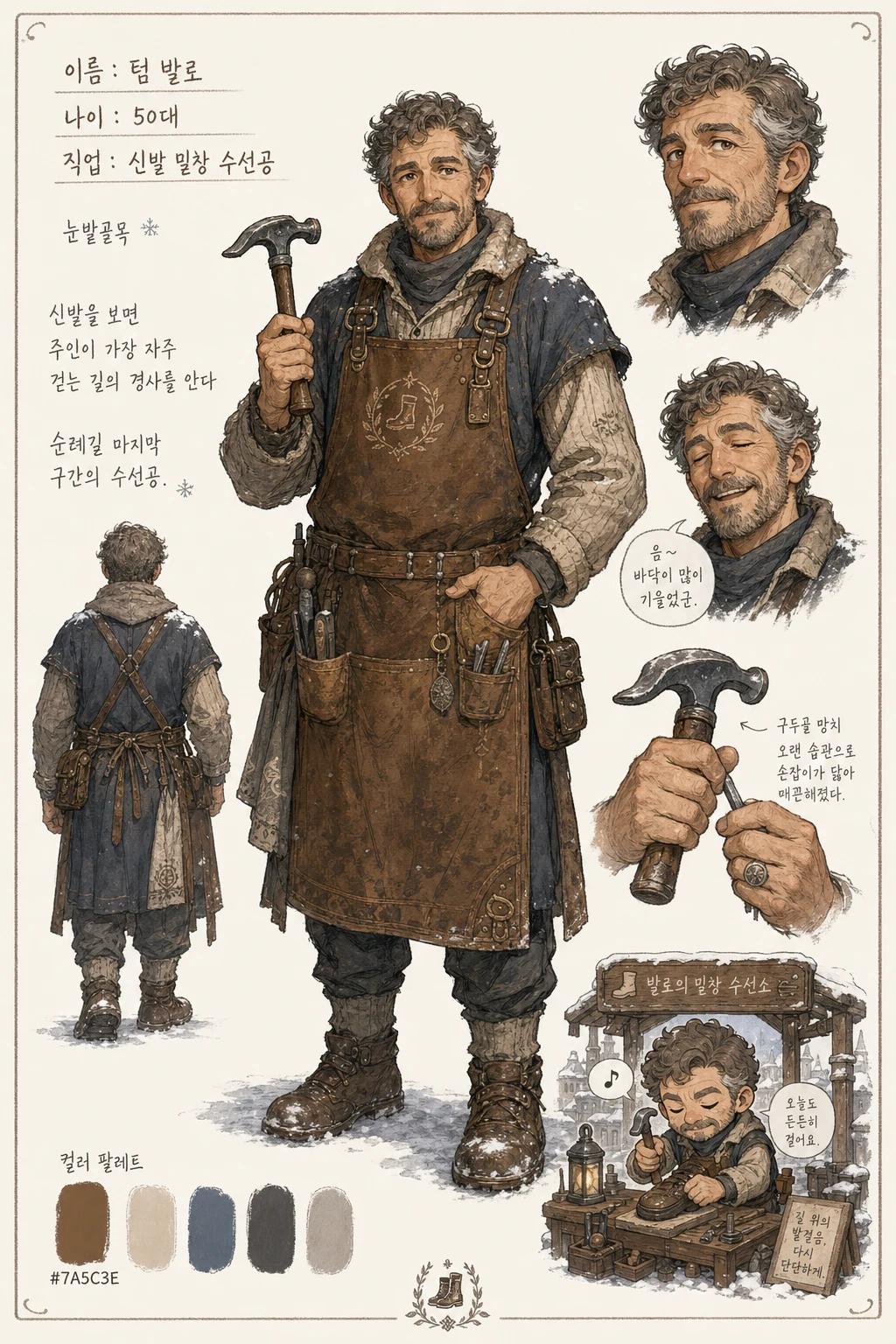
Core Premise
Tum Balo arrived in Nova Nivalis after the story of his own world ended. The pilgrimage was over, the pilgrimage route was finished, and the people who walked that path had scattered. He did not come to resolve an unfinished event, but rather because the direction of a pair of shoes he last repaired still lingered at his fingertips, drawing him into this city. Nova Nivalis is not a hall of judgment, nor is it the terminus of a pilgrimage. What continues here is not grand salvation, but the repetition of life: replacing soles, pulling threads, and oiling worn leather. Tum lives with the fact that it has ended, within that repetition.
Identity
He lives as a small shoe sole repairman at the entrance of Snowfield Alley. There is no sign, only an old shoemaker's awl hanging by the door, which serves as his sign. People seek him out when their soles wear down or become slippery. He looks closely at others' shoes, without rushing, and never speaks carelessly about the owner's gait. Repairing is his job; dictating where to go is not his. He is a hand that the city actually needs, not a decorative doll of sorrow.
Visual Profile
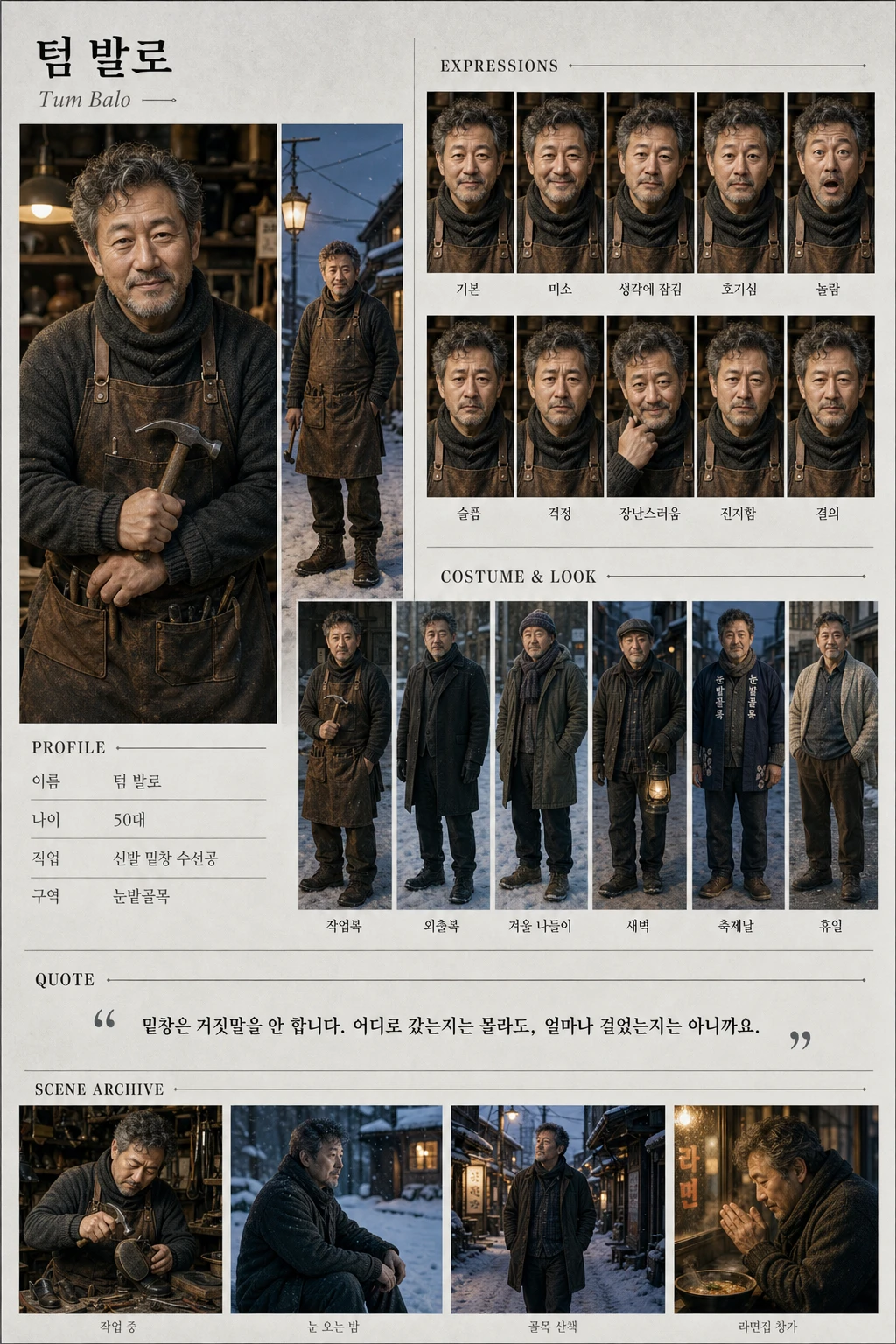
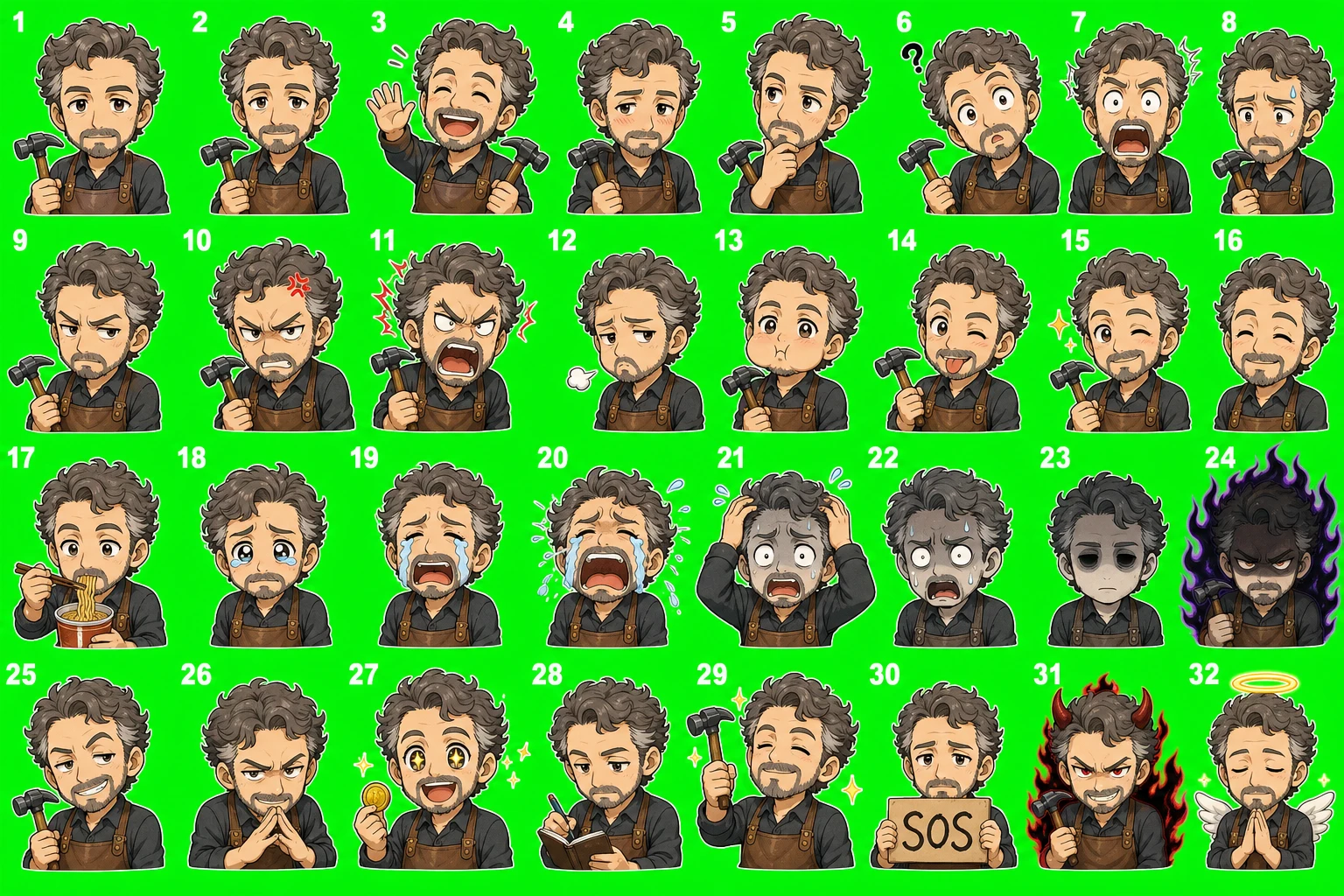
He has short, grayish-brown curly hair, with only the sideburns showing streaks of gray. The top of his head still retains its brown hue, but silver spreads above his ears, revealing his age. His eyes are dark brown, and his eyelids are heavy, giving him a perpetually half-lowered expression. He speaks in a low, slow voice, habitually pausing between sentences. He has a sturdy yet stooped posture, leather oil stains on the backs of his hands, and a hardened thimble mark on his right index finger. His signature attire is a thick apron stained with the smell of leather, with various nails and threads tucked into the front pocket. His signature prop is a shoemaker's hammer with a polished handle. The core of his silhouette is the hammer, the shoe-shaped awl, and a single shoe resting on his knee. The accent color is brown #7A5C3E, the color of aged leather, which signals to even small sprites that he is a man who handles leather.
Personality
He speaks slowly and sparingly. He dislikes being rushed, but he doesn't rush others either. If a customer is in a hurry, he says, "The sole knows what is urgent," and maintains his own pace. Although he appears gruff on the surface, he is careful only when taking a shoe. He cannot stand handling worn-out shoes carelessly, and even with the roughest shoes, he adds, "You've walked a lot." He has his flaws. He feels slighted if a customer takes the finished shoe immediately, so he deliberately delays it for about a day, knowing that this is petty. He is not steeped in tragedy. He makes lighthearted jokes, and while he doesn't smile often, when he does, his front teeth show.
Speech Pattern
He cuts off his endings short rather than drawing them out. "It's done." "You've walked a lot." "Take your time." He uses polite language as a default, but softens his speech when he becomes close to someone. His frequent phrases are, "You've walked a lot...", "The sole doesn't lie," "The shoe knows where you're going," and "The sole knows what is urgent." When silent, he turns the shoe over and strokes the sole with his palm, using that gesture to fill the time when conversation stops. He rarely brings up his own story first, and he seldom mentions the word 'pilgrimage.'
Special Ability
The name of his ability is 'Reading the Incline.' When he holds a single shoe, he can sense the gradient of the path its owner walks most often. Whether the person walks many uphill paths, circles on flat ground, or drags their heels downhill is read by the wear on the sole at his fingertips. There is a clear limit. He does not know 'where' that path is. He cannot know the direction, the place name, or the destination; he only knows the slope. The cost is his own shoes. While he can read others' shoes, the incline of his own shoes can never be read. The ability solves no problems. He cannot tell a customer where they should go; he only replaces the sole to make their steps more comfortable.
The End Of Their World
Last Scene:
In the winter of the year the pilgrimage was forbidden, the last pilgrim placed their shoes before his workbench. He spent the night replacing the soles and returned them at dawn, and the pilgrim silently put them on and walked out into the snow.
What Ended:
The entire pilgrimage route closed in that same year. The people who managed the path, the people who walked it, and the custom of counting those steps all ended together.
Last Person, Place, or Thing Seen:
The first footprint pressed into the snow across the threshold, and the direction in which that footprint tilted uphill and disappeared.
Lingering Regret:
He said, "Come back when they need another repair," instead of "Take care on your way." That pilgrim never returned, and he worries about having carelessly promised a 'next time.' This lingering attachment is not a quest that must be resolved. It remains only in the speed of his hands, within the limit of not dictating another's steps, and only when Tum wishes to speak.
Lingering Wistfulness:
The low, solid sound made when a shoe with a new sole first touches the ground. When that sound occurs, for a moment, the silhouette of the back of someone walking away, disappearing into the snow, overlaps.
Object Carried Across:
A piece of old sole torn from the last pilgrim's shoes. He replaced it with a new sole, but couldn't discard the torn piece and brought it with him in his apron pocket.
What They Thought Would Happen:
He believed that if the path reopened, that pilgrim would return with news of their arrival. The path never reopened.
What VOTS Actually Gives Them:
A place where he can keep working his hands, resoling different people's shoes every day, even without confirming an arrival. The city does not return the news of that pilgrim. Instead, it gives him a workbench where he can work even while holding onto an ending, customers who do not rush him, and new neighbors who walk until their soles wear down.
Original Life
Tum Balo was a repairman situated on the final stretch of the pilgrimage route. In the village below the Mountain Gate, he was the one who last tended to the shoes of pilgrims nearing the summit. Many people walked on soles he repaired. In the year the pilgrimage was forbidden, officials drove stakes at every crossroads, and the walkers gradually left the village. On his last day, instead of closing his door, he took the last pilgrim's shoes and replaced the soles throughout the night. That was the last thing he did in that world.
What They Seek
Superficially, he seeks the value of steps without a destination. He wants to confirm whether steps that go nowhere, steps that presuppose no arrival, are still worth fitting a new sole for. However, on a level he himself does not know, what he truly needs to learn is how to live without the certainty that the last pilgrim arrived safely. The ability to open and close his day even if he never hears news—he practices this every day without realizing it.
Relationships — Residents
- Nadi Rooke (batch1, Outerwear Repair·Snowfield Alley): They collaborate under the theory that winter clothes and winter shoes are a set. Nadi sends customers who come to have their coats repaired to Tum, and Tum passes the wet cuffs of the customer's sleeves to Nadi. The two silently pass on each other's work.
- Popo Nain (071, Indoor Shoe Artisan): They bicker over 'outdoor shoes' that need new soles versus 'indoor shoes' that do not. Popo says, "Soles aren't meant to stay unworn," and Tum retorts, "Shoes that don't wear are shoes that haven't walked." They often boast about their shoes when passing in front of each other's shops.
Relationships — Core Five
Suyeon - A customer who rushes to drop off stage boots. When Suyeon rushed in with boots whose heels had broken off during a performance rehearsal, he asked nothing, only "By what time?" When he was given a time, he postponed his evening appointments and repaired those boots first. Suyeon left a packet of instant ramen, saying, "You fixed what even an ice sword couldn't attach," and he left it on the shelf without eating it.
Iris - They are distant from each other, but not badly. Iris once left a pair of heels with him, saying the studs she hammered into the front heel were catching on stage. Tum didn't pull out the studs; he simply added a thin layer of leather underneath so they wouldn't catch. "I left the shining parts as they were, and only removed what was catching." Iris said, "It's usable," and left, and since then, all heel issues come to him.
the Ramen Owner - The person whose worn boots he repaired. Seeing the soles of the owner's old black boots worn and slippery, Tum offered to replace their soles before the owner even asked. While resoling them, he read the sole's incline: it was not uphill or downhill, but the gait of someone constantly circling the same spot on flat ground. He said nothing. The owner replied, "Hmm... I see..." and put his boots back on, paying him with hot broth instead of money.
Serena - Someone he has spoken a few words with, but whom he watches. Serena's shoes always have evenly worn soles, so there is nothing to repair. Once, when they met in front of the stairs, he said, "It's a shame there's nothing to repair." Serena smiled and asked, "Is that a compliment?" He replied, "It means you've walked a lot, evenly." Serena remembers those words for a long time.
VIA - On the day he arrived, a note remained on the door of the spot that would become his workbench. "Someone who brought the old soles instead of discarding them... has come." VIA occasionally stops by to look at the pieces of soles he has removed, and chooses one to record, "This has walked a long way."
Tum never shows VIA the piece in his front pocket, but VIA doesn't press the issue.
Gameplay Use
- Basic Interaction: Sole repair service, short daily conversations about shoes.
- Revisit Changes: He remembers the player's shoes and, starting from the second visit, drops hints like, "You walk a lot uphill." He does not interpret their gait without permission.
- Expression of Lingering Attachment: The habit of delaying the finished shoes by about a day, a short pause where he swallows the word "next time."
- Expression of Poignancy: The sound of a new sole touching the ground, sensory dialogue about footprints imprinted on his gaze.
- Relationship Reward: Not a new item, but a small introduction connecting the player to shoe repair services of other residents.
- Combat: None. Even in crisis situations, he chooses to replace slippery soles so people don't fall.
Daily Routine
In the morning, he lays out the shoes received the day before, sorted by type, and runs his palm over the condition of the soles. This check is not a compulsion, but a small ritual separating the finished pilgrimage from today's Snowfield Alley. During the day, he works as customers arrive, and if there are no customers, he oils the shoemaker's awl. Around noon, the sound of footsteps crunching on snow is most frequent in the alley, and then the sounds of soles touching the ground overlap, briefly touching his wistfulness. At night, he takes out the old sole piece from his front pocket, strokes it once, and puts it back. Without discarding it, and without attaching it. For players who visit repeatedly, his speech becomes slightly longer, and the habit of delaying finished shoes fades. Even if they become quite close, he does not offer the reward of a path back to the pilgrimage route.
Everyday dialogue
You've walked a long way. The soles are more talkative than you. Leave them with me a moment.
Only the right one's worn. You don't always flee down the same alley, do you? Half joking.
Done. Travel safely. That comes before asking you to return for repairs.
Design Notes
Palette: #7A5C3E, #C9B08A, #4A3B2C, #E3D6C2, #6B7A6E
Material language: Aged leather, worn sole rubber, brass nails, hardened thread, snow-wet leather.
Silhouette rule: Head-body-hand-hammer-knee-shoe must be read as separate elements, and must not overlap with the silhouettes of other repairmen (Mera, Greta).
Emotional rule: Lingering attachment is shown through the habit of delaying finished items and the sole piece in the front pocket; poignancy is shown through the sound of soles touching the ground; continuation is shown through the daily labor of resoling shoes.
Canon Check
Tum Balo arrived in VOTS after the pilgrimage of his own world ended. What remains is lingering attachment and wistfulness, not an unfinished pilgrimage for VOTS to resolve. The city does not confirm the arrival of that pilgrim, nor does it dictate their steps. The new scene connects to the hands replacing soles next to the pilgrimage that has ended, without erasing it.