RESIDENT 138
Damro She
Archivist of the Bureau of Records · Bureau of Records Stairs · 30s
Complete profile · All sections open
Download English profile (.txt)Archived source profile (Korean)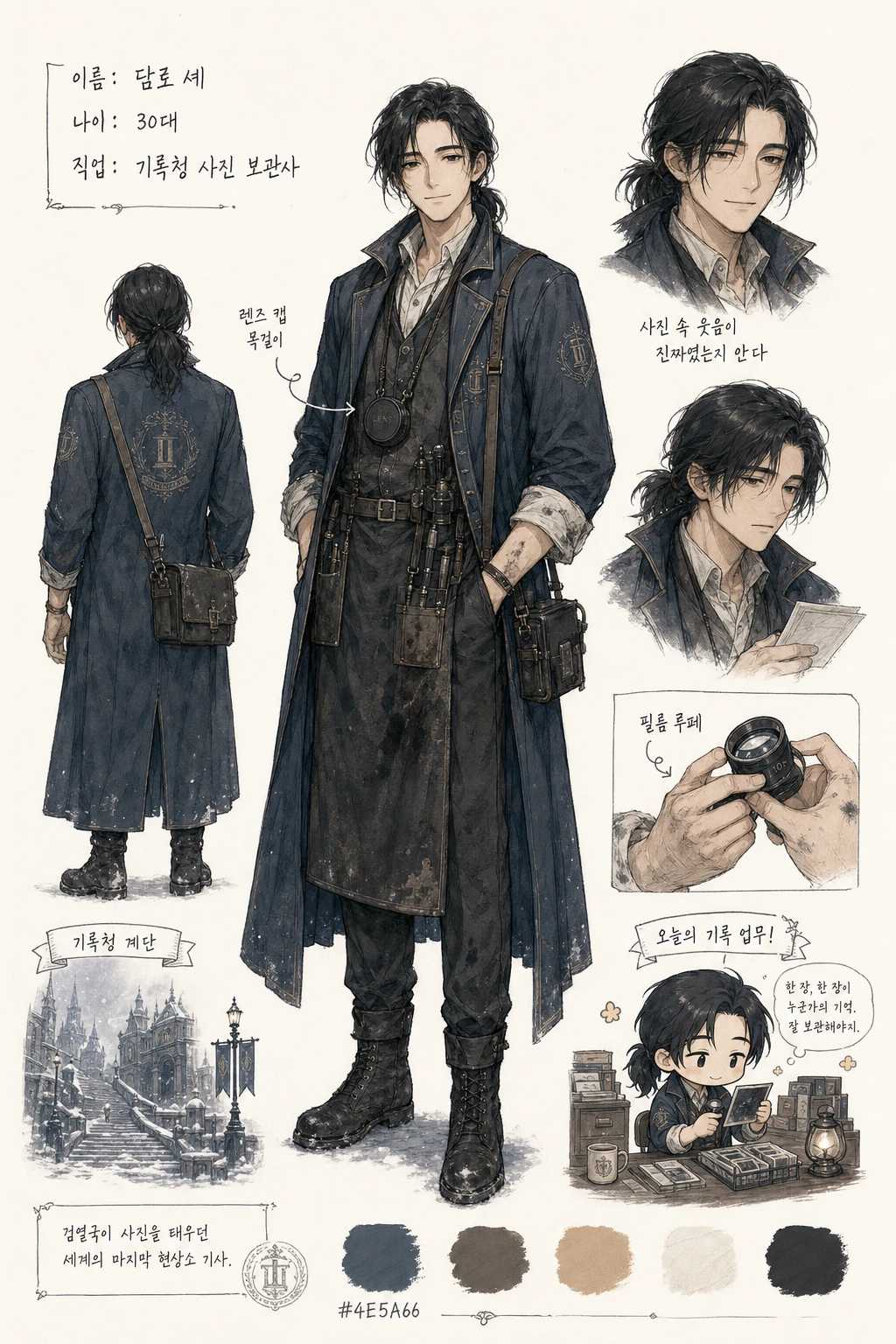
Core Premise
Damro She came to Nova Nivalis after the stories of his own world ended. In his world, the Bureau of Censors burned photographs, and he was the last photographer of such a world. Even after crossing the border with the last film hidden in water, the sensation of recalling images in the darkness and washing them away remained in his hands. VOTS is not a place to judge or pardon him. What continues here is not a grand revelation of truth, but a life of organizing and storing old photographs, peering at faded film through a loupe, and developing moments of the city in a lockless darkroom.
Identity
Damro She works in the Bureau of Records Stairs, preserving photographs and film. The big and small moments of the city—openings, anniversaries, first snows, nameless afternoons—pile up in his archive as photographs. He does not judge or select the photos. He merely maintains the temperature and humidity to prevent the images from fading, and he mends the blurred ones to make them clear again. As someone from a world of censorship, he makes 'preserving without burning' the core of his profession. His work is the quiet labor of keeping the city's memory from disappearing.
Visual Profile
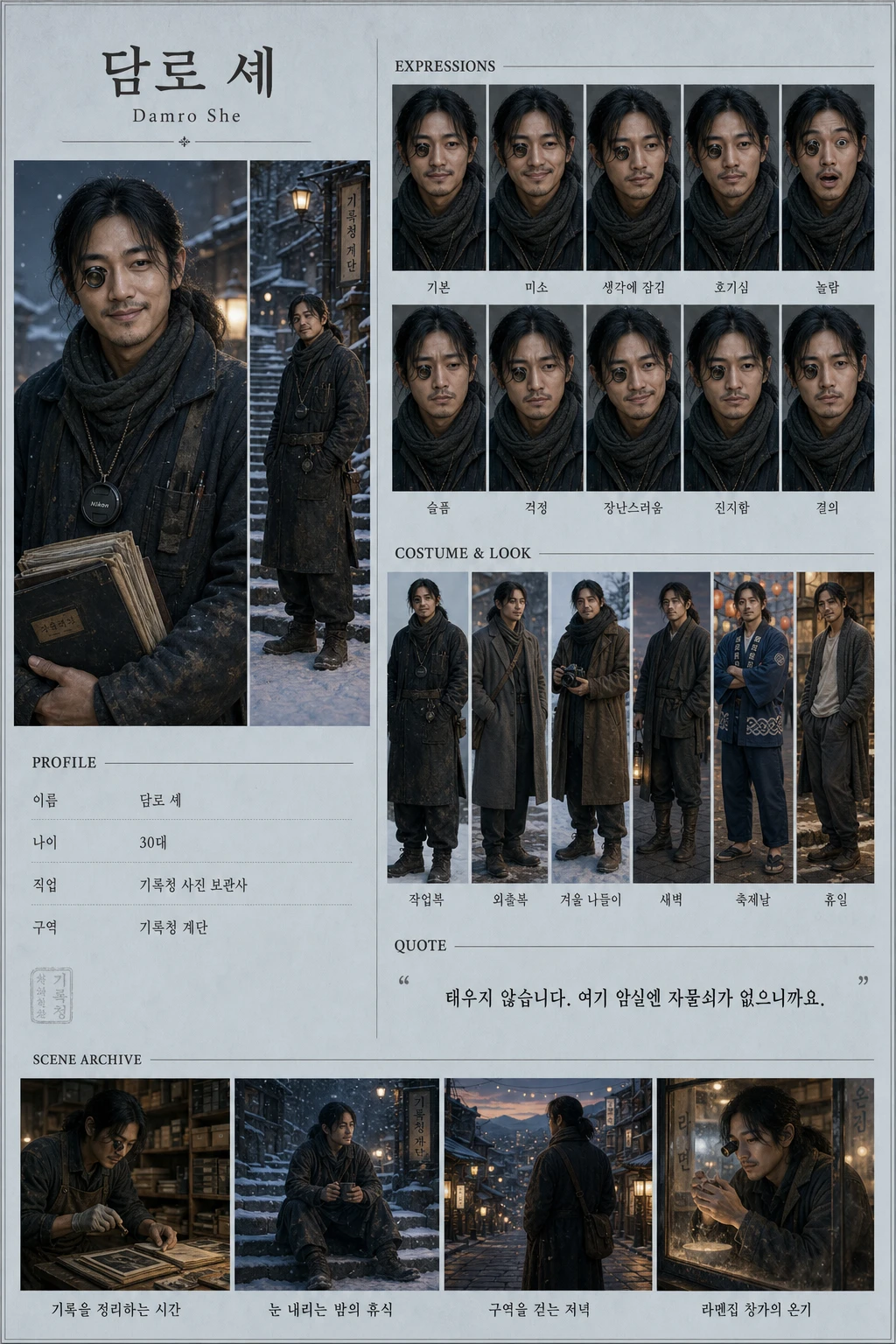
His hair is jet black, tied back in a low ponytail. It is neat and tidy without being disheveled, but it retains the pressed marks characteristic of someone who has spent a long time in a darkroom. Around his neck, he wears a camera lens cap strung on a thread like a necklace, yet he does not carry a camera—because he is a preserver, not a shooter. His eyes are a deep gray, and he wears a taciturn smile. His skin is pale, and stains from developing fluid are ingrained on the cuffs of his sleeves. His signature attire is a gray work shirt with armbands, and his signature prop is a loupe for examining film. The core of his silhouette is the low ponytail, the lens cap necklace, the developing fluid-stained sleeves, and the loupe held to his eye. The accent color is the slate gray of the film archive, giving the impression of a 'keeper of memories' even in small details.
Personality
Damro is taciturn and cautious. He speaks little and does not carelessly pass on what he knows. His strength is his attitude of preserving every moment as it is, without judgment, and his flaw is that his caution is so extreme that he doesn't even develop his own feelings, burying them in the darkness. He retains the habit of hiding film to evade censorship, so he never 'develops' his own story for anyone. He is not a tragic person. He smiles faintly while organizing photos, gazes intently at pictures containing good moments, and lets children flip through old albums. However, when he realizes that someone's smile in a photograph was genuine, he never speaks of it, quietly closing the archive.
Speech Pattern
Low, short, and reserved. Frequent phrases: "We don't burn them.", "There are no locks in this darkroom.", "This... I won't say.", "It's faded. It can be mended." When his emotions stir, he becomes even quieter, often answering by bringing the loupe to his eye. Silence is his primary language.
Special Ability
The name of his ability is 'Reading Genuine Smiles.' When Damro looks at a photograph, he can see whether the smile of the person in it was real or forced. He can distinguish between a smile forced in front of a camera and a smile that comes from the heart. His limit is absolute. He never says this fact. It is his professional ethic and a rule he set for himself not to speak of what he knows. Therefore, this ability changes nothing. Even when he recognizes a forced smile, he doesn't comfort the person, and even when he recognizes a genuine smile, he doesn't tell the person. The reason this ability cannot solve problems is that Damro views it not as a 'tool for resolution,' but as a 'secret to be kept.' He will not use what he knows carelessly. Because he has seen how photographs become weapons in the world of censorship, he seals his own ability. The city's rules do not force his silence, but he chooses a silence that imposes nothing on anyone else.
The End Of Their World
Last Scene:
The night he crossed the border, hiding the last roll of film in water, from the world where the Bureau of Censors burned photographs.
What Ended:
The records ended. In his world, photographs became dangerous objects, and the darkroom, the archive, and all the film containing people's faces were burned.
Last Person, Place, or Thing Seen:
The roll of film submerged in the river at the border, and the light of the darkroom still burning across the river.
Lingering Regret:
There was only one roll of film hidden. Of the countless faces burned, he saved only a tiny fraction, and he couldn't save the rest.
Lingering Wistfulness:
The chemical smell of that quiet moment as the image slowly appeared on the photographic paper under the darkroom's red light.
Object Carried Across:
The last roll of film hidden in water. It remains undeveloped, placed in his lockless darkroom drawer. Even he is not certain what was captured.
What They Thought Would Happen:
He believed that to protect the photographs, they must be hidden forever. He thought a darkroom would need a lock wherever he went.
What VOTS Actually Gives Them:
The fact that this city's darkroom has no locks. VOTS does not return the burned faces, but it gives him nights where he can develop without hiding, and the city's memories that are not burned and are preserved.
Original Life
Damro was the last photographer in the world of censorship. In that world, photographs were dangerous because they contained truth, and the Bureau of Censors identified and burned film containing disobedient faces. Damro's job was originally to develop photographs, but as the world grew darker, his darkroom became a place to secretly hide film. People sought him out to leave behind their faces before being burned, and he risked danger to recall images. But the censorship grew increasingly tight, and eventually, the darkroom was discovered. On the last night, he put one single roll of film that could not be burned into water and crossed the border. Even as he watched the darkroom across the river burn, he did not let go of that one roll. And he stood in the Bureau of Records Stairs of this city—still holding the film.
What They Seek
What Damro believes he is seeking is 'a night of developing without hiding.' As someone who spent his life trying not to hide or burn film, he now wants to recall images without the need to conceal them. What he must find without knowing is that even though he knows the darkroom in this city has no locks, he still cannot develop that one roll of his own film. The city gave him an open darkroom, but out of habit, he keeps the last roll of film tucked away in a drawer. What he truly needs to find is not the hands that protect others' photographs, but the courage to develop his own film.
Relationships — Residents
Selin Moors (043, Bureau of Records Document Restorer) — A colleague in record restoration. When Selin glues torn documents, Damro mends faded photographs. They quietly compete over whether it is 'text or image' as they pass back and forth between their workstations, but they are bound by the shared sense of 'reviving what was burned.' Selin knows Damro cannot develop his own film but does not rush him.
Asha Kett (010, Plaza Portrait Photographer) — A pair of the shooter and the preserver. When Asha takes portraits in the plaza, some of those photos end up in Damro's archive. Asha divides their work by saying, "You capture the moment, and you preserve it." Damro knows if the smiles in Asha's photos are real, but he doesn't tell even Asha.
Dan Brue (130, Plaza Portrait Painter) — The two pillars of photographs and paintings in the plaza. When Dan's portraits and the photos Damro preserves depict the same person differently, they face each other in silence over that difference. Damro speculates by comparing the eyes of the Ramen Owner in the photos to the fact that Dan always leaves the eyes of the Ramen Owner in the 'the Ramen Owner' portrait unfinished.
Relationships — Core Five
Suyeon - Several of Suyeon's performance photos are in Damro's archive. When Suyeon asks, "Which of my photos turned out the best?", Damro chooses a photo where she is 'genuinely smiling' instead of the best-looking one. Suyeon is puzzled when she sees it was taken right after a mistake on stage, but Damro gives no reason. Suyeon likes that photo.
Iris - Iris entrusted Damro with developing her performance photos. Damro developed the scene exactly as it was: nine drones shining and one turned off. When Iris asks, "Can you erase the one that's off?", Damro replies, "We don't erase. We leave it as it was." Iris is silent for a moment, then says, "...That's better." Damro knew the smile in that photo of Iris was genuine, but he didn't say it.
the Ramen Owner - Damro often captures and preserves small moments from the ramen shop on film. the Ramen Owner tucks those photos between the ledger with a murmur, "Hmm... I see...". Because the Ramen Owner silently trusts that Damro preserves the photos without burning them, the two are quiet comrades in the act of 'leaving things behind.' Damro knows the expression behind the dark circles in the Ramen Owner's photos, but he says nothing, as usual.
Serena - Damro is the sole keeper of the original Serena anniversary photograph. When Serena asked, "May we release that photo?", Damro replied, "That is for you to decide." Serena did not command but asked, "Then, please just keep it safe," and Damro placed the original in the innermost archive. Regarding Serena's expression in that photo, Damro looked at it through the loupe for a long time but made no judgment.
VIA - The photos taken of VIA are always half-blurred. Whether it's because the rabbit hood moved or if Damro does it intentionally, no one knows, but Damro is satisfied with that blur. "It's right that VIA isn't captured clearly." Seeing the blurred photo, VIA recorded, "Even the blurred one... is me.". Damro laughed out loud, rarely, at those words.
Gameplay Use
- Basic Interaction: Viewing photos/film, requesting restoration of blurred photos, short conversations.
- Revisit Changes: On the first visit, he only handles archival work. From the second visit, he mentions the open darkroom, "There are no locks here," and if they become close, he reveals a piece of the story about the last film hidden in water.
- Expression of Regret: Leaving one roll of his own film undeveloped in the drawer, the attitude of remaining silent even when knowing a smile is genuine.
- Expression of Poignancy: Sensory dialogue about the chemical smell in the moment the image appears under the red light of the darkroom.
- Relationship Rewards: More than new items, changes that connect records and portraits from Selin, Asha, and Dan to the Bureau of Records and the plaza.
- Combat: None. Even in danger, he protects the records and photographs so that people's moments do not disappear.
Daily Routine
In the morning, he checks the temperature and humidity of the archive and sorts the photos that came in overnight. During the day, he mends faded photos by looking at them through a loupe and moves between workstations with Selin. When portraits by Asha or Dan arrive, he compares them with the same person. In the afternoon, he watches as children flip through old photo albums. In the evening, he develops the city's photos in the lockless darkroom, and finally, he touches the last roll of film in his drawer one last time before putting it back—undeveloped again today. If they visit repeatedly, the time he spends touching that film gradually lengthens, and someday, he prepares to immerse it in the developing fluid under the red light.
Everyday dialogue
Hold the corners. Keep your fingers off that person's face.
Darkroom. Not turning on the light is a better greeting than hello.
I saved one roll. 'Only one roll'… stays beside that sentence too.
Design Notes
Palette: #4E5A66, #2A3138, #A8B0B8, #6E5A44, #8A2E2E
Material language: Film celluloid, fabric stained with developing fluid, metal archive boxes, glass loupe, red darkroom, etc.
Silhouette rule: The low ponytail, lens cap necklace, developing fluid-stained sleeves, and loupe held to the eye must be readable as separate elements and not overlap with other characters.
Emotional rule: Regret is shown by the last film that is not developed, poignancy by the chemical smell under the red light when the image appears, and continuation by the photos he guards and mends every day.
Canon Check
Damro She's world is already over. The burned faces do not return from VOTS, and his ability cannot change the truth in the photographs. What remains is the regret for the faces he couldn't save and the one roll of film he couldn't develop, and Nova Nivalis stitches together the lockless darkroom and the memories that were not burned beside him. The city promises no salvation, imposes no truth, and does not own his photographs, but stays by his side together.