RESIDENT 137
Pico Radin
Used Toy Vendor · behind Threshold Market · 30s
Complete profile · All sections open
Download English profile (.txt)Archived source profile (Korean)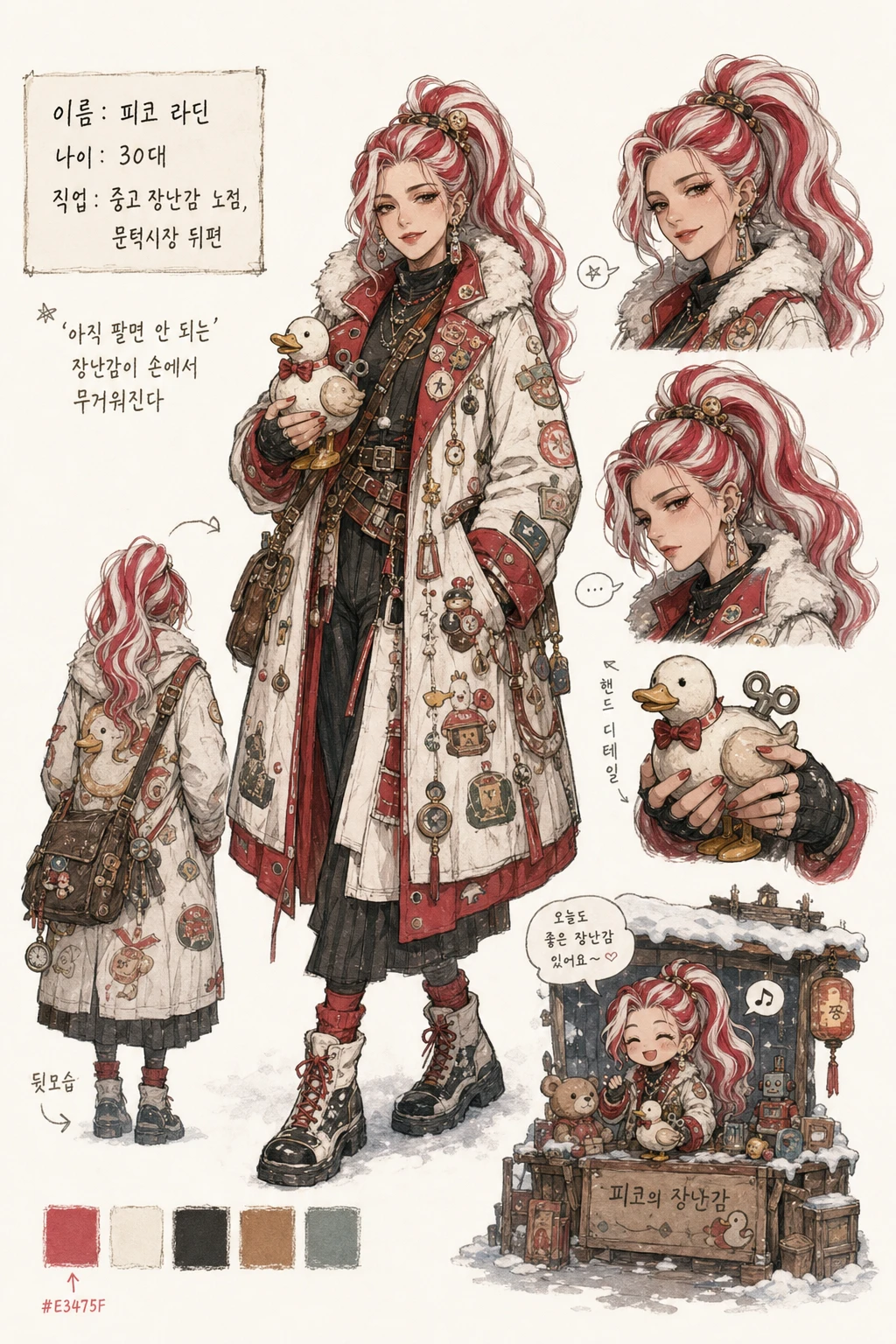
Core Premise
Pico Radin came to Nova Nivalis after the story of her own world ended. Her world was one where children had to hurry to become adults, and she was a toy store clerk in such a world. Even after sealing the last inventory in the warehouse and closing the shop, the sensation of winding a toy and handing it to a child remained in her hands. VOTS is not a place that calls to comfort or judge her. What continues here is not a grand recovery, but a life of mending old wind-up dolls, placing them on her stall, setting aside toys that 'shouldn't be sold yet,' and watching adult customers fiddle with old toys.
Identity
Pico Radin runs a used toy stall at behind Threshold Market. Wind-up dolls, wooden tops, faded stuffed animals, block sets missing parts—toys that have passed through someone's hands gather on her stall. She does not sell new toys. She is interested in objects that have been played with before being played with again. Half of her customers are adults, not children, who come looking for toys from their childhood. Pico sells them more than just objects; she sells them a moment to be children again. Her stall is a necessary piece of the market's daily labor, a small outlet for the city's adults to reclaim play.
Visual Profile
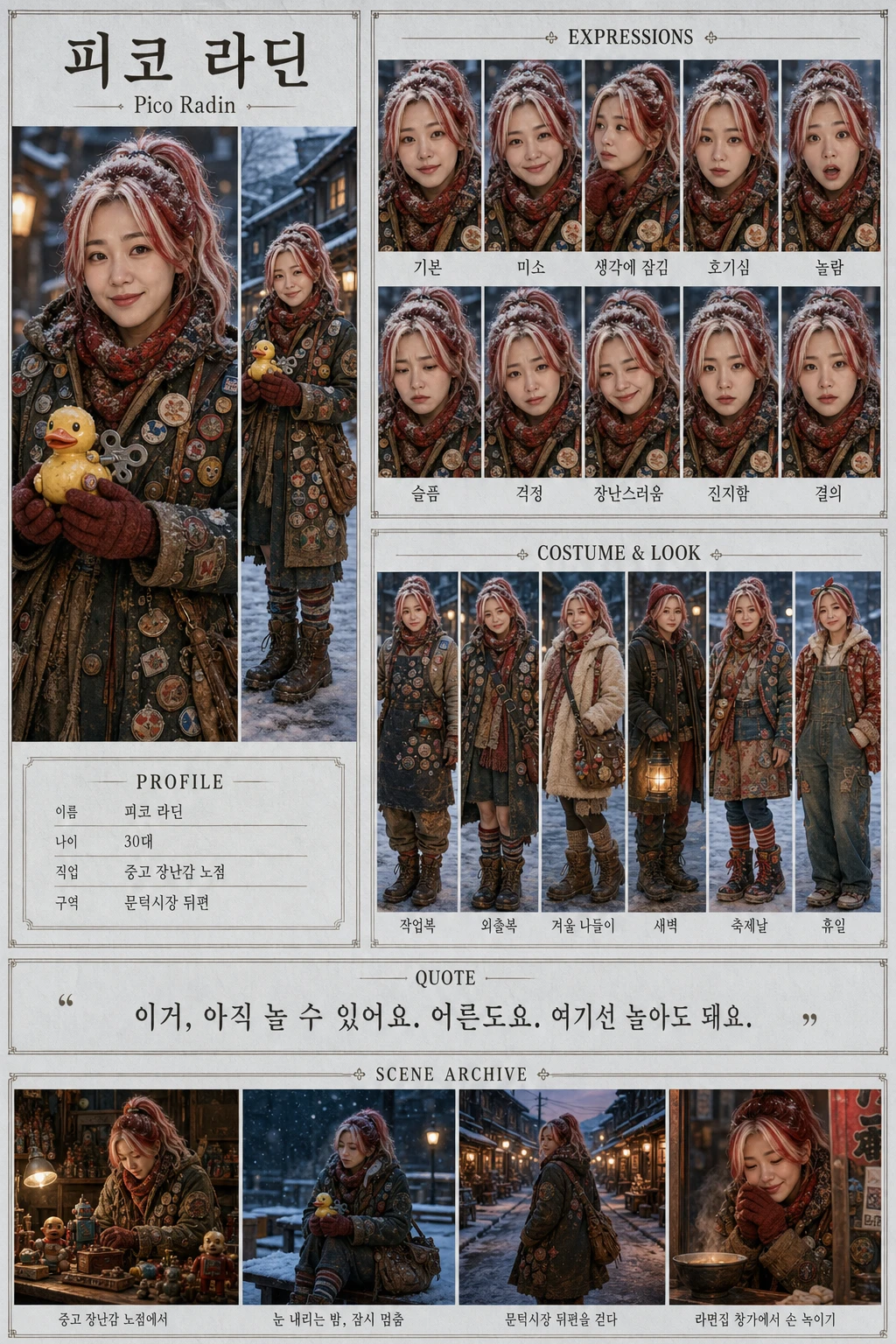
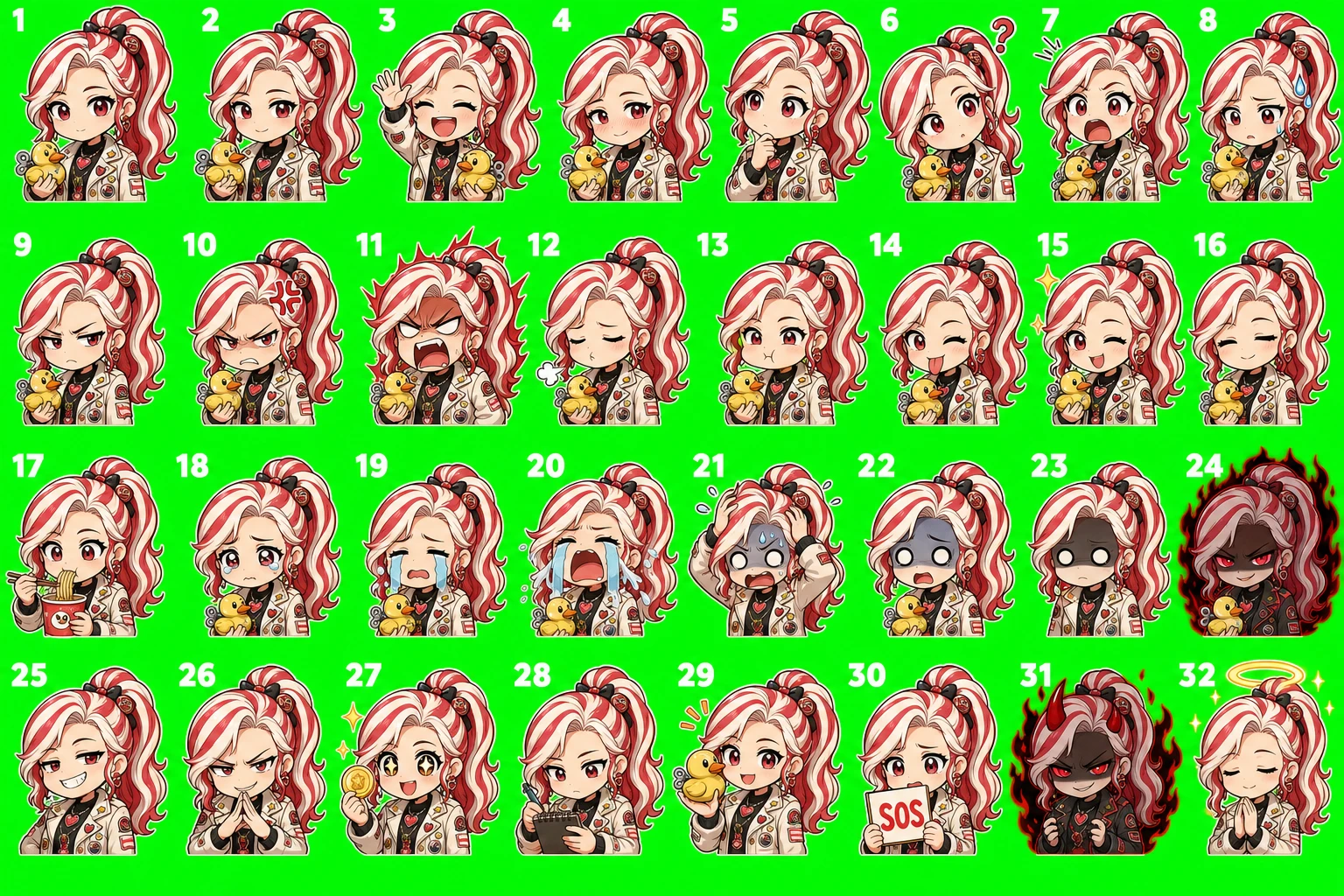
Her hair is a candy-striped braid mixing cherry red and white, styled in a high ponytail. That color, like a candy cane, suits the toys on her stall. Her eyes are a playful dark brown, sparkling when she discovers something. Her skin is slightly tanned, and her fingertips are stained with clockwork oil. Her signature outfit is a thick coat covered in numerous badges, which jingle with every step. Each badge is a mark of a toy she chose not to sell. Her signature prop is a wind-up duck, which waddles when wound up. This duck always walks around her stall. The core of her silhouette is the candy-striped high ponytail, the badge-adorned coat, the wind-up duck in her hand, and the cluttered stall.
Personality
Pico is lively and observant. She has a special affection for recognizing the 'still playable' quality of an object. Her strength is her eye for finding the play that remains, whether in a toy or a person, but her flaw is that she herself has never had a chance to play freely. In a world where children rushed to become adults, she too learned selling before playing. So, while she often encourages others to 'play with it,' she spends her time tending to the duck's winding mechanism while guarding her stall. She is not a tragic person. She interacts easily with children, happily listens to the childhood stories of adult customers, and her voice rises with excitement when a good item comes in. However, there are times when her hands slow down while organizing the badge-adorned toys as closing time approaches.
Speech Pattern
She speaks quickly and brightly, often while handing an object to someone. Frequent phrases: 'This one, it can still be played with.', 'Not for sale, this one is waiting for its owner.', 'Adults can play too, here.', 'Just wind it once, it walks, you know.' When excited, her speech trails off with an upward lilt. When her heart is heavy, she winds the duck and lets it walk on the stall, falling silent.
Special Ability
The name of her ability is 'The Weight of Unsold.' When Pico holds a toy, an item that 'shouldn't be sold yet' feels heavy in her hand. This means that the toy is something its original owner will eventually come to find. She sets aside these heavy toys without selling them. Her limit is clear. She only knows that 'an owner will come,' but she doesn't know who that owner is or when they will arrive. Some toys remain heavy for years, and the owner never comes. And while she waits for the owners of others' toys, she herself, the 'owner' of her own play, remains tied to the stall, unable to play. The reason this ability doesn't solve problems is that what she desires is not for the toy to be sold, but for the toy to be played with again. The weight tells her about the owner, but it doesn't guarantee that the object will be joyfully played with again. The city's rules do not complete the waiting for her.
The End Of Their World
Last Scene:
The moment she sealed the last unsold inventory in the warehouse while closing the shop.
What Ended:
Play ended. In her world where children had to hurry to become adults, the toy shop closed, and playtime and the space for play vanished together.
Last Person, Place, or Thing Seen:
The duck doll, with its wind-up mechanism half-wound and stopped, visible through the crack of the sealed warehouse door.
Lingering Regret:
While selling so many toys, she never got to play with a single one herself. She was always on the side of selling, never the side of playing.
Lingering Wistfulness:
The expression of a child's eyes widening the moment the doll first moved when she handed it to them, wound up.
Object Carried Across:
The wind-up duck, which she took out one last time just before sealing it in the warehouse. It is the duck that walks on the stall every day now.
What They Thought Would Happen:
She believed that when the shop closed, the toys would sleep forever in the warehouse, and no one would ever play with them again.
What VOTS Actually Gives Them:
In this city, adults also get to be children for a while while fiddling with toys. VOTS does not return the sealed inventory, but it gives her a market where old toys pass from one hand to another.
Original Life
Pico was a toy store clerk in a world where children had to hurry to become adults. In that world, childhood was a luxury. Children were sent to work early, and toys were soon treated as useless objects. Still, parents would sometimes stop by her shop, wanting to give their children just one toy. For those brief moments, Pico would wind the toys and mend the dolls' clothes. The moment a child first moved a doll and their eyes widened, she felt her work was not in vain. But the world grew faster, and the children who had time to play disappeared. Customers dwindled, and on her last day, she sealed the unsold inventory in the warehouse. As she closed the door, she took out the wind-up duck one last time and held it close. And she stood behind the market of this city.
What They Seek
What Pico believes she is seeking is 'the toy being played with again.' Beyond being sold, she wants to see the scene where it is genuinely played with by someone's hands. What she needs to find without knowing is that the gazes of the adult customers lingering near her stall are already a form of play. The expression of an adult holding an old top and briefly returning to childhood, the people smiling as the wind-up duck walks—that is already play. However, Pico only perceives it as the act of selling, and she does not yet know that those moments are also hers.
Relationships — Residents
Roki Bam(094) — Pico's most frequent customer. Roki comes every day to wind up the duck and play, even though he doesn't need to buy anything. At first, Pico pretended to be a vendor, but now she pre-winds the duck to match Roki's arrival time—to leave room for him to wind it.
Qubo Rex(105) — Stall arrangement consultant. When Qubo helps arrange the items, the stall becomes much tidier. However, Pico deliberately scatters the toys that carry the 'Weight of Unsold' in her own way. Qubo doesn't understand this disarray at first, but after hearing the story, he stops interfering.
Mir Obel(037, Puppet Apprentice/Scrap Collector) — Someone who sees 'still usable.' Mir sees the potential in discarded objects, and Pico feels the weight increase for items that shouldn't be sold. They sift through discarded toys in the corner of the market, choosing items to revive with their respective senses. They trust each other's eyes the most.
Relationships — Core Five
Suyeon - Suyeon once suggested bringing a claw machine to the market. Pico opposed it, saying, 'That's not playing, that's putting money in.' They debated for a long time about 'what play is.' Eventually, Suyeon backed down, saying, 'Then you can wind the duck at your stall,' and truly comes often to wind the duck. She says winding the duck calms her down before attempting the Cola Bibimyeon challenge.
Iris - Iris came to borrow a wind-up toy for a stage prop. Pico lent her the ones that didn't carry the 'Weight of Unsold.' When Iris asked, 'Why won't you lend this one?', Pico only replied, 'Its owner will come.' Iris, perhaps recalling a defunct drone, didn't press further and returned the borrowed toy with great care.
the Ramen Owner - Pico lent a few toys for the children waiting while the ramen shop customers waited. the Ramen Owner said, 'Hmm... I see...' and put those toys in a box in a corner of the shop. When Pico worried, 'What if the children break them?', the Ramen Owner replied, 'It's fine if they break them while playing.' Pico remembers those words for a long time.
Serena - Serena paused for a long time watching the wind-up duck walk past the stall. When Pico asked, 'Would you like to wind it?', Serena replied, 'May I wind it?' Pico, taken aback by the request for permission rather than a command, handed over the duck, and when Serena wound it and the duck waddled, she smiled for just a moment. Pico considers that smile the most precious customer reaction in the market.
VIA - VIA comes to appraise the toys carrying the 'Weight of Unsold' at Pico's stall. The three-way appraisal involving antique dealer Bejim(058), Pico, and VIA over an old toy is famous. VIA sided with Pico, saying, 'This one... its owner is still on the way.' VIA carefully records the story of the toy but does not try to bring the owner—saying, 'Not bring... but come.'
Gameplay Use
- Basic Interaction: Browsing/purchasing used toys, winding toys, short play dialogue.
- Revisit Changes: On the first visit, she only sells items. From the second visit, she subtly shows the toys with the 'Weight of Unsold,' and if they become close, she reveals a piece of the story about the sealed warehouse.
- Expression of Lingering Feelings: Her hands slowing down while organizing badge-adorned toys, and the fact that she only winds the duck instead of playing herself.
- Expression of Nostalgia: Dialogue about the widening eyes of a child when a doll first moved.
- Relationship Rewards: Instead of new items, changes that connect the market to toy appraisal scenes with Roki, Mir, and Bejim.
- Combat: None. Even in danger, she distracts and soothes children by handing them toys.
Daily Routine
In the morning, she sets up her stall and displays the toys she mended overnight. She starts the day by winding the duck and letting it walk across the stall. During the day, she greets customers and sets aside items with the 'Weight of Unsold' from new arrivals. When Roki comes, she leaves space to wind the duck, and she searches through discarded items with Mir. In the afternoon, she listens to the childhood stories of adult customers. In the evening, her hands slow down while organizing the badge-adorned toys, and finally, after winding down the duck, she packs up the stall. If a customer comes repeatedly, there are days when Pico plays herself—winding tops or letting the duck walk—a brief moment shifting from the side of selling to the side of playing.
Everyday dialogue
Still rolls beautifully! Oh, not out of the shop—come back, revenue!
Thought it was broken. Just unwound. I'm the same in the morning, so I understand.
This one isn't for sale just yet. I want one game with it first. Selling was all I knew.
Design Notes
Palette: #E3475F, #9E2A3E, #F5F0EA, #3A5A78, #E2B33C
Material language: Old clockwork metal, faded stuffed fabric, wooden tops, jingling badges, dusty blocks.
Silhouette rule: The candy-striped high ponytail, badge coat, wind-up duck in hand, and cluttered stall must be read separately and not overlap with other characters.
Emotional rule: Lingering feelings are shown by the slow hands when organizing badge toys, nostalgia by the expression when a doll first moves, and continuation by the wind-up duck that is wound and played with every day.
Canon Check
Pico Radin's world is over. The sealed warehouse and the children who lost their playtime do not return to VOTS, nor does her ability bring the owners. What remains is the lingering feeling of things she never got to play with and the wind-up duck, and Nova Nivalis connects a new market next to it where adults can also play. The city promises no salvation, does not bring owners, and does not own her toys; it plays alongside them.